Three-dimensional Quantitative Evaluation of Interfacial Mass Transfer for Performance Enhanced and Durable Large-scale Reversible Protonic Ceramic Cells
Youle Liu, Yufeng Zhang, Yucheng Zhang, Hongkun Li, Ze Liu, Yuxuan Zhang, Peng Du, Jingzeng Cui, Jianqiu Zhu, Ziting Xia, Zhiwei Hu, Guntae Kim, Xiao Lin, Jian-Qiang Wang, Linjuan Zhang
{"title":"Three-dimensional Quantitative Evaluation of Interfacial Mass Transfer for Performance Enhanced and Durable Large-scale Reversible Protonic Ceramic Cells","authors":"Youle Liu, Yufeng Zhang, Yucheng Zhang, Hongkun Li, Ze Liu, Yuxuan Zhang, Peng Du, Jingzeng Cui, Jianqiu Zhu, Ziting Xia, Zhiwei Hu, Guntae Kim, Xiao Lin, Jian-Qiang Wang, Linjuan Zhang","doi":"10.1002/smll.202411136","DOIUrl":null,"url":null,"abstract":"Reversible protonic ceramic cells (R-PCCs) hold significant promise for energy storage and conversion. However, achieving high-performance, large-scale cells remains challenging, primarily due to issues with compatibility and adhesion at the electrode-electrolyte interface. Here, a scalable strategy is presented for regulating an active interface structure (AIS) via tape casting to develop high-performance, durable R-PCCs. The AIS, located between BaZr₀.₁Ce₀.₇Y₀.₁Yb₀.₁O₃-δ (BZCYYb) electrolyte and Ni-BZCYYb anode, is systematically analyzed for its impact on electrochemical performance. Cells with a 20 µm AIS (20AIS) achieve peak power densities of 1.50 W cm⁻<sup>2</sup> and current densities of − 1.66 A cm<sup>−</sup><sup>2</sup> at 650 °C, outperforming conventional cells without AIS (0AIS) by ≈50%. The stable reversible operation is maintained for over 200 h. FIB-SEM and 3D reconstruction reveal that the 20AIS sample exhibits a 65.7% increase in triple-phase boundary length, despite reduced pore counts affecting gas transport, optimizing the balance between TPB length and transport resistance. Furthermore, the scalability of this approach is demonstrated by fabricating 10 × 10 cm<sup>2</sup> cells, meeting industry standards and reinforcing the method's commercial viability. These findings highlight a practical pathway for advancing R<b>-</b>PCC technology toward industrial applications.","PeriodicalId":228,"journal":{"name":"Small","volume":"32 1","pages":""},"PeriodicalIF":12.1000,"publicationDate":"2025-02-28","publicationTypes":"Journal Article","fieldsOfStudy":null,"isOpenAccess":false,"openAccessPdf":"","citationCount":"0","resultStr":null,"platform":"Semanticscholar","paperid":null,"PeriodicalName":"Small","FirstCategoryId":"88","ListUrlMain":"https://doi.org/10.1002/smll.202411136","RegionNum":2,"RegionCategory":"材料科学","ArticlePicture":[],"TitleCN":null,"AbstractTextCN":null,"PMCID":null,"EPubDate":"","PubModel":"","JCR":"Q1","JCRName":"CHEMISTRY, MULTIDISCIPLINARY","Score":null,"Total":0}
引用次数: 0
Abstract
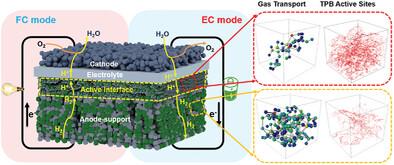
Reversible protonic ceramic cells (R-PCCs) hold significant promise for energy storage and conversion. However, achieving high-performance, large-scale cells remains challenging, primarily due to issues with compatibility and adhesion at the electrode-electrolyte interface. Here, a scalable strategy is presented for regulating an active interface structure (AIS) via tape casting to develop high-performance, durable R-PCCs. The AIS, located between BaZr₀.₁Ce₀.₇Y₀.₁Yb₀.₁O₃-δ (BZCYYb) electrolyte and Ni-BZCYYb anode, is systematically analyzed for its impact on electrochemical performance. Cells with a 20 µm AIS (20AIS) achieve peak power densities of 1.50 W cm⁻2 and current densities of − 1.66 A cm−2 at 650 °C, outperforming conventional cells without AIS (0AIS) by ≈50%. The stable reversible operation is maintained for over 200 h. FIB-SEM and 3D reconstruction reveal that the 20AIS sample exhibits a 65.7% increase in triple-phase boundary length, despite reduced pore counts affecting gas transport, optimizing the balance between TPB length and transport resistance. Furthermore, the scalability of this approach is demonstrated by fabricating 10 × 10 cm2 cells, meeting industry standards and reinforcing the method's commercial viability. These findings highlight a practical pathway for advancing R-PCC technology toward industrial applications.
可逆质子陶瓷电池(R-PCCs)在能量存储和转换方面具有重要的前景。然而,实现高性能、大规模的电池仍然具有挑战性,主要是由于电极-电解质界面的兼容性和粘附性问题。本文提出了一种可扩展的策略,通过带铸造来调节主动界面结构(AIS),以开发高性能、耐用的R-PCCs。AIS,位于BaZr₀.₁Ce₀.₇Y₀.₁Yb₀之间。系统分析了1₁O₃-δ (BZCYYb)电解质和Ni-BZCYYb阳极对电化学性能的影响。具有20µm AIS (20AIS)的细胞在650°C时的峰值功率密度为1.50 W cm - 2,电流密度为- 1.66 a cm - 2,比没有AIS (0AIS)的传统细胞高出约50%。FIB-SEM和3D重建显示,20AIS样品的三相边界长度增加了65.7%,尽管减少了影响气体输运的孔隙数量,优化了TPB长度和输运阻力之间的平衡。此外,通过制造10 × 10 cm2的电池,证明了该方法的可扩展性,符合工业标准并增强了该方法的商业可行性。这些发现突出了推进R-PCC技术走向工业应用的实际途径。
期刊介绍:
Small serves as an exceptional platform for both experimental and theoretical studies in fundamental and applied interdisciplinary research at the nano- and microscale. The journal offers a compelling mix of peer-reviewed Research Articles, Reviews, Perspectives, and Comments.
With a remarkable 2022 Journal Impact Factor of 13.3 (Journal Citation Reports from Clarivate Analytics, 2023), Small remains among the top multidisciplinary journals, covering a wide range of topics at the interface of materials science, chemistry, physics, engineering, medicine, and biology.
Small's readership includes biochemists, biologists, biomedical scientists, chemists, engineers, information technologists, materials scientists, physicists, and theoreticians alike.



 京公网安备 11010802042870号
京ICP备2023020795号-1
京公网安备 11010802042870号
京ICP备2023020795号-1

 分享
分享
 求助内容:
求助内容: 应助结果提醒方式:
 扫码关注我们
