Yutong Nong, Xiaowei Wang, Minghuang Li, Jingyi Zhang, Weijie Ji, Yi Zhao, Lei Cheng, Xing Ou, Lei Ming, Xiaoming Yuan, Jiafeng Zhang, Bao Zhang, Lei Dong, Jianmin Feng, Ruirui Zhao, Zhiyuan Sang, Ji Liang
{"title":"Gradient Sodium Deficiency Optimization in O3-Type Cathode Materials for Superior Performance and Air Stability","authors":"Yutong Nong, Xiaowei Wang, Minghuang Li, Jingyi Zhang, Weijie Ji, Yi Zhao, Lei Cheng, Xing Ou, Lei Ming, Xiaoming Yuan, Jiafeng Zhang, Bao Zhang, Lei Dong, Jianmin Feng, Ruirui Zhao, Zhiyuan Sang, Ji Liang","doi":"10.1021/acsnano.4c16523","DOIUrl":null,"url":null,"abstract":"O3-type layered oxides are promising cathode materials for sodium-ion batteries due to their easy synthesis and high sodium content. However, complex phase transitions and poor air stability limit their practical applications. Introducing sodium deficiency suppresses reactions with air and improves phase stability, but often at the cost of significantly compromising the sodium storage capacity. Herein, we present a hierarchical composition regulation strategy to achieve radial concentration control of sodium in the O3-type layered oxides, constructing radially distributed sodium gradients. The gradient Na content structure not only can alleviate the volume changes caused by the O3–P3 phase transition, which minimizes the degradation of electrochemical performance during cycling, but also suppresses Na<sup>+</sup>/H<sup>+</sup> exchange. This ensures enhanced air stability, improved kinetic performance, and cycling stability. The modified cathode material exhibits a capacity retention rate of 93.37% after 400 cycles at 5 C. When exposed to 82% relative humidity, CO<sub>2</sub> concentration of 3044 ppm for 10 h, it still maintains a specific capacity of 84.9 mA h g<sup>–1</sup> after 300 cycles at 1 C, with a capacity retention rate of 77.27%. This work provides a strategy for radial sodium concentration control, contributing to the development of high-performance and air-stable O3-type sodium-ion battery cathode materials.","PeriodicalId":21,"journal":{"name":"ACS Nano","volume":"1 1","pages":""},"PeriodicalIF":17.3000,"publicationDate":"2025-02-28","publicationTypes":"Journal Article","fieldsOfStudy":null,"isOpenAccess":false,"openAccessPdf":"","citationCount":"0","resultStr":null,"platform":"Semanticscholar","paperid":null,"PeriodicalName":"ACS Nano","FirstCategoryId":"88","ListUrlMain":"https://doi.org/10.1021/acsnano.4c16523","RegionNum":1,"RegionCategory":"材料科学","ArticlePicture":[],"TitleCN":null,"AbstractTextCN":null,"PMCID":null,"EPubDate":"","PubModel":"","JCR":"Q1","JCRName":"CHEMISTRY, MULTIDISCIPLINARY","Score":null,"Total":0}
引用次数: 0
Abstract
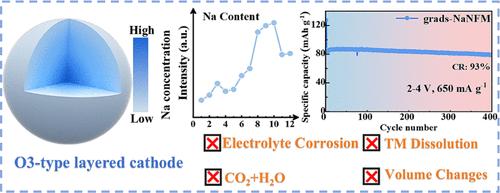
O3-type layered oxides are promising cathode materials for sodium-ion batteries due to their easy synthesis and high sodium content. However, complex phase transitions and poor air stability limit their practical applications. Introducing sodium deficiency suppresses reactions with air and improves phase stability, but often at the cost of significantly compromising the sodium storage capacity. Herein, we present a hierarchical composition regulation strategy to achieve radial concentration control of sodium in the O3-type layered oxides, constructing radially distributed sodium gradients. The gradient Na content structure not only can alleviate the volume changes caused by the O3–P3 phase transition, which minimizes the degradation of electrochemical performance during cycling, but also suppresses Na+/H+ exchange. This ensures enhanced air stability, improved kinetic performance, and cycling stability. The modified cathode material exhibits a capacity retention rate of 93.37% after 400 cycles at 5 C. When exposed to 82% relative humidity, CO2 concentration of 3044 ppm for 10 h, it still maintains a specific capacity of 84.9 mA h g–1 after 300 cycles at 1 C, with a capacity retention rate of 77.27%. This work provides a strategy for radial sodium concentration control, contributing to the development of high-performance and air-stable O3-type sodium-ion battery cathode materials.
o3型层状氧化物具有合成简单、钠含量高等优点,是钠离子电池极具发展前景的正极材料。然而,复杂的相变和较差的空气稳定性限制了它们的实际应用。钠的缺乏抑制了与空气的反应,提高了相稳定性,但往往以显著降低钠的储存容量为代价。本文提出了一种分层成分调控策略,通过构建径向分布的钠梯度,实现了o3型层状氧化物中钠的径向浓度控制。梯度Na含量结构不仅可以缓解O3-P3相变引起的体积变化,最大限度地减少循环过程中电化学性能的下降,而且可以抑制Na+/H+交换。这确保了增强的空气稳定性,改进的动力学性能和循环稳定性。在相对湿度为82%、CO2浓度为3044 ppm的条件下,循环10 h,在1℃条件下循环300次,其比容量仍保持84.9 mA h g-1,容量保持率为77.27%。本研究为径向钠浓度控制提供了一种策略,有助于开发高性能、空气稳定的o3型钠离子电池正极材料。
期刊介绍:
ACS Nano, published monthly, serves as an international forum for comprehensive articles on nanoscience and nanotechnology research at the intersections of chemistry, biology, materials science, physics, and engineering. The journal fosters communication among scientists in these communities, facilitating collaboration, new research opportunities, and advancements through discoveries. ACS Nano covers synthesis, assembly, characterization, theory, and simulation of nanostructures, nanobiotechnology, nanofabrication, methods and tools for nanoscience and nanotechnology, and self- and directed-assembly. Alongside original research articles, it offers thorough reviews, perspectives on cutting-edge research, and discussions envisioning the future of nanoscience and nanotechnology.




 京公网安备 11010802042870号
京ICP备2023020795号-1
京公网安备 11010802042870号
京ICP备2023020795号-1

 分享
分享
 求助内容:
求助内容: 应助结果提醒方式:
 扫码关注我们
