Seunghwan Bang, Byeongmin Park, Jae Chul Park, Harin Jin, Ji Sung Shim, Jahyun Koo, Kwan Hyi Lee, Man Kyu Shim, Hojun Kim
{"title":"Exosome-Inspired Lipid Nanoparticles for Enhanced Tissue Penetration","authors":"Seunghwan Bang, Byeongmin Park, Jae Chul Park, Harin Jin, Ji Sung Shim, Jahyun Koo, Kwan Hyi Lee, Man Kyu Shim, Hojun Kim","doi":"10.1021/acsnano.4c16629","DOIUrl":null,"url":null,"abstract":"The extracellular matrix (ECM) is a complex network of biomolecules with varying pore sizes, posing a challenge for the effective penetration of lipid nanoparticles. In contrast, cell-derived lipid nanoparticles, such as exosomes, have demonstrated the ability to travel to distant organs, indicating their capacity to penetrate the ECM. Here, we designed exosome-like vesicles (ELVs) inspired by exosomes’ distinct transport phenomena. Specifically, we integrated three exosomal components (anionic lipid, cholesterol, and aquaporin-1) associated with transport into our ELVs to mimic the superior diffusion behavior of exosomes over synthetic lipid nanoparticles. Surprisingly, both bulk- and single-particle-diffusion studies revealed a more than 33 times increase in the effective diffusion coefficient within model ECM compared to conventional lipid nanoparticles. Furthermore, ELVs show an 80% increase in the effective diffusion coefficient within biological tissues. The excellent transport behavior of ELVs was further validated <i>in vivo</i>, where intratumoral injection showcased their superior transport. These findings provide insights into lipid nanoparticle design for improved tissue penetration.","PeriodicalId":21,"journal":{"name":"ACS Nano","volume":"43 2 1","pages":""},"PeriodicalIF":16.0000,"publicationDate":"2025-02-28","publicationTypes":"Journal Article","fieldsOfStudy":null,"isOpenAccess":false,"openAccessPdf":"","citationCount":"0","resultStr":null,"platform":"Semanticscholar","paperid":null,"PeriodicalName":"ACS Nano","FirstCategoryId":"88","ListUrlMain":"https://doi.org/10.1021/acsnano.4c16629","RegionNum":1,"RegionCategory":"材料科学","ArticlePicture":[],"TitleCN":null,"AbstractTextCN":null,"PMCID":null,"EPubDate":"","PubModel":"","JCR":"Q1","JCRName":"CHEMISTRY, MULTIDISCIPLINARY","Score":null,"Total":0}
引用次数: 0
Abstract
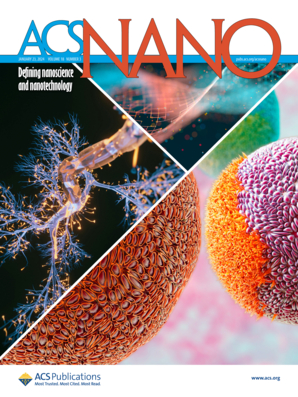
The extracellular matrix (ECM) is a complex network of biomolecules with varying pore sizes, posing a challenge for the effective penetration of lipid nanoparticles. In contrast, cell-derived lipid nanoparticles, such as exosomes, have demonstrated the ability to travel to distant organs, indicating their capacity to penetrate the ECM. Here, we designed exosome-like vesicles (ELVs) inspired by exosomes’ distinct transport phenomena. Specifically, we integrated three exosomal components (anionic lipid, cholesterol, and aquaporin-1) associated with transport into our ELVs to mimic the superior diffusion behavior of exosomes over synthetic lipid nanoparticles. Surprisingly, both bulk- and single-particle-diffusion studies revealed a more than 33 times increase in the effective diffusion coefficient within model ECM compared to conventional lipid nanoparticles. Furthermore, ELVs show an 80% increase in the effective diffusion coefficient within biological tissues. The excellent transport behavior of ELVs was further validated in vivo, where intratumoral injection showcased their superior transport. These findings provide insights into lipid nanoparticle design for improved tissue penetration.
期刊介绍:
ACS Nano, published monthly, serves as an international forum for comprehensive articles on nanoscience and nanotechnology research at the intersections of chemistry, biology, materials science, physics, and engineering. The journal fosters communication among scientists in these communities, facilitating collaboration, new research opportunities, and advancements through discoveries. ACS Nano covers synthesis, assembly, characterization, theory, and simulation of nanostructures, nanobiotechnology, nanofabrication, methods and tools for nanoscience and nanotechnology, and self- and directed-assembly. Alongside original research articles, it offers thorough reviews, perspectives on cutting-edge research, and discussions envisioning the future of nanoscience and nanotechnology.




 京公网安备 11010802042870号
京ICP备2023020795号-1
京公网安备 11010802042870号
京ICP备2023020795号-1

 分享
分享
 求助内容:
求助内容: 应助结果提醒方式:
 扫码关注我们
