Contrasting effects of temperature rise in different seasons on larger and smaller phytoplankton assemblages in a temperate coastal water, Laoshan Bay, northern Yellow Sea, China
Wei Zhao , Jihua Liu , Tingting Li , Hui Song , Bokun Chen , Bingzhang Chen , Gang Li
{"title":"Contrasting effects of temperature rise in different seasons on larger and smaller phytoplankton assemblages in a temperate coastal water, Laoshan Bay, northern Yellow Sea, China","authors":"Wei Zhao , Jihua Liu , Tingting Li , Hui Song , Bokun Chen , Bingzhang Chen , Gang Li","doi":"10.1016/j.marenvres.2025.107034","DOIUrl":null,"url":null,"abstract":"<div><div>Anthropogenic influences and climate change are leading to more frequent and intense heatwaves, which are known to affect marine ecosystems. However, the effects of rising temperatures on <em>in-situ</em> phytoplankton size classes have not yet been adequately studied. In this study, two cell-sized phytoplankton assemblages (>20 μm, <20 μm) were cultured at a range of temperatures [i.e., ambient temperature (AT), AT+3 °C, AT+6 °C and AT+9 °C] in Laoshan Bay, Yellow Sea, China, at half-month intervals between June 2022 and July 2023. Total chlorophyll <em>a</em> concentration fluctuated between 0.84 and 7.76 μg L<sup>−1</sup> throughout the year, with the highest value presented in winter with the lowest proportion of smaller cells. Photosynthetic efficiency (F<sub>V</sub>/F<sub>M</sub>) of larger cells, which varied between 0.15 in winter and 0.52 in summer, was 22% higher than their smaller counterparts, while their growth rate (μ, −0.21 to 0.91 d<sup>−1</sup>) was 60% higher. The slope derived from the linear fit of F<sub>V</sub>/F<sub>M</sub> or μ to temperature, an indicator of temperature sensitivity, was positive in winter but negative in summer, depending mainly on ambient temperature. The μ of larger cells was increased more than that of smaller cells by an increase in temperature in winter, but inhibited more in summer, indicating their greater sensitivity to temperature. Our results also showed that the integrated inhibition of a 1 °C temperature increase over one year is 5.45% and 3.68% on the growth of larger and smaller cells, respectively, suggesting a negative effect of temperature increase on phytoplankton community in Laoshan Bay.</div></div>","PeriodicalId":18204,"journal":{"name":"Marine environmental research","volume":"206 ","pages":"Article 107034"},"PeriodicalIF":3.2000,"publicationDate":"2025-02-24","publicationTypes":"Journal Article","fieldsOfStudy":null,"isOpenAccess":false,"openAccessPdf":"","citationCount":"0","resultStr":null,"platform":"Semanticscholar","paperid":null,"PeriodicalName":"Marine environmental research","FirstCategoryId":"93","ListUrlMain":"https://www.sciencedirect.com/science/article/pii/S0141113625000911","RegionNum":3,"RegionCategory":"环境科学与生态学","ArticlePicture":[],"TitleCN":null,"AbstractTextCN":null,"PMCID":null,"EPubDate":"","PubModel":"","JCR":"Q2","JCRName":"ENVIRONMENTAL SCIENCES","Score":null,"Total":0}
引用次数: 0
Abstract
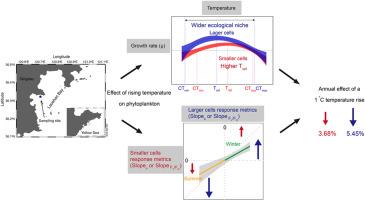
Anthropogenic influences and climate change are leading to more frequent and intense heatwaves, which are known to affect marine ecosystems. However, the effects of rising temperatures on in-situ phytoplankton size classes have not yet been adequately studied. In this study, two cell-sized phytoplankton assemblages (>20 μm, <20 μm) were cultured at a range of temperatures [i.e., ambient temperature (AT), AT+3 °C, AT+6 °C and AT+9 °C] in Laoshan Bay, Yellow Sea, China, at half-month intervals between June 2022 and July 2023. Total chlorophyll a concentration fluctuated between 0.84 and 7.76 μg L−1 throughout the year, with the highest value presented in winter with the lowest proportion of smaller cells. Photosynthetic efficiency (FV/FM) of larger cells, which varied between 0.15 in winter and 0.52 in summer, was 22% higher than their smaller counterparts, while their growth rate (μ, −0.21 to 0.91 d−1) was 60% higher. The slope derived from the linear fit of FV/FM or μ to temperature, an indicator of temperature sensitivity, was positive in winter but negative in summer, depending mainly on ambient temperature. The μ of larger cells was increased more than that of smaller cells by an increase in temperature in winter, but inhibited more in summer, indicating their greater sensitivity to temperature. Our results also showed that the integrated inhibition of a 1 °C temperature increase over one year is 5.45% and 3.68% on the growth of larger and smaller cells, respectively, suggesting a negative effect of temperature increase on phytoplankton community in Laoshan Bay.
期刊介绍:
Marine Environmental Research publishes original research papers on chemical, physical, and biological interactions in the oceans and coastal waters. The journal serves as a forum for new information on biology, chemistry, and toxicology and syntheses that advance understanding of marine environmental processes.
Submission of multidisciplinary studies is encouraged. Studies that utilize experimental approaches to clarify the roles of anthropogenic and natural causes of changes in marine ecosystems are especially welcome, as are those studies that represent new developments of a theoretical or conceptual aspect of marine science. All papers published in this journal are reviewed by qualified peers prior to acceptance and publication. Examples of topics considered to be appropriate for the journal include, but are not limited to, the following:
– The extent, persistence, and consequences of change and the recovery from such change in natural marine systems
– The biochemical, physiological, and ecological consequences of contaminants to marine organisms and ecosystems
– The biogeochemistry of naturally occurring and anthropogenic substances
– Models that describe and predict the above processes
– Monitoring studies, to the extent that their results provide new information on functional processes
– Methodological papers describing improved quantitative techniques for the marine sciences.



 京公网安备 11010802042870号
京ICP备2023020795号-1
京公网安备 11010802042870号
京ICP备2023020795号-1

 分享
分享
 求助内容:
求助内容: 应助结果提醒方式:
 扫码关注我们
