Chunqiu Zhao, Qiang Chang, Fu Yin, Guowei Niu, Chenghua Zhang, Dan Liu, Bhekie B. Mamba, Alex T. Kuvarega
{"title":"Catalytic Performance of Highly Dispersed Bimetallic Catalysts for CO Hydrogenation to DME","authors":"Chunqiu Zhao, Qiang Chang, Fu Yin, Guowei Niu, Chenghua Zhang, Dan Liu, Bhekie B. Mamba, Alex T. Kuvarega","doi":"10.1002/cplu.202500010","DOIUrl":null,"url":null,"abstract":"<p>Highly dispersed bimetallic atomic-scale catalysts have garnered significant attention in syngas conversion filed due to the synergistic effects of the precisely structured bimetallic site, which facilitate the effective activation of CO. Despite their potential, synthesizing these catalysts to meet the specific application requirements remains challenging. Herein, various bimetallic catalysts were synthesized through the pyrolysis of the bimetallic ZIF precursors which were prepared by <i>in situ</i> doping of different metals (Mn, Fe, Co, Ni and Cu) into the ZIF-8 structure. In the presence of a highly dispersed and highly loaded Zn, the doping content in the ultimate second metallic catalysts varied between 0.15–1.20 wt % for different metals. The catalysts were systematically characterized using XRD, BET, TEM, XPS, Raman, ICP, and H<sub>2</sub>-TPD techniques. Among them, the Zn−NC regulated with Cu or Ni exhibited superior catalytic performance. Notably, the Cu−Zn−NC catalyst showed the highest activity, achieving a CO conversion of 32.8 % and optimal DME selectivity approaching 95.2 % in CO hydrogenation reactions. These enhanced performance metrics were attributed to the synergetic effects of bimetallic components. The incorporation of Cu not only preserved the original Zn−N structure but also preserved the catalytic performance unchanged. This preparation strategy is expected to filter out new research targets to use in diverse catalytic applications.</p>","PeriodicalId":148,"journal":{"name":"ChemPlusChem","volume":"90 5","pages":""},"PeriodicalIF":2.8000,"publicationDate":"2025-02-28","publicationTypes":"Journal Article","fieldsOfStudy":null,"isOpenAccess":false,"openAccessPdf":"https://onlinelibrary.wiley.com/doi/epdf/10.1002/cplu.202500010","citationCount":"0","resultStr":null,"platform":"Semanticscholar","paperid":null,"PeriodicalName":"ChemPlusChem","FirstCategoryId":"92","ListUrlMain":"https://chemistry-europe.onlinelibrary.wiley.com/doi/10.1002/cplu.202500010","RegionNum":4,"RegionCategory":"化学","ArticlePicture":[],"TitleCN":null,"AbstractTextCN":null,"PMCID":null,"EPubDate":"","PubModel":"","JCR":"Q2","JCRName":"CHEMISTRY, MULTIDISCIPLINARY","Score":null,"Total":0}
引用次数: 0
Abstract
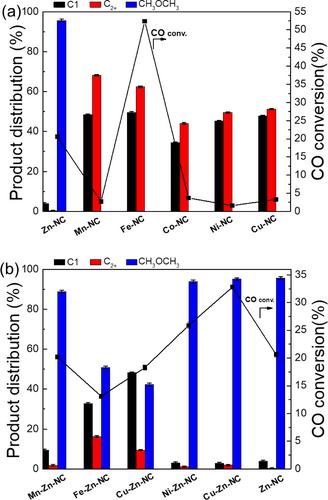
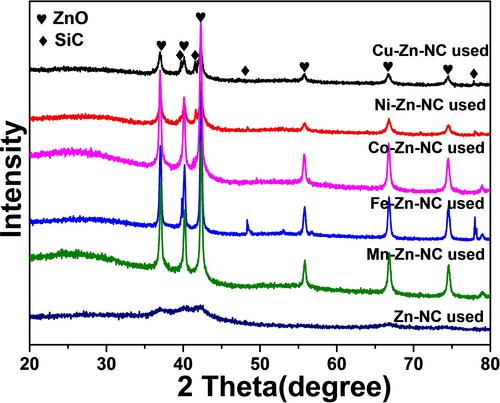
Highly dispersed bimetallic atomic-scale catalysts have garnered significant attention in syngas conversion filed due to the synergistic effects of the precisely structured bimetallic site, which facilitate the effective activation of CO. Despite their potential, synthesizing these catalysts to meet the specific application requirements remains challenging. Herein, various bimetallic catalysts were synthesized through the pyrolysis of the bimetallic ZIF precursors which were prepared by in situ doping of different metals (Mn, Fe, Co, Ni and Cu) into the ZIF-8 structure. In the presence of a highly dispersed and highly loaded Zn, the doping content in the ultimate second metallic catalysts varied between 0.15–1.20 wt % for different metals. The catalysts were systematically characterized using XRD, BET, TEM, XPS, Raman, ICP, and H2-TPD techniques. Among them, the Zn−NC regulated with Cu or Ni exhibited superior catalytic performance. Notably, the Cu−Zn−NC catalyst showed the highest activity, achieving a CO conversion of 32.8 % and optimal DME selectivity approaching 95.2 % in CO hydrogenation reactions. These enhanced performance metrics were attributed to the synergetic effects of bimetallic components. The incorporation of Cu not only preserved the original Zn−N structure but also preserved the catalytic performance unchanged. This preparation strategy is expected to filter out new research targets to use in diverse catalytic applications.
期刊介绍:
ChemPlusChem is a peer-reviewed, general chemistry journal that brings readers the very best in multidisciplinary research centering on chemistry. It is published on behalf of Chemistry Europe, an association of 16 European chemical societies.
Fully comprehensive in its scope, ChemPlusChem publishes articles covering new results from at least two different aspects (subfields) of chemistry or one of chemistry and one of another scientific discipline (one chemistry topic plus another one, hence the title ChemPlusChem). All suitable submissions undergo balanced peer review by experts in the field to ensure the highest quality, originality, relevance, significance, and validity.





 京公网安备 11010802042870号
京ICP备2023020795号-1
京公网安备 11010802042870号
京ICP备2023020795号-1

 分享
分享
 求助内容:
求助内容: 应助结果提醒方式:
 扫码关注我们
