Fabio Pettinato, Viviana Marzà, Fiorella Ciantia, Giorgia Romanello, Maria Donatella Cocuzza, Marco Fichera, Renata Rizzo, Rita Barone
{"title":"Acute neurological regression following fever as presenting sign of pontocerebellar hypoplasia type 2D (<i>SEPSECS</i> mutation).","authors":"Fabio Pettinato, Viviana Marzà, Fiorella Ciantia, Giorgia Romanello, Maria Donatella Cocuzza, Marco Fichera, Renata Rizzo, Rita Barone","doi":"10.3892/br.2025.1945","DOIUrl":null,"url":null,"abstract":"<p><p>Pontocerebellar hypoplasia type 2D (PCH2D) is caused by mutations in the gene encoding O-phosphoseryl-tRNA:selenocysteinyl-tRNA synthase (<i>SEPSECS</i>; chromosome 4p15.2). This is a key enzyme in the biosynthesis of selenoproteins, which act in maintaining antioxidant systems. To date, 26 patients with PCH2D have been reported, all with neurological involvement characterized by progressive pontocerebellar and cerebral atrophy. The present study reports on a patient with compound heterozygosity in the <i>SEPSECS</i> gene, including a novel missense variant, c.440G>A (p.Ser147Asn). The patient exhibited acute neurological regression following a vaccination-related fever, which is reminiscent of primary mitochondrial disease. In addition, the patient displayed severe spastic tetraparesis, convergent strabismus and postnatal onset of microcephaly, as well as recurrent blood lactate elevation. Brain MRI showed multiple alterations in the peri/supraventricular and subcortical white matter and progressive pontocerebellar and cerebral atrophy. A review of the clinical spectrum associated with <i>SEPSECS</i> mutations was conducted and the first report on a patient with <i>SEPSECS</i> mutations of acute neurological regression following a catabolic stressor at the onset of PCH2D was provided. This study broadens the genetic background of PCH2D and associated PCH2D phenotype, supporting the causal link between selenoprotein biosynthesis deficiency and mitochondrial disorders.</p>","PeriodicalId":8863,"journal":{"name":"Biomedical reports","volume":"22 4","pages":"67"},"PeriodicalIF":1.9000,"publicationDate":"2025-02-14","publicationTypes":"Journal Article","fieldsOfStudy":null,"isOpenAccess":false,"openAccessPdf":"https://www.ncbi.nlm.nih.gov/pmc/articles/PMC11865714/pdf/","citationCount":"0","resultStr":null,"platform":"Semanticscholar","paperid":null,"PeriodicalName":"Biomedical reports","FirstCategoryId":"1085","ListUrlMain":"https://doi.org/10.3892/br.2025.1945","RegionNum":0,"RegionCategory":null,"ArticlePicture":[],"TitleCN":null,"AbstractTextCN":null,"PMCID":null,"EPubDate":"2025/4/1 0:00:00","PubModel":"eCollection","JCR":"Q3","JCRName":"MEDICINE, RESEARCH & EXPERIMENTAL","Score":null,"Total":0}
引用次数: 0
Abstract
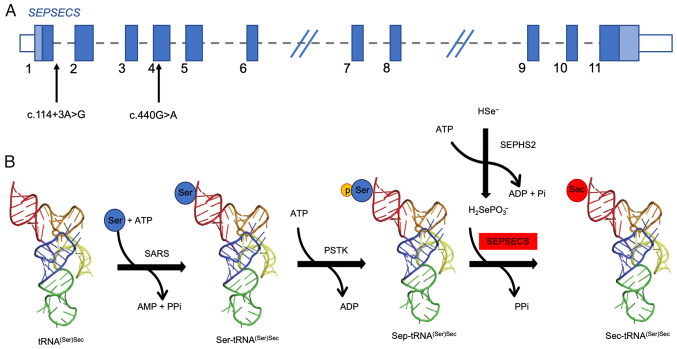
Pontocerebellar hypoplasia type 2D (PCH2D) is caused by mutations in the gene encoding O-phosphoseryl-tRNA:selenocysteinyl-tRNA synthase (SEPSECS; chromosome 4p15.2). This is a key enzyme in the biosynthesis of selenoproteins, which act in maintaining antioxidant systems. To date, 26 patients with PCH2D have been reported, all with neurological involvement characterized by progressive pontocerebellar and cerebral atrophy. The present study reports on a patient with compound heterozygosity in the SEPSECS gene, including a novel missense variant, c.440G>A (p.Ser147Asn). The patient exhibited acute neurological regression following a vaccination-related fever, which is reminiscent of primary mitochondrial disease. In addition, the patient displayed severe spastic tetraparesis, convergent strabismus and postnatal onset of microcephaly, as well as recurrent blood lactate elevation. Brain MRI showed multiple alterations in the peri/supraventricular and subcortical white matter and progressive pontocerebellar and cerebral atrophy. A review of the clinical spectrum associated with SEPSECS mutations was conducted and the first report on a patient with SEPSECS mutations of acute neurological regression following a catabolic stressor at the onset of PCH2D was provided. This study broadens the genetic background of PCH2D and associated PCH2D phenotype, supporting the causal link between selenoprotein biosynthesis deficiency and mitochondrial disorders.
期刊介绍:
Biomedical Reports is a monthly, peer-reviewed journal, dedicated to publishing research across all fields of biology and medicine, including pharmacology, pathology, gene therapy, genetics, microbiology, neurosciences, infectious diseases, molecular cardiology and molecular surgery. The journal provides a home for original research, case reports and review articles.





 京公网安备 11010802042870号
京ICP备2023020795号-1
京公网安备 11010802042870号
京ICP备2023020795号-1

 分享
分享
 求助内容:
求助内容: 应助结果提醒方式:
 扫码关注我们
