Alemnew F Dagnew, Colleen F Hanrahan, David W Dowdy, Neil A Martinson, Limakatso Lebina, Bareng A S Nonyane
{"title":"Group-based trajectory modeling to describe the geographical distribution of tuberculosis notifications.","authors":"Alemnew F Dagnew, Colleen F Hanrahan, David W Dowdy, Neil A Martinson, Limakatso Lebina, Bareng A S Nonyane","doi":"10.1186/s12889-025-22083-x","DOIUrl":null,"url":null,"abstract":"<p><strong>Background: </strong>Tuberculosis (TB) is a major public health problem, and understanding the geographic distribution of the disease is critical in planning and evaluating intervention strategies. This manuscript illustrates the application of Group-Based Trajectory Modeling (GBTM), a statistical method that analyzes the evolution of an outcome over time to identify groups with similar trajectories. Specifically, we apply GBTM to identify the evolution of the number of TB notifications over time across various geographic locations, aiming to identify groups of locations with similar trajectories. Locations sharing the same trajectory may be considered geographic TB clusters, indicating areas with similar TB notifications. We used data abstracted from clinic records in Limpopo province, South Africa, treating the clinics as a proxy for the spatial location of their respective catchment areas.</p><p><strong>Methods: </strong>Data for this analysis were obtained as part of a cluster-randomized trial involving 56 clinics to evaluate two active TB patient-finding strategies in South Africa. We utilized GBTM to identify groups of clinics with similar trajectories of the number of TB patients.</p><p><strong>Results: </strong>We identified three trajectory groups: Groups 1, comprising 57.8% of clinics; Group 2, 33.9%; and Group 3, 8.3%. These groups accounted for 30.8%, 44.4%, and 24.8% of total TB-diagnosed patients, respectively. The estimated mean number of TB-diagnosed patients was highest in trajectory group 3 followed by trajectory group 2 across the 12 months, with no overlap in the corresponding 95% confidence intervals. The estimated mean number of TB-diagnosed patients over time was fairly constant for trajectory groups 1 and 2 with exponentiated slopes of 0.979 (95% CI: 0.950, 1.004) and 1.004 (95% CI: 0.977, 1.044), respectively. In contrast, there was a statistically significant 3.8% decrease in the number of TB patients per month for trajectory group 3 with an exponentiated slope of 0.962 (95% CI: 0.901, 0.985) per month.</p><p><strong>Conclusions: </strong>GBTM is a powerful tool for identifying geographic clusters of varying levels of TB notification when longitudinal data on the number of TB diagnoses are available. This analysis can inform the planning and evaluation of intervention strategies.</p>","PeriodicalId":9039,"journal":{"name":"BMC Public Health","volume":"25 1","pages":"797"},"PeriodicalIF":3.6000,"publicationDate":"2025-02-27","publicationTypes":"Journal Article","fieldsOfStudy":null,"isOpenAccess":false,"openAccessPdf":"https://www.ncbi.nlm.nih.gov/pmc/articles/PMC11866561/pdf/","citationCount":"0","resultStr":null,"platform":"Semanticscholar","paperid":null,"PeriodicalName":"BMC Public Health","FirstCategoryId":"3","ListUrlMain":"https://doi.org/10.1186/s12889-025-22083-x","RegionNum":2,"RegionCategory":"医学","ArticlePicture":[],"TitleCN":null,"AbstractTextCN":null,"PMCID":null,"EPubDate":"","PubModel":"","JCR":"Q1","JCRName":"PUBLIC, ENVIRONMENTAL & OCCUPATIONAL HEALTH","Score":null,"Total":0}
引用次数: 0
Abstract
Background: Tuberculosis (TB) is a major public health problem, and understanding the geographic distribution of the disease is critical in planning and evaluating intervention strategies. This manuscript illustrates the application of Group-Based Trajectory Modeling (GBTM), a statistical method that analyzes the evolution of an outcome over time to identify groups with similar trajectories. Specifically, we apply GBTM to identify the evolution of the number of TB notifications over time across various geographic locations, aiming to identify groups of locations with similar trajectories. Locations sharing the same trajectory may be considered geographic TB clusters, indicating areas with similar TB notifications. We used data abstracted from clinic records in Limpopo province, South Africa, treating the clinics as a proxy for the spatial location of their respective catchment areas.
Methods: Data for this analysis were obtained as part of a cluster-randomized trial involving 56 clinics to evaluate two active TB patient-finding strategies in South Africa. We utilized GBTM to identify groups of clinics with similar trajectories of the number of TB patients.
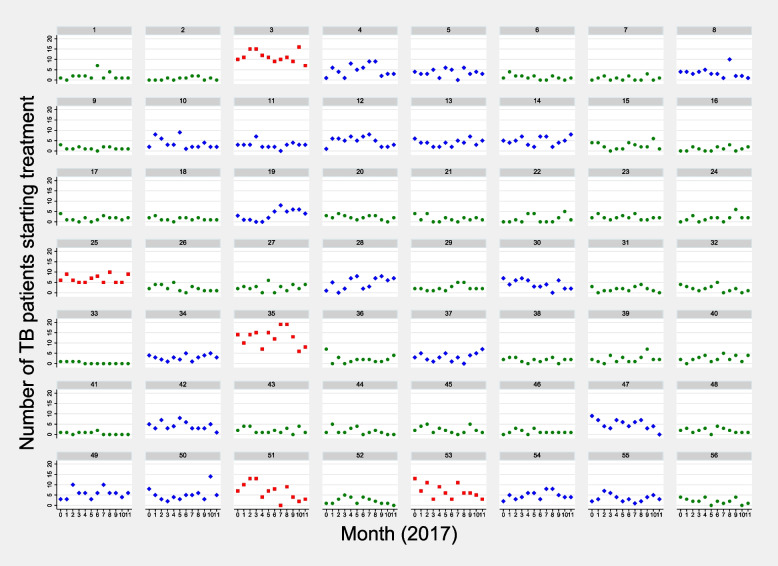
Results: We identified three trajectory groups: Groups 1, comprising 57.8% of clinics; Group 2, 33.9%; and Group 3, 8.3%. These groups accounted for 30.8%, 44.4%, and 24.8% of total TB-diagnosed patients, respectively. The estimated mean number of TB-diagnosed patients was highest in trajectory group 3 followed by trajectory group 2 across the 12 months, with no overlap in the corresponding 95% confidence intervals. The estimated mean number of TB-diagnosed patients over time was fairly constant for trajectory groups 1 and 2 with exponentiated slopes of 0.979 (95% CI: 0.950, 1.004) and 1.004 (95% CI: 0.977, 1.044), respectively. In contrast, there was a statistically significant 3.8% decrease in the number of TB patients per month for trajectory group 3 with an exponentiated slope of 0.962 (95% CI: 0.901, 0.985) per month.
Conclusions: GBTM is a powerful tool for identifying geographic clusters of varying levels of TB notification when longitudinal data on the number of TB diagnoses are available. This analysis can inform the planning and evaluation of intervention strategies.
期刊介绍:
BMC Public Health is an open access, peer-reviewed journal that considers articles on the epidemiology of disease and the understanding of all aspects of public health. The journal has a special focus on the social determinants of health, the environmental, behavioral, and occupational correlates of health and disease, and the impact of health policies, practices and interventions on the community.






 京公网安备 11010802042870号
京ICP备2023020795号-1
京公网安备 11010802042870号
京ICP备2023020795号-1

 分享
分享
 求助内容:
求助内容: 应助结果提醒方式:
 扫码关注我们
