{"title":"Discriminating High from Low Energy Conformers of Druglike Molecules: An Assessment of Machine Learning Potentials and Quantum Chemical Methods","authors":"Linghan Kong, Richard A. Bryce","doi":"10.1002/cphc.202400992","DOIUrl":null,"url":null,"abstract":"<p>Accurate and efficient prediction of high energy ligand conformations is important in structure-based drug discovery for the exclusion of unrealistic structures in docking-based virtual screening and <i>de novo</i> design approaches. In this work, we constructed a database of 140 solution conformers from 20 druglike molecules of varying size and chemical complexity, with energetics evaluated at the DLPNO-CCSD(T)/complete basis set (CBS) level. We then assessed a selection of machine learning potentials and semiempirical quantum mechanical models for their ability to predict conformational energetics. The GFN2-xTB tight binding density functional method correlates with reference conformer energies, yielding a Kendall's τ of 0.63 and mean absolute error of 2.2 kcal/mol. As putative internal energy filters for screening, we find that the GFN2-xTB, ANI-2x and MACE-OFF23(L) models perform well in identifying low energy conformer geometries, with sensitivities of 95 %, 89 % and 95 % respectively, but display a reduced ability to exclude high energy conformers, with respective specificities of 80 %, 61 % and 63 %. The GFN2-xTB method therefore exhibited the best overall performance and appears currently the most suitable of the three methods to act as an internal energy filter for integration into drug discovery workflows. Enrichment of high energy conformers in the training of machine learning potentials could improve their performance as conformational filters.</p>","PeriodicalId":9819,"journal":{"name":"Chemphyschem","volume":"26 8","pages":""},"PeriodicalIF":2.2000,"publicationDate":"2025-02-27","publicationTypes":"Journal Article","fieldsOfStudy":null,"isOpenAccess":false,"openAccessPdf":"https://onlinelibrary.wiley.com/doi/epdf/10.1002/cphc.202400992","citationCount":"0","resultStr":null,"platform":"Semanticscholar","paperid":null,"PeriodicalName":"Chemphyschem","FirstCategoryId":"92","ListUrlMain":"https://chemistry-europe.onlinelibrary.wiley.com/doi/10.1002/cphc.202400992","RegionNum":3,"RegionCategory":"化学","ArticlePicture":[],"TitleCN":null,"AbstractTextCN":null,"PMCID":null,"EPubDate":"","PubModel":"","JCR":"Q3","JCRName":"CHEMISTRY, PHYSICAL","Score":null,"Total":0}
引用次数: 0
Abstract
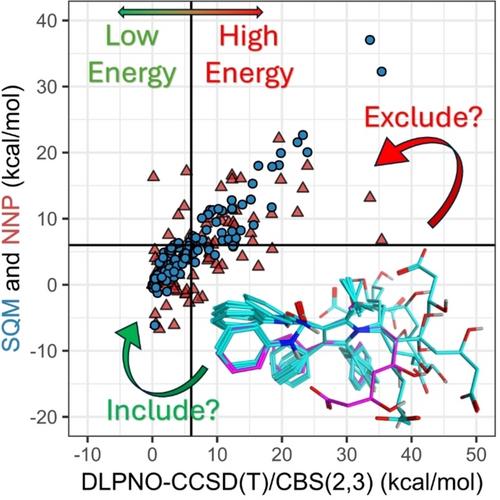
Accurate and efficient prediction of high energy ligand conformations is important in structure-based drug discovery for the exclusion of unrealistic structures in docking-based virtual screening and de novo design approaches. In this work, we constructed a database of 140 solution conformers from 20 druglike molecules of varying size and chemical complexity, with energetics evaluated at the DLPNO-CCSD(T)/complete basis set (CBS) level. We then assessed a selection of machine learning potentials and semiempirical quantum mechanical models for their ability to predict conformational energetics. The GFN2-xTB tight binding density functional method correlates with reference conformer energies, yielding a Kendall's τ of 0.63 and mean absolute error of 2.2 kcal/mol. As putative internal energy filters for screening, we find that the GFN2-xTB, ANI-2x and MACE-OFF23(L) models perform well in identifying low energy conformer geometries, with sensitivities of 95 %, 89 % and 95 % respectively, but display a reduced ability to exclude high energy conformers, with respective specificities of 80 %, 61 % and 63 %. The GFN2-xTB method therefore exhibited the best overall performance and appears currently the most suitable of the three methods to act as an internal energy filter for integration into drug discovery workflows. Enrichment of high energy conformers in the training of machine learning potentials could improve their performance as conformational filters.
期刊介绍:
ChemPhysChem is one of the leading chemistry/physics interdisciplinary journals (ISI Impact Factor 2018: 3.077) for physical chemistry and chemical physics. It is published on behalf of Chemistry Europe, an association of 16 European chemical societies.
ChemPhysChem is an international source for important primary and critical secondary information across the whole field of physical chemistry and chemical physics. It integrates this wide and flourishing field ranging from Solid State and Soft-Matter Research, Electro- and Photochemistry, Femtochemistry and Nanotechnology, Complex Systems, Single-Molecule Research, Clusters and Colloids, Catalysis and Surface Science, Biophysics and Physical Biochemistry, Atmospheric and Environmental Chemistry, and many more topics. ChemPhysChem is peer-reviewed.






 京公网安备 11010802042870号
京ICP备2023020795号-1
京公网安备 11010802042870号
京ICP备2023020795号-1

 分享
分享
 求助内容:
求助内容: 应助结果提醒方式:
 扫码关注我们
