Azadeh Nouhi Siahroudi, Seyed Saeed Hashemi Nazari, Mahshid Namdari, Mohammad Hossein Panahi, Seyed Amirhosein Mahdavi, Ali Khademi
{"title":"The effect of COVID-19 on completed suicide rate in Iran: an Interrupted Time Series study (ITS).","authors":"Azadeh Nouhi Siahroudi, Seyed Saeed Hashemi Nazari, Mahshid Namdari, Mohammad Hossein Panahi, Seyed Amirhosein Mahdavi, Ali Khademi","doi":"10.3389/fpubh.2025.1387213","DOIUrl":null,"url":null,"abstract":"<p><strong>Background: </strong>Suicide represents a critical public health concern and one of the most devastating forms of death. Based on a report from the World Health Organization, around 700,000 deaths by suicide occur globally each year. In 2019, the worldwide suicide mortality rate was 9.0 per 100,000 people, while in Iran, this rate has been reported to be an average of 5.2 per 100,000. Suicide is influenced by various factors spanning individual, relational, community, and social domains, all of which may elevate the risk of suicide and related death. One significant factor potentially impacting this issue was the COVID-19 pandemic, which may have affected these trends by disrupting individuals' social interactions and gatherings. To explore this further, the present study was carried out to investigate the impact of the COVID-19 pandemic on the changes in suicide rates leading to death in Iran.</p><p><strong>Methods: </strong>This study was designed using an Interrupted Time Series approach combined with negative binomial regression. Seasonal variations were adjusted for using the harmonic method. The research sample comprised 63,514 suicide-related deaths recorded between April 20, 2009, and March 20, 2023. Suicide mortality data were sourced from the National Legal Medicine Organization, while population statistics were obtained from the official website of the Statistical Center of Iran. The study analyzed trends in suicide incidence both prior to and during the COVID-19 pandemic. The period used to evaluate pandemic-related changes in Iran began in May 2020, following the World Health Organization's declaration of COVID-19 as a global public health emergency. Descriptive analyses were performed using Stata software, and trend assessments through the Interrupted Time Series (ITS) method were conducted using R software and the \"lmtest\" statistical package.</p><p><strong>Results: </strong>The changes in the incidence of suicide during the study increased by 1.003 monthly (<i>p</i> < 0.001). This rate increased by 1.1 (<i>p</i> < 0.001) compared to the times before the onset of the pandemic after entering the effect of the COVID-19 pandemic in the model. When the interaction effect of time with the COVID-19 pandemic was added to the base model, no significant relationship was observed.</p><p><strong>Conclusion: </strong>Before the COVID-19 pandemic, suicides in Iran had a proportional increasing trend. However, three months after the pandemic, an increasing trend in the level of suicide deaths was observed. Most likely, the COVID-19 pandemic phenomenon had an impact on the occurrence of suicide.</p>","PeriodicalId":12548,"journal":{"name":"Frontiers in Public Health","volume":"13 ","pages":"1387213"},"PeriodicalIF":3.4000,"publicationDate":"2025-02-13","publicationTypes":"Journal Article","fieldsOfStudy":null,"isOpenAccess":false,"openAccessPdf":"https://www.ncbi.nlm.nih.gov/pmc/articles/PMC11864926/pdf/","citationCount":"0","resultStr":null,"platform":"Semanticscholar","paperid":null,"PeriodicalName":"Frontiers in Public Health","FirstCategoryId":"3","ListUrlMain":"https://doi.org/10.3389/fpubh.2025.1387213","RegionNum":3,"RegionCategory":"医学","ArticlePicture":[],"TitleCN":null,"AbstractTextCN":null,"PMCID":null,"EPubDate":"2025/1/1 0:00:00","PubModel":"eCollection","JCR":"Q2","JCRName":"PUBLIC, ENVIRONMENTAL & OCCUPATIONAL HEALTH","Score":null,"Total":0}
引用次数: 0
Abstract
Background: Suicide represents a critical public health concern and one of the most devastating forms of death. Based on a report from the World Health Organization, around 700,000 deaths by suicide occur globally each year. In 2019, the worldwide suicide mortality rate was 9.0 per 100,000 people, while in Iran, this rate has been reported to be an average of 5.2 per 100,000. Suicide is influenced by various factors spanning individual, relational, community, and social domains, all of which may elevate the risk of suicide and related death. One significant factor potentially impacting this issue was the COVID-19 pandemic, which may have affected these trends by disrupting individuals' social interactions and gatherings. To explore this further, the present study was carried out to investigate the impact of the COVID-19 pandemic on the changes in suicide rates leading to death in Iran.
Methods: This study was designed using an Interrupted Time Series approach combined with negative binomial regression. Seasonal variations were adjusted for using the harmonic method. The research sample comprised 63,514 suicide-related deaths recorded between April 20, 2009, and March 20, 2023. Suicide mortality data were sourced from the National Legal Medicine Organization, while population statistics were obtained from the official website of the Statistical Center of Iran. The study analyzed trends in suicide incidence both prior to and during the COVID-19 pandemic. The period used to evaluate pandemic-related changes in Iran began in May 2020, following the World Health Organization's declaration of COVID-19 as a global public health emergency. Descriptive analyses were performed using Stata software, and trend assessments through the Interrupted Time Series (ITS) method were conducted using R software and the "lmtest" statistical package.
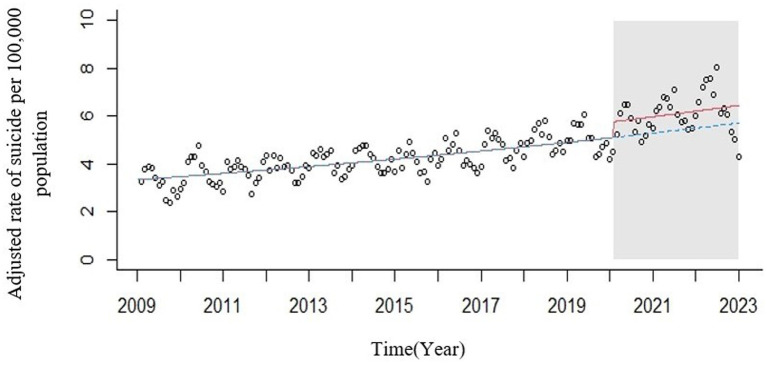
Results: The changes in the incidence of suicide during the study increased by 1.003 monthly (p < 0.001). This rate increased by 1.1 (p < 0.001) compared to the times before the onset of the pandemic after entering the effect of the COVID-19 pandemic in the model. When the interaction effect of time with the COVID-19 pandemic was added to the base model, no significant relationship was observed.
Conclusion: Before the COVID-19 pandemic, suicides in Iran had a proportional increasing trend. However, three months after the pandemic, an increasing trend in the level of suicide deaths was observed. Most likely, the COVID-19 pandemic phenomenon had an impact on the occurrence of suicide.
背景:自杀是一个严重的公共卫生问题,也是最具破坏性的死亡形式之一。根据世界卫生组织的一份报告,全球每年约有70万人死于自杀。2019年,全球自杀死亡率为每10万人中有9.0人,而在伊朗,据报道这一死亡率平均为每10万人中有5.2人。自杀受到个人、关系、社区和社会领域的各种因素的影响,所有这些因素都可能提高自杀和相关死亡的风险。可能影响这一问题的一个重要因素是COVID-19大流行,它可能通过扰乱个人的社交互动和聚会来影响这些趋势。为了进一步探讨这一点,本研究旨在调查COVID-19大流行对伊朗导致死亡的自杀率变化的影响。方法:本研究采用中断时间序列方法结合负二项回归设计。使用调和法调整季节变化。研究样本包括2009年4月20日至2023年3月20日期间记录的63,514例与自杀有关的死亡。自杀死亡率数据来源于国家法律医学组织,人口统计数据来源于伊朗统计中心官方网站。该研究分析了2019冠状病毒病大流行之前和期间的自杀发生率趋势。用于评估伊朗大流行相关变化的时期始于2020年5月,当时世界卫生组织宣布COVID-19为全球突发公共卫生事件。使用Stata软件进行描述性分析,使用R软件和“lmtest”统计软件包通过中断时间序列(ITS)方法进行趋势评估。结果:研究期间自杀发生率的变化每月增加1.003个(p p )。结论:在2019冠状病毒病大流行前,伊朗自杀率呈比例上升趋势。然而,在大流行三个月后,观察到自杀死亡人数呈上升趋势。最有可能的是,新冠疫情对自杀的发生产生了影响。
期刊介绍:
Frontiers in Public Health is a multidisciplinary open-access journal which publishes rigorously peer-reviewed research and is at the forefront of disseminating and communicating scientific knowledge and impactful discoveries to researchers, academics, clinicians, policy makers and the public worldwide. The journal aims at overcoming current fragmentation in research and publication, promoting consistency in pursuing relevant scientific themes, and supporting finding dissemination and translation into practice.
Frontiers in Public Health is organized into Specialty Sections that cover different areas of research in the field. Please refer to the author guidelines for details on article types and the submission process.





 京公网安备 11010802042870号
京ICP备2023020795号-1
京公网安备 11010802042870号
京ICP备2023020795号-1

 分享
分享
 求助内容:
求助内容: 应助结果提醒方式:
 扫码关注我们
