Júlia Arendt, Malú Zamariolli, Liriel Almodobar, Lucas Toshio Ito, Rafaella Ormond, Adrielle M Oliveira, Vanessa Ota, Luis Augusto Rohde, Euripedes Constantino Miguel, Pedro Pan, Rodrigo Bressan, Giovanni Salum, Sintia Belangero, Marcos Santoro
{"title":"Copy number variations in the Brazilian High-Risk Cohort for Mental Conditions.","authors":"Júlia Arendt, Malú Zamariolli, Liriel Almodobar, Lucas Toshio Ito, Rafaella Ormond, Adrielle M Oliveira, Vanessa Ota, Luis Augusto Rohde, Euripedes Constantino Miguel, Pedro Pan, Rodrigo Bressan, Giovanni Salum, Sintia Belangero, Marcos Santoro","doi":"10.47626/1516-4446-2024-3765","DOIUrl":null,"url":null,"abstract":"<p><strong>Objective: </strong>This study's purpose was to characterize copy number variations in a Brazilian cohort regarding frequency and inheritance patterns and to determine the effect of copy number variations previously associated with mental health disorders on the risk of developing these disorders.</p><p><strong>Methods: </strong>A total of 2,250 probands and 3,174 parents (897 trios) from the Brazilian High-Risk Cohort Study for Mental Conditions (BHRCS) were genotyped, with copy number variations detected using PennCNV software.</p><p><strong>Results: </strong>In total, 56.03% of the copy number variations were inherited. Among the distinct copy number variations, 96.15% were rare (frequency < 1% in the BHRCS). Duplications in 2q13 and 15q13.3 were less frequent, while those in 2q11.2 and 16p11.2 were more frequent in the BHRCS than in databases such as the Database of Genomic Variants and the Genome Aggregation Database. Of the 40 copy number variations previously associated with mental health disorders, 18 were identified in the sample. While duplication in 7q11.2 has been considered protective for schizophrenia, we found that deletion in 7q11.2 was protective for mental health disorders (p = 0.033, OR = 0.103). No significant results were found for the other copy number variations, despite mild effect sizes.</p><p><strong>Conclusions: </strong>This is one of the largest copy number variation studies to have been conducted in a Brazilian sample, and it will be a valuable resource for future meta-analysis, advancing our understanding of the genetics of mental health disorders, especially in diverse populations.</p>","PeriodicalId":21244,"journal":{"name":"Revista Brasileira de Psiquiatria","volume":" ","pages":"e20243765"},"PeriodicalIF":2.6000,"publicationDate":"2025-01-01","publicationTypes":"Journal Article","fieldsOfStudy":null,"isOpenAccess":false,"openAccessPdf":"https://www.ncbi.nlm.nih.gov/pmc/articles/PMC12815305/pdf/","citationCount":"0","resultStr":null,"platform":"Semanticscholar","paperid":null,"PeriodicalName":"Revista Brasileira de Psiquiatria","FirstCategoryId":"3","ListUrlMain":"https://doi.org/10.47626/1516-4446-2024-3765","RegionNum":3,"RegionCategory":"医学","ArticlePicture":[],"TitleCN":null,"AbstractTextCN":null,"PMCID":null,"EPubDate":"2025/2/27 0:00:00","PubModel":"Epub","JCR":"Q1","JCRName":"PSYCHIATRY","Score":null,"Total":0}
引用次数: 0
Abstract
Objective: This study's purpose was to characterize copy number variations in a Brazilian cohort regarding frequency and inheritance patterns and to determine the effect of copy number variations previously associated with mental health disorders on the risk of developing these disorders.
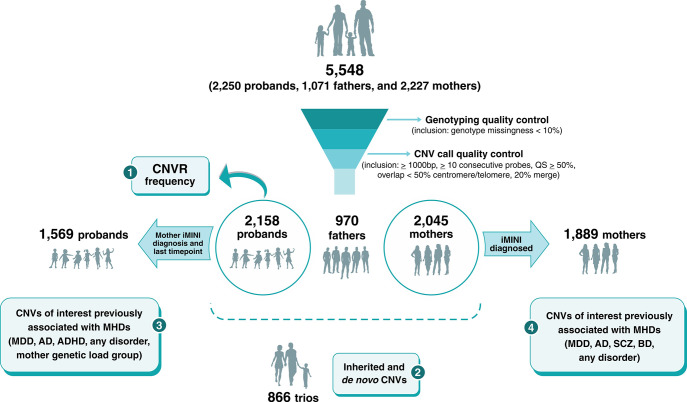
Methods: A total of 2,250 probands and 3,174 parents (897 trios) from the Brazilian High-Risk Cohort Study for Mental Conditions (BHRCS) were genotyped, with copy number variations detected using PennCNV software.
Results: In total, 56.03% of the copy number variations were inherited. Among the distinct copy number variations, 96.15% were rare (frequency < 1% in the BHRCS). Duplications in 2q13 and 15q13.3 were less frequent, while those in 2q11.2 and 16p11.2 were more frequent in the BHRCS than in databases such as the Database of Genomic Variants and the Genome Aggregation Database. Of the 40 copy number variations previously associated with mental health disorders, 18 were identified in the sample. While duplication in 7q11.2 has been considered protective for schizophrenia, we found that deletion in 7q11.2 was protective for mental health disorders (p = 0.033, OR = 0.103). No significant results were found for the other copy number variations, despite mild effect sizes.
Conclusions: This is one of the largest copy number variation studies to have been conducted in a Brazilian sample, and it will be a valuable resource for future meta-analysis, advancing our understanding of the genetics of mental health disorders, especially in diverse populations.
期刊介绍:
The Revista Brasileira de Psiquiatria (RBP) is the official organ of the Associação Brasileira de Psiquiatria (ABP - Brazilian Association of Psychiatry).
The Brazilian Journal of Psychiatry is a bimonthly publication that aims to publish original manuscripts in all areas of psychiatry, including public health, clinical epidemiology, basic science, and mental health problems. The journal is fully open access, and there are no article processing or publication fees. Articles must be written in English.



 京公网安备 11010802042870号
京ICP备2023020795号-1
京公网安备 11010802042870号
京ICP备2023020795号-1

 分享
分享
 求助内容:
求助内容: 应助结果提醒方式:
 扫码关注我们
