Mark Tomlinson, Mary Jane Rotheram-Borus, Linnea Stansert Katzen, William Gertsch, Ingrid le Roux, Elaine Dippenaar, Karl le Roux
{"title":"Relationship of perinatal outcomes to the competence and quantity of contact with community health workers.","authors":"Mark Tomlinson, Mary Jane Rotheram-Borus, Linnea Stansert Katzen, William Gertsch, Ingrid le Roux, Elaine Dippenaar, Karl le Roux","doi":"10.7189/jogh.15.04094","DOIUrl":null,"url":null,"abstract":"<p><strong>Background: </strong>The effectiveness of perinatal home visits by community health workers (CHWs) often diminishes when large regional or national programmes are implemented. To address this gap, we aimed to identify which CHW behaviours influence maternal and child outcomes.</p><p><strong>Methods: </strong>We randomised all government-funded CHWs at eight deeply rural clinics (n = 43) by clinic to usual care, which consisted of home visits (control group; four clinics, 23 CHWs, 392 mothers), or to home visiting, which included improved monitoring and supervision (intervention group; four clinics, 20 CHWs, 423 mothers). Since fewer than 7% of CHWs in the control group ever implemented home visits and no data was available on the frequency of visits, we focussed on the CHWs in the intervention group. We monitored the number and timing of home visits over time and documented it by paper and mobile phone records. Supervisors who conducted at-home observations of visits completed competency ratings on each CHW. We evaluated the associations between the competency of the CHW and the number and timing of CHWs' visits with 13 maternal/child outcomes using multiple regression analyses.</p><p><strong>Results: </strong>Consistent home visits by CHWs reached the threshold at about 9-12 months, with the frequency reducing because of COVID-19. There were two significant outcomes (antiretroviral therapy adherence and securing the child grant) associated with the number of home visits in the intervention group, but insufficient to demonstrate efficacy. The CHW competency was unrelated to any maternal/child outcome. Moreover, CHWs visited 7% of mothers during the first two days of their infants' lives, 26% during the first week, 57% within the first month, and 90% by the first three months of life.</p><p><strong>Conclusions: </strong>Current standards for training and monitoring of paraprofessional home visitors are highly unrealistic. Substantial and ongoing investments are needed for visits to occur consistently over time. However, hiring and selection criteria are likely as important as training and monitoring. CHW programmes must be embedded in organisational contexts that are well functioning and have management and support structures that are operational to ensure their success.Keywords.</p>","PeriodicalId":48734,"journal":{"name":"Journal of Global Health","volume":"15 ","pages":"04094"},"PeriodicalIF":4.3000,"publicationDate":"2025-02-28","publicationTypes":"Journal Article","fieldsOfStudy":null,"isOpenAccess":false,"openAccessPdf":"https://www.ncbi.nlm.nih.gov/pmc/articles/PMC11869529/pdf/","citationCount":"0","resultStr":null,"platform":"Semanticscholar","paperid":null,"PeriodicalName":"Journal of Global Health","FirstCategoryId":"3","ListUrlMain":"https://doi.org/10.7189/jogh.15.04094","RegionNum":3,"RegionCategory":"医学","ArticlePicture":[],"TitleCN":null,"AbstractTextCN":null,"PMCID":null,"EPubDate":"","PubModel":"","JCR":"Q1","JCRName":"PUBLIC, ENVIRONMENTAL & OCCUPATIONAL HEALTH","Score":null,"Total":0}
引用次数: 0
Abstract
Background: The effectiveness of perinatal home visits by community health workers (CHWs) often diminishes when large regional or national programmes are implemented. To address this gap, we aimed to identify which CHW behaviours influence maternal and child outcomes.
Methods: We randomised all government-funded CHWs at eight deeply rural clinics (n = 43) by clinic to usual care, which consisted of home visits (control group; four clinics, 23 CHWs, 392 mothers), or to home visiting, which included improved monitoring and supervision (intervention group; four clinics, 20 CHWs, 423 mothers). Since fewer than 7% of CHWs in the control group ever implemented home visits and no data was available on the frequency of visits, we focussed on the CHWs in the intervention group. We monitored the number and timing of home visits over time and documented it by paper and mobile phone records. Supervisors who conducted at-home observations of visits completed competency ratings on each CHW. We evaluated the associations between the competency of the CHW and the number and timing of CHWs' visits with 13 maternal/child outcomes using multiple regression analyses.
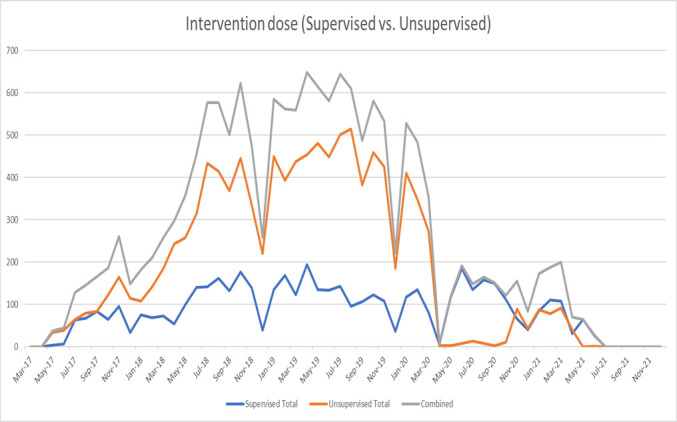
Results: Consistent home visits by CHWs reached the threshold at about 9-12 months, with the frequency reducing because of COVID-19. There were two significant outcomes (antiretroviral therapy adherence and securing the child grant) associated with the number of home visits in the intervention group, but insufficient to demonstrate efficacy. The CHW competency was unrelated to any maternal/child outcome. Moreover, CHWs visited 7% of mothers during the first two days of their infants' lives, 26% during the first week, 57% within the first month, and 90% by the first three months of life.
Conclusions: Current standards for training and monitoring of paraprofessional home visitors are highly unrealistic. Substantial and ongoing investments are needed for visits to occur consistently over time. However, hiring and selection criteria are likely as important as training and monitoring. CHW programmes must be embedded in organisational contexts that are well functioning and have management and support structures that are operational to ensure their success.Keywords.
期刊介绍:
Journal of Global Health is a peer-reviewed journal published by the Edinburgh University Global Health Society, a not-for-profit organization registered in the UK. We publish editorials, news, viewpoints, original research and review articles in two issues per year.



 京公网安备 11010802042870号
京ICP备2023020795号-1
京公网安备 11010802042870号
京ICP备2023020795号-1

 分享
分享
 求助内容:
求助内容: 应助结果提醒方式:
 扫码关注我们
