Sophie Gregg, Niamh Purcell, Maeve Doyle, Grace Chan
{"title":"Reducing blood culture contamination: an environmental imperative.","authors":"Sophie Gregg, Niamh Purcell, Maeve Doyle, Grace Chan","doi":"10.1099/acmi.0.000897.v3","DOIUrl":null,"url":null,"abstract":"<p><p>Blood culture (BC) investigation remains the gold standard for the diagnosis of bloodstream infections. However, BC contamination can have clinical implications for the patient, cost implications for service providers and less well-documented, environmental impacts. Efforts to reduce BC contamination are a long-standing theme in quality improvement initiatives in emergency departments (EDs) and hospitals, prompted by hospital costs, healthcare inefficiencies and antimicrobial stewardship efforts. The WHO's global analysis of healthcare waste in the context of COVID-19 has reported that tens of thousands of tonnes of extra medical waste were produced from the response to the COVID-19 pandemic, basing its estimates on the quantity of personal protective equipment. Additionally, recent literature has also shown increased BC contamination rates during the COVID-19 pandemic. We performed a retrospective review of the trend of BC contamination during the COVID-19 pandemic in our institution's ED. We further discuss some of the potential implications of BC contamination, including potential environmental, economic and efficiency implications.</p>","PeriodicalId":94366,"journal":{"name":"Access microbiology","volume":"7 2","pages":""},"PeriodicalIF":0.0000,"publicationDate":"2025-02-26","publicationTypes":"Journal Article","fieldsOfStudy":null,"isOpenAccess":false,"openAccessPdf":"https://www.ncbi.nlm.nih.gov/pmc/articles/PMC11865496/pdf/","citationCount":"0","resultStr":null,"platform":"Semanticscholar","paperid":null,"PeriodicalName":"Access microbiology","FirstCategoryId":"1085","ListUrlMain":"https://doi.org/10.1099/acmi.0.000897.v3","RegionNum":0,"RegionCategory":null,"ArticlePicture":[],"TitleCN":null,"AbstractTextCN":null,"PMCID":null,"EPubDate":"2025/1/1 0:00:00","PubModel":"eCollection","JCR":"","JCRName":"","Score":null,"Total":0}
引用次数: 0
Abstract
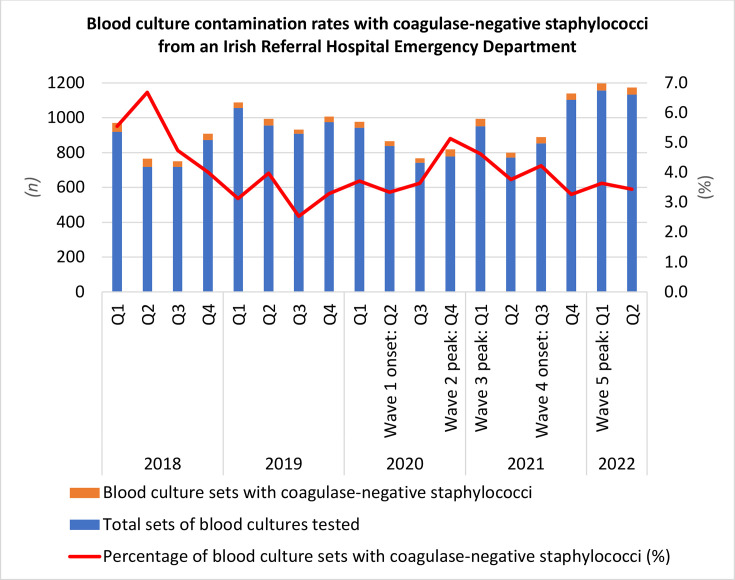
Blood culture (BC) investigation remains the gold standard for the diagnosis of bloodstream infections. However, BC contamination can have clinical implications for the patient, cost implications for service providers and less well-documented, environmental impacts. Efforts to reduce BC contamination are a long-standing theme in quality improvement initiatives in emergency departments (EDs) and hospitals, prompted by hospital costs, healthcare inefficiencies and antimicrobial stewardship efforts. The WHO's global analysis of healthcare waste in the context of COVID-19 has reported that tens of thousands of tonnes of extra medical waste were produced from the response to the COVID-19 pandemic, basing its estimates on the quantity of personal protective equipment. Additionally, recent literature has also shown increased BC contamination rates during the COVID-19 pandemic. We performed a retrospective review of the trend of BC contamination during the COVID-19 pandemic in our institution's ED. We further discuss some of the potential implications of BC contamination, including potential environmental, economic and efficiency implications.



 京公网安备 11010802042870号
京ICP备2023020795号-1
京公网安备 11010802042870号
京ICP备2023020795号-1

 分享
分享

 求助内容:
求助内容: 应助结果提醒方式:
 扫码关注我们
