Hannah K. Adams, Max Kadarauch, Nicholas J. Hodson, Arthur R. Lit, Robert J. Phipps
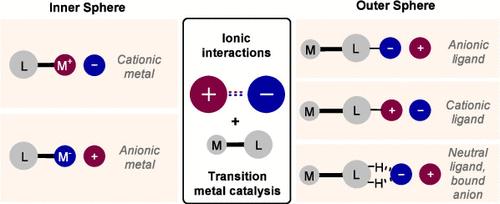
{"title":"Design Approaches That Utilize Ionic Interactions to Control Selectivity in Transition Metal Catalysis","authors":"Hannah K. Adams, Max Kadarauch, Nicholas J. Hodson, Arthur R. Lit, Robert J. Phipps","doi":"10.1021/acs.chemrev.4c00849","DOIUrl":null,"url":null,"abstract":"The attractive force between two oppositely charged ions can constitute a powerful design tool in selective catalysis. Enzymes make extensive use of ionic interactions alongside a variety of other noncovalent interactions; recent years have seen synthetic chemists begin to seriously explore these interactions in catalyst designs that also incorporate a reactive transition metal. In isolation, a single ionic interaction exhibits low directionality, but in many successful systems they exist alongside additional interactions which can provide a high degree of organization at the selectivity-determining transition state. Even in situations with a single key interaction, low directionality is not always detrimental, and can even be advantageous, conferring generality to a single catalyst. This Review explores design approaches that utilize ionic interactions to control selectivity in transition metal catalysis. It is divided into two halves: in the first, the ionic interaction occurs in the outer sphere of the metal complex, using a ligand which is charged or bound to an anion; in the second, the metal bears a formal charge, and the ionic interaction is with an associated counterion.","PeriodicalId":32,"journal":{"name":"Chemical Reviews","volume":"4 1","pages":""},"PeriodicalIF":55.8000,"publicationDate":"2025-02-28","publicationTypes":"Journal Article","fieldsOfStudy":null,"isOpenAccess":false,"openAccessPdf":"","citationCount":"0","resultStr":null,"platform":"Semanticscholar","paperid":null,"PeriodicalName":"Chemical Reviews","FirstCategoryId":"92","ListUrlMain":"https://doi.org/10.1021/acs.chemrev.4c00849","RegionNum":1,"RegionCategory":"化学","ArticlePicture":[],"TitleCN":null,"AbstractTextCN":null,"PMCID":null,"EPubDate":"","PubModel":"","JCR":"Q1","JCRName":"CHEMISTRY, MULTIDISCIPLINARY","Score":null,"Total":0}
引用次数: 0
Abstract
The attractive force between two oppositely charged ions can constitute a powerful design tool in selective catalysis. Enzymes make extensive use of ionic interactions alongside a variety of other noncovalent interactions; recent years have seen synthetic chemists begin to seriously explore these interactions in catalyst designs that also incorporate a reactive transition metal. In isolation, a single ionic interaction exhibits low directionality, but in many successful systems they exist alongside additional interactions which can provide a high degree of organization at the selectivity-determining transition state. Even in situations with a single key interaction, low directionality is not always detrimental, and can even be advantageous, conferring generality to a single catalyst. This Review explores design approaches that utilize ionic interactions to control selectivity in transition metal catalysis. It is divided into two halves: in the first, the ionic interaction occurs in the outer sphere of the metal complex, using a ligand which is charged or bound to an anion; in the second, the metal bears a formal charge, and the ionic interaction is with an associated counterion.
期刊介绍:
Chemical Reviews is a highly regarded and highest-ranked journal covering the general topic of chemistry. Its mission is to provide comprehensive, authoritative, critical, and readable reviews of important recent research in organic, inorganic, physical, analytical, theoretical, and biological chemistry.
Since 1985, Chemical Reviews has also published periodic thematic issues that focus on a single theme or direction of emerging research.



 京公网安备 11010802042870号
京ICP备2023020795号-1
京公网安备 11010802042870号
京ICP备2023020795号-1

 分享
分享
 求助内容:
求助内容: 应助结果提醒方式:
 扫码关注我们
