Mechanistic insight into the environmental fate of highly concerned transformation products of aqueous micropollutants during the solar/chlorine treatment
{"title":"Mechanistic insight into the environmental fate of highly concerned transformation products of aqueous micropollutants during the solar/chlorine treatment","authors":"Yuwei Xie, Wenzheng Chen, Zhantu Ye, Junmei Yan, Xin Yu, Mingbao Feng","doi":"10.1016/j.watres.2025.123413","DOIUrl":null,"url":null,"abstract":"<div><div>Transformation products (TPs) arising from the degradation of micropollutants have been frequently detected in various water bodies and may exhibit higher toxicity than their parent compounds. However, the current understanding of their chemical reactivity remains limited, and the mechanisms underlying the solar-driven oxidation processes (e.g., solar/chlorine system) of TPs have not been well investigated. This study explored the elimination of six typical TPs derived from carbamazepine (CBZ) and atrazine (ATZ) by solar/oxidant systems. It was observed that these TPs could be effectively degraded in the solar/oxidant systems, except for the solar/hydrogen peroxide system. The reactivity evaluation and quantitative contribution analysis revealed that hydroxyl radicals (<sup>•</sup>OH) and ozone played pivotal roles in the removal of all six typical TPs by the solar/chlorine system, whereas the reactive chlorine species contributed minimally. The transformation mechanisms of carbamazepine 10, 11-epoxide (CBZ-EP) involved hydroxyl addition and electron transfer, while the TPs of ATZ underwent dealkylation only. The computational study indicated that <sup>•</sup>OH primarily reacted with CBZ-EP via radical addition reaction. Furthermore, the TPs of CBZ-EP and hydroxyatrazine showed no obvious change in environmental persistence but enhanced mobility and toxicity compared to the parent compounds, implying treatment-driven secondary risks. Overall, this investigation provided an in-depth mechanistic exploration of the transformation behaviors, fate, and secondary environmental risks of highly concerned TPs under the solar/oxidant treatments.</div></div>","PeriodicalId":443,"journal":{"name":"Water Research","volume":"278 ","pages":"Article 123413"},"PeriodicalIF":12.4000,"publicationDate":"2025-06-15","publicationTypes":"Journal Article","fieldsOfStudy":null,"isOpenAccess":false,"openAccessPdf":"","citationCount":"0","resultStr":null,"platform":"Semanticscholar","paperid":null,"PeriodicalName":"Water Research","FirstCategoryId":"93","ListUrlMain":"https://www.sciencedirect.com/science/article/pii/S0043135425003264","RegionNum":1,"RegionCategory":"环境科学与生态学","ArticlePicture":[],"TitleCN":null,"AbstractTextCN":null,"PMCID":null,"EPubDate":"2025/2/28 0:00:00","PubModel":"Epub","JCR":"Q1","JCRName":"ENGINEERING, ENVIRONMENTAL","Score":null,"Total":0}
引用次数: 0
Abstract
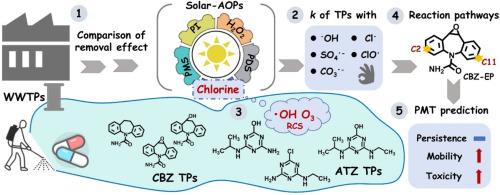
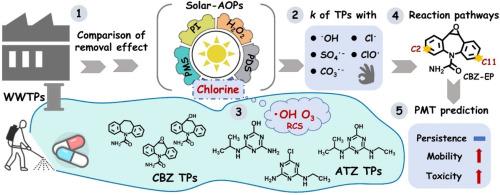
Transformation products (TPs) arising from the degradation of micropollutants have been frequently detected in various water bodies and may exhibit higher toxicity than their parent compounds. However, the current understanding of their chemical reactivity remains limited, and the mechanisms underlying the solar-driven oxidation processes (e.g., solar/chlorine system) of TPs have not been well investigated. This study explored the elimination of six typical TPs derived from carbamazepine (CBZ) and atrazine (ATZ) by solar/oxidant systems. It was observed that these TPs could be effectively degraded in the solar/oxidant systems, except for the solar/hydrogen peroxide system. The reactivity evaluation and quantitative contribution analysis revealed that hydroxyl radicals (•OH) and ozone played pivotal roles in the removal of all six typical TPs by the solar/chlorine system, whereas the reactive chlorine species contributed minimally. The transformation mechanisms of carbamazepine 10, 11-epoxide (CBZ-EP) involved hydroxyl addition and electron transfer, while the TPs of ATZ underwent dealkylation only. The computational study indicated that •OH primarily reacted with CBZ-EP via radical addition reaction. Furthermore, the TPs of CBZ-EP and hydroxyatrazine showed no obvious change in environmental persistence but enhanced mobility and toxicity compared to the parent compounds, implying treatment-driven secondary risks. Overall, this investigation provided an in-depth mechanistic exploration of the transformation behaviors, fate, and secondary environmental risks of highly concerned TPs under the solar/oxidant treatments.
期刊介绍:
Water Research, along with its open access companion journal Water Research X, serves as a platform for publishing original research papers covering various aspects of the science and technology related to the anthropogenic water cycle, water quality, and its management worldwide. The audience targeted by the journal comprises biologists, chemical engineers, chemists, civil engineers, environmental engineers, limnologists, and microbiologists. The scope of the journal include:
•Treatment processes for water and wastewaters (municipal, agricultural, industrial, and on-site treatment), including resource recovery and residuals management;
•Urban hydrology including sewer systems, stormwater management, and green infrastructure;
•Drinking water treatment and distribution;
•Potable and non-potable water reuse;
•Sanitation, public health, and risk assessment;
•Anaerobic digestion, solid and hazardous waste management, including source characterization and the effects and control of leachates and gaseous emissions;
•Contaminants (chemical, microbial, anthropogenic particles such as nanoparticles or microplastics) and related water quality sensing, monitoring, fate, and assessment;
•Anthropogenic impacts on inland, tidal, coastal and urban waters, focusing on surface and ground waters, and point and non-point sources of pollution;
•Environmental restoration, linked to surface water, groundwater and groundwater remediation;
•Analysis of the interfaces between sediments and water, and between water and atmosphere, focusing specifically on anthropogenic impacts;
•Mathematical modelling, systems analysis, machine learning, and beneficial use of big data related to the anthropogenic water cycle;
•Socio-economic, policy, and regulations studies.




 京公网安备 11010802042870号
京ICP备2023020795号-1
京公网安备 11010802042870号
京ICP备2023020795号-1

 分享
分享
 求助内容:
求助内容: 应助结果提醒方式:
 扫码关注我们
