Ming Liu, Jingpi Gao, Yang Zhang, Xin Zhou, Yu Wang, Li Wu, Zhiyuan Tian and Jian-Hong Tang
{"title":"Recent advances in bioresponsive macrocyclic gadolinium(iii) complexes for MR imaging and therapy","authors":"Ming Liu, Jingpi Gao, Yang Zhang, Xin Zhou, Yu Wang, Li Wu, Zhiyuan Tian and Jian-Hong Tang","doi":"10.1039/D5DT00191A","DOIUrl":null,"url":null,"abstract":"<p >Magnetic resonance (MR) imaging is a non-invasive clinical diagnostic modality that provides anatomical and physiological information with sub-millimetre spatial resolution at the organ and tissue levels. It utilizes the relaxation times (<em>T</em><small><sub>1</sub></small> and <em>T</em><small><sub>2</sub></small>) of protons in water to generate MR images. However, the intrinsic MR contrast produced by water relaxation in organs and tissues is limited. To enhance the sensitivity and specificity of MR imaging, about 30%–45% of all clinical MR diagnoses need to use contrast media. Currently, all clinically approved MR contrast agents are linear or macrocyclic gadolinium(<small>III</small>) (Gd(<small>III</small>)) complexes, which are not specific to particular biological events. Due to the relatively high potential for releasing toxic free Gd(<small>III</small>), linear Gd(<small>III</small>) complexes raise safety concerns, making macrocyclic Gd(<small>III</small>) probes the preferred choice for clinical MR imaging without acute safety issues. To enhance the capability of MR imaging for detecting dynamic biological processes and conditions, many bioresponsive macrocyclic Gd(<small>III</small>) complexes capable of targeting diverse biomarkers have been developed. This review provides a concise and timely summary of bioresponsive macrocyclic Gd(<small>III</small>) contrast agents, particularly those developed between 2019 and 2024. We focus on three major types of Gd(<small>III</small>) agent that respond specifically to changes in pH, chemicals, and enzymes, highlighting their molecular design strategies, proton-relaxivity responses, and applications in <em>in vitro</em> and <em>in vivo</em> MR imaging for monitoring specific biomedical conditions and therapies.</p>","PeriodicalId":71,"journal":{"name":"Dalton Transactions","volume":" 17","pages":" 6741-6777"},"PeriodicalIF":3.3000,"publicationDate":"2025-03-01","publicationTypes":"Journal Article","fieldsOfStudy":null,"isOpenAccess":false,"openAccessPdf":"","citationCount":"0","resultStr":null,"platform":"Semanticscholar","paperid":null,"PeriodicalName":"Dalton Transactions","FirstCategoryId":"92","ListUrlMain":"https://pubs.rsc.org/en/content/articlelanding/2025/dt/d5dt00191a","RegionNum":3,"RegionCategory":"化学","ArticlePicture":[],"TitleCN":null,"AbstractTextCN":null,"PMCID":null,"EPubDate":"","PubModel":"","JCR":"Q2","JCRName":"CHEMISTRY, INORGANIC & NUCLEAR","Score":null,"Total":0}
引用次数: 0
Abstract
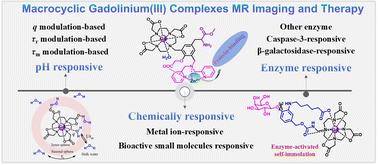
Magnetic resonance (MR) imaging is a non-invasive clinical diagnostic modality that provides anatomical and physiological information with sub-millimetre spatial resolution at the organ and tissue levels. It utilizes the relaxation times (T1 and T2) of protons in water to generate MR images. However, the intrinsic MR contrast produced by water relaxation in organs and tissues is limited. To enhance the sensitivity and specificity of MR imaging, about 30%–45% of all clinical MR diagnoses need to use contrast media. Currently, all clinically approved MR contrast agents are linear or macrocyclic gadolinium(III) (Gd(III)) complexes, which are not specific to particular biological events. Due to the relatively high potential for releasing toxic free Gd(III), linear Gd(III) complexes raise safety concerns, making macrocyclic Gd(III) probes the preferred choice for clinical MR imaging without acute safety issues. To enhance the capability of MR imaging for detecting dynamic biological processes and conditions, many bioresponsive macrocyclic Gd(III) complexes capable of targeting diverse biomarkers have been developed. This review provides a concise and timely summary of bioresponsive macrocyclic Gd(III) contrast agents, particularly those developed between 2019 and 2024. We focus on three major types of Gd(III) agent that respond specifically to changes in pH, chemicals, and enzymes, highlighting their molecular design strategies, proton-relaxivity responses, and applications in in vitro and in vivo MR imaging for monitoring specific biomedical conditions and therapies.
期刊介绍:
Dalton Transactions is a journal for all areas of inorganic chemistry, which encompasses the organometallic, bioinorganic and materials chemistry of the elements, with applications including synthesis, catalysis, energy conversion/storage, electrical devices and medicine. Dalton Transactions welcomes high-quality, original submissions in all of these areas and more, where the advancement of knowledge in inorganic chemistry is significant.



 京公网安备 11010802042870号
京ICP备2023020795号-1
京公网安备 11010802042870号
京ICP备2023020795号-1

 分享
分享
 求助内容:
求助内容: 应助结果提醒方式:
 扫码关注我们
