Yan Wang, Yuxiang Zhu, Zhengtao Jia, Shaohui Wang, Xiang Zhong, Qiufan Sun, Jianfeng Yao
{"title":"Highly active microleaves derived from MIL-101(Fe) through acid etching for improved visible light nitrogen reduction","authors":"Yan Wang, Yuxiang Zhu, Zhengtao Jia, Shaohui Wang, Xiang Zhong, Qiufan Sun, Jianfeng Yao","doi":"10.1016/j.cej.2025.161158","DOIUrl":null,"url":null,"abstract":"In this work, MIL-101(Fe) was etched with nitric acid to create biomimetic microleaf architectures for improved photocatalytic ammonia synthesis. The etching process is controlled by the concentration of acid molecules passing through the MOFs windows, allowing precise tuning of the inherent crystallinity and external morphology of the resulting catalysts. Notably, at the optimal acid concentration, the resulting catalyst forms microleaf structures less than 5 µm in length, growing together at one end. This catalyst achieves a visible light photocatalytic ammonia yield rate of 8.2 mmol g<sub>cat</sub><sup>−1</sup> after 4 h irradiation with an apparent quantum efficiency of 6.58 % at 420 nm. Moreover, the stable generation of ammonia using seawater, tap water, lake water, and turbid water without sacrificial reagents highlights the potential of the microleaf-shaped materials as a commercially viable photocatalytic system. Further mechanistic studies reveal that the deficient iron centers promote the chemisorption of nitrogen molecules and photoinduced electron transfer. The nitro groups incorporated through nitration may aid in forming the vein-like microleaf structure which not only exposes more active sites but also enhances the interaction between reactants and the catalyst surface. This work presents a promising strategy for synthesizing MOFs-derived hierarchical architectures for energy and environmental applications.","PeriodicalId":270,"journal":{"name":"Chemical Engineering Journal","volume":"10 3 1","pages":""},"PeriodicalIF":13.2000,"publicationDate":"2025-03-01","publicationTypes":"Journal Article","fieldsOfStudy":null,"isOpenAccess":false,"openAccessPdf":"","citationCount":"0","resultStr":null,"platform":"Semanticscholar","paperid":null,"PeriodicalName":"Chemical Engineering Journal","FirstCategoryId":"5","ListUrlMain":"https://doi.org/10.1016/j.cej.2025.161158","RegionNum":1,"RegionCategory":"工程技术","ArticlePicture":[],"TitleCN":null,"AbstractTextCN":null,"PMCID":null,"EPubDate":"","PubModel":"","JCR":"Q1","JCRName":"ENGINEERING, CHEMICAL","Score":null,"Total":0}
引用次数: 0
Abstract
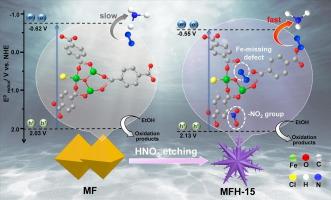
In this work, MIL-101(Fe) was etched with nitric acid to create biomimetic microleaf architectures for improved photocatalytic ammonia synthesis. The etching process is controlled by the concentration of acid molecules passing through the MOFs windows, allowing precise tuning of the inherent crystallinity and external morphology of the resulting catalysts. Notably, at the optimal acid concentration, the resulting catalyst forms microleaf structures less than 5 µm in length, growing together at one end. This catalyst achieves a visible light photocatalytic ammonia yield rate of 8.2 mmol gcat−1 after 4 h irradiation with an apparent quantum efficiency of 6.58 % at 420 nm. Moreover, the stable generation of ammonia using seawater, tap water, lake water, and turbid water without sacrificial reagents highlights the potential of the microleaf-shaped materials as a commercially viable photocatalytic system. Further mechanistic studies reveal that the deficient iron centers promote the chemisorption of nitrogen molecules and photoinduced electron transfer. The nitro groups incorporated through nitration may aid in forming the vein-like microleaf structure which not only exposes more active sites but also enhances the interaction between reactants and the catalyst surface. This work presents a promising strategy for synthesizing MOFs-derived hierarchical architectures for energy and environmental applications.
期刊介绍:
The Chemical Engineering Journal is an international research journal that invites contributions of original and novel fundamental research. It aims to provide an international platform for presenting original fundamental research, interpretative reviews, and discussions on new developments in chemical engineering. The journal welcomes papers that describe novel theory and its practical application, as well as those that demonstrate the transfer of techniques from other disciplines. It also welcomes reports on carefully conducted experimental work that is soundly interpreted. The main focus of the journal is on original and rigorous research results that have broad significance. The Catalysis section within the Chemical Engineering Journal focuses specifically on Experimental and Theoretical studies in the fields of heterogeneous catalysis, molecular catalysis, and biocatalysis. These studies have industrial impact on various sectors such as chemicals, energy, materials, foods, healthcare, and environmental protection.



 京公网安备 11010802042870号
京ICP备2023020795号-1
京公网安备 11010802042870号
京ICP备2023020795号-1

 分享
分享
 求助内容:
求助内容: 应助结果提醒方式:
 扫码关注我们
