Anubhav Dhull, Ki Wan Park, Aqib Iqbal Dar, Andrew Wang, Anu Rani, Rishi Sharma, Tulio A Valdez, Anjali Sharma
{"title":"Mixed-Layered Glycodendrimer Probe for Imaging Inflammation at Surgical Site Infections","authors":"Anubhav Dhull, Ki Wan Park, Aqib Iqbal Dar, Andrew Wang, Anu Rani, Rishi Sharma, Tulio A Valdez, Anjali Sharma","doi":"10.1021/acssensors.4c03544","DOIUrl":null,"url":null,"abstract":"Surgical site infections (SSIs) remain the most common cause for readmission following surgery and are associated with significant medical comorbidities. Distinguishing between inflammation and early infection postsurgery is a critical challenge for clinicians. Intraoperative surgical debridement of infectious tissues relies heavily on the surgeon’s experience, risking error due to difficulty in distinguishing infection from inflammation. We evaluated the simultaneous use of two fluorescent probes, maltotriose-indocyanine-green (ICG-DBCO-maltotriose) and a mixed-layered 2-deoxyglucose dendrimer (2DG-D) labeled with cyanine 5 (2DG-D-Cy5), to delineate between SSI and inflammation in vitro in cell-bacteria coculture and in vivo in an early implant SSI model via multiplexed short-wave infrared (SWIR) imaging. To our knowledge, this study is the first to use multiple fluorescent dyes combined with small molecules and dendrimer-based nanoprobes to differentiate between inflammation and infection within the same experimental model. We synthesized 2DG-D using a convergent method, simplifying synthesis and purification. 2DG-D-Cy5 exclusively labeled the macrophages associated with inflammation in vitro. In vivo SWIR imaging using both probes in a murine implant infection model successfully distinguished infection from inflammation in real time, allowing targeted surgical debridement. This real-time detection of infection and inflammation may enhance diagnostic confidence and aid in the monitoring of therapeutic responses.","PeriodicalId":24,"journal":{"name":"ACS Sensors","volume":"13 1","pages":""},"PeriodicalIF":9.1000,"publicationDate":"2025-02-28","publicationTypes":"Journal Article","fieldsOfStudy":null,"isOpenAccess":false,"openAccessPdf":"","citationCount":"0","resultStr":null,"platform":"Semanticscholar","paperid":null,"PeriodicalName":"ACS Sensors","FirstCategoryId":"92","ListUrlMain":"https://doi.org/10.1021/acssensors.4c03544","RegionNum":1,"RegionCategory":"化学","ArticlePicture":[],"TitleCN":null,"AbstractTextCN":null,"PMCID":null,"EPubDate":"","PubModel":"","JCR":"Q1","JCRName":"CHEMISTRY, ANALYTICAL","Score":null,"Total":0}
引用次数: 0
Abstract
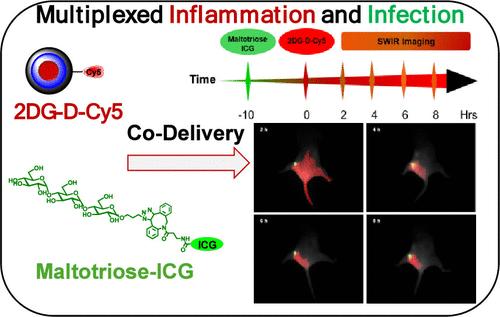
Surgical site infections (SSIs) remain the most common cause for readmission following surgery and are associated with significant medical comorbidities. Distinguishing between inflammation and early infection postsurgery is a critical challenge for clinicians. Intraoperative surgical debridement of infectious tissues relies heavily on the surgeon’s experience, risking error due to difficulty in distinguishing infection from inflammation. We evaluated the simultaneous use of two fluorescent probes, maltotriose-indocyanine-green (ICG-DBCO-maltotriose) and a mixed-layered 2-deoxyglucose dendrimer (2DG-D) labeled with cyanine 5 (2DG-D-Cy5), to delineate between SSI and inflammation in vitro in cell-bacteria coculture and in vivo in an early implant SSI model via multiplexed short-wave infrared (SWIR) imaging. To our knowledge, this study is the first to use multiple fluorescent dyes combined with small molecules and dendrimer-based nanoprobes to differentiate between inflammation and infection within the same experimental model. We synthesized 2DG-D using a convergent method, simplifying synthesis and purification. 2DG-D-Cy5 exclusively labeled the macrophages associated with inflammation in vitro. In vivo SWIR imaging using both probes in a murine implant infection model successfully distinguished infection from inflammation in real time, allowing targeted surgical debridement. This real-time detection of infection and inflammation may enhance diagnostic confidence and aid in the monitoring of therapeutic responses.
期刊介绍:
ACS Sensors is a peer-reviewed research journal that focuses on the dissemination of new and original knowledge in the field of sensor science, particularly those that selectively sense chemical or biological species or processes. The journal covers a broad range of topics, including but not limited to biosensors, chemical sensors, gas sensors, intracellular sensors, single molecule sensors, cell chips, and microfluidic devices. It aims to publish articles that address conceptual advances in sensing technology applicable to various types of analytes or application papers that report on the use of existing sensing concepts in new ways or for new analytes.



 京公网安备 11010802042870号
京ICP备2023020795号-1
京公网安备 11010802042870号
京ICP备2023020795号-1

 分享
分享
 求助内容:
求助内容: 应助结果提醒方式:
 扫码关注我们
