Identifying priority habitat for future spatial conservation and management decisions of East Asian finless porpoise within Miaodao Archipelago waters, China
Yongtao Li , Zhongxun Wu , Yongzhong Chu , Zhaolong Cheng , Tao Zuo , Mingxiang Niu , Jun Wang
{"title":"Identifying priority habitat for future spatial conservation and management decisions of East Asian finless porpoise within Miaodao Archipelago waters, China","authors":"Yongtao Li , Zhongxun Wu , Yongzhong Chu , Zhaolong Cheng , Tao Zuo , Mingxiang Niu , Jun Wang","doi":"10.1016/j.marenvres.2025.107040","DOIUrl":null,"url":null,"abstract":"<div><div>In the realm of marine biodiversity conservation, understanding the dynamics between species' spatial distributions, habitat utilization, and human impacts is crucial. This knowledge is indispensable for marine spatial planning, facilitating the identification and mitigation of conflicts between human activities and the conservation goals of marine ecosystems. The East Asian finless porpoise (<em>Neophocaena asiaeorientalis sunameri</em>), classified as endangered by the IUCN Red List, is the only cetacean routinely observed in the vicinity of the Miaodao Archipelago. To identify key areas for this species and assess the impact of human activities, boat-based surveys were conducted from 2019 to 2023, covering 6220 km<sup>2</sup> of the Miaodao Archipelago's waters. These surveys recorded 1610 porpoise sightings over 75 survey days. Spatial analysis revealed that the East Asian finless porpoises primarily frequent three core density areas characterized by high sighting densities. Additionally, intermediate density and habitat range areas were delineated, which are essential for the porpoises' movement between these core regions. The study also analyzed the spatial usage of porpoises within and outside areas affected by human activities, revealing that sighting densities were significantly higher in regions with minimal human impact (p < 0.01). Based on these findings, it is proposed that the areas with high porpoise sighting densities be managed as a unified protected area network. These findings should guide future conservation and management strategies within the National Park to ensure the effective preservation of this endangered species.</div></div>","PeriodicalId":18204,"journal":{"name":"Marine environmental research","volume":"206 ","pages":"Article 107040"},"PeriodicalIF":3.2000,"publicationDate":"2025-02-26","publicationTypes":"Journal Article","fieldsOfStudy":null,"isOpenAccess":false,"openAccessPdf":"","citationCount":"0","resultStr":null,"platform":"Semanticscholar","paperid":null,"PeriodicalName":"Marine environmental research","FirstCategoryId":"93","ListUrlMain":"https://www.sciencedirect.com/science/article/pii/S0141113625000972","RegionNum":3,"RegionCategory":"环境科学与生态学","ArticlePicture":[],"TitleCN":null,"AbstractTextCN":null,"PMCID":null,"EPubDate":"","PubModel":"","JCR":"Q2","JCRName":"ENVIRONMENTAL SCIENCES","Score":null,"Total":0}
引用次数: 0
Abstract
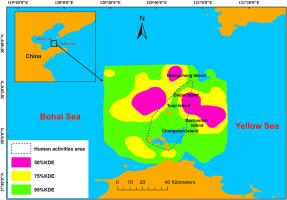
In the realm of marine biodiversity conservation, understanding the dynamics between species' spatial distributions, habitat utilization, and human impacts is crucial. This knowledge is indispensable for marine spatial planning, facilitating the identification and mitigation of conflicts between human activities and the conservation goals of marine ecosystems. The East Asian finless porpoise (Neophocaena asiaeorientalis sunameri), classified as endangered by the IUCN Red List, is the only cetacean routinely observed in the vicinity of the Miaodao Archipelago. To identify key areas for this species and assess the impact of human activities, boat-based surveys were conducted from 2019 to 2023, covering 6220 km2 of the Miaodao Archipelago's waters. These surveys recorded 1610 porpoise sightings over 75 survey days. Spatial analysis revealed that the East Asian finless porpoises primarily frequent three core density areas characterized by high sighting densities. Additionally, intermediate density and habitat range areas were delineated, which are essential for the porpoises' movement between these core regions. The study also analyzed the spatial usage of porpoises within and outside areas affected by human activities, revealing that sighting densities were significantly higher in regions with minimal human impact (p < 0.01). Based on these findings, it is proposed that the areas with high porpoise sighting densities be managed as a unified protected area network. These findings should guide future conservation and management strategies within the National Park to ensure the effective preservation of this endangered species.
期刊介绍:
Marine Environmental Research publishes original research papers on chemical, physical, and biological interactions in the oceans and coastal waters. The journal serves as a forum for new information on biology, chemistry, and toxicology and syntheses that advance understanding of marine environmental processes.
Submission of multidisciplinary studies is encouraged. Studies that utilize experimental approaches to clarify the roles of anthropogenic and natural causes of changes in marine ecosystems are especially welcome, as are those studies that represent new developments of a theoretical or conceptual aspect of marine science. All papers published in this journal are reviewed by qualified peers prior to acceptance and publication. Examples of topics considered to be appropriate for the journal include, but are not limited to, the following:
– The extent, persistence, and consequences of change and the recovery from such change in natural marine systems
– The biochemical, physiological, and ecological consequences of contaminants to marine organisms and ecosystems
– The biogeochemistry of naturally occurring and anthropogenic substances
– Models that describe and predict the above processes
– Monitoring studies, to the extent that their results provide new information on functional processes
– Methodological papers describing improved quantitative techniques for the marine sciences.



 京公网安备 11010802042870号
京ICP备2023020795号-1
京公网安备 11010802042870号
京ICP备2023020795号-1

 分享
分享
 求助内容:
求助内容: 应助结果提醒方式:
 扫码关注我们
