Anna Clebone, P Allan Klock, Ellen Y Choi, Avery Tung
{"title":"Why are critical event checklists not always used in the perioperative setting?: A retrospective survey.","authors":"Anna Clebone, P Allan Klock, Ellen Y Choi, Avery Tung","doi":"10.1371/journal.pone.0314774","DOIUrl":null,"url":null,"abstract":"<p><strong>Introduction: </strong>During surgery and anesthesia, life-threatening critical events, including cardiac arrest, may occur. By facilitating recall of key management steps, suggesting diagnostic possibilities, and providing dose and drug information, cognitive aids may improve clinician performance during such events. In actual clinical practice, however, cognitive aids may be available but inconsistently used. One possibility explaining aid non-use during critical events is a lack of familiarity with how cognitive aids may be helpful. We hypothesized that introduction of critical event cognitive aids along with implementation of cognitive aid resources would change the quantitative incidence of cognitive aid use and qualitative reasons for aid non-use. We surveyed members of an academic anesthesia department before and after implementation of critical event cognitive aid resources.</p><p><strong>Methods: </strong>All anesthesia clinicians at a single academic medical center were surveyed. Participants were surveyed both pre- and post-training with a focused program to introduce critical event cognitive aid resources. Incidences of and reasons for cognitive aid use and non-use were collected and analyzed. Survey responses were compared pre- and post-implementation.</p><p><strong>Results: </strong>The response rate was 64.5%. One-hundred eighty-five reasons for non-use were collected before the focused program and 149 after. Overall, 80% of clinicians had encountered at least one critical event during the study period and use of cognitive aids during all reported events was 7%. Six categories of reasons for non-use were identified: 'Not Available', 'Not Needed', 'No Time', 'Another Person In Charge', 'Used In Another Way', 'No Reason Given'. After implementation, a decrease in the number of respondents who cited availability and who cited 'another person running crisis,' as reasons for non-use was observed (p < 0.001).</p><p><strong>Conclusions: </strong>Implementation of cognitive aids for critical events in an academic anesthesia environment improved the perception of cognitive aid availability and decreased the number of subjects who chose to not use the aid due to another person running the crisis response. Looking at the multiple reasons for cognitive aid non-use may guide implementation, training, and design.</p>","PeriodicalId":20189,"journal":{"name":"PLoS ONE","volume":"20 2","pages":"e0314774"},"PeriodicalIF":2.6000,"publicationDate":"2025-02-28","publicationTypes":"Journal Article","fieldsOfStudy":null,"isOpenAccess":false,"openAccessPdf":"https://www.ncbi.nlm.nih.gov/pmc/articles/PMC11870359/pdf/","citationCount":"0","resultStr":null,"platform":"Semanticscholar","paperid":null,"PeriodicalName":"PLoS ONE","FirstCategoryId":"103","ListUrlMain":"https://doi.org/10.1371/journal.pone.0314774","RegionNum":3,"RegionCategory":"综合性期刊","ArticlePicture":[],"TitleCN":null,"AbstractTextCN":null,"PMCID":null,"EPubDate":"2025/1/1 0:00:00","PubModel":"eCollection","JCR":"Q1","JCRName":"MULTIDISCIPLINARY SCIENCES","Score":null,"Total":0}
引用次数: 0
Abstract
Introduction: During surgery and anesthesia, life-threatening critical events, including cardiac arrest, may occur. By facilitating recall of key management steps, suggesting diagnostic possibilities, and providing dose and drug information, cognitive aids may improve clinician performance during such events. In actual clinical practice, however, cognitive aids may be available but inconsistently used. One possibility explaining aid non-use during critical events is a lack of familiarity with how cognitive aids may be helpful. We hypothesized that introduction of critical event cognitive aids along with implementation of cognitive aid resources would change the quantitative incidence of cognitive aid use and qualitative reasons for aid non-use. We surveyed members of an academic anesthesia department before and after implementation of critical event cognitive aid resources.
Methods: All anesthesia clinicians at a single academic medical center were surveyed. Participants were surveyed both pre- and post-training with a focused program to introduce critical event cognitive aid resources. Incidences of and reasons for cognitive aid use and non-use were collected and analyzed. Survey responses were compared pre- and post-implementation.
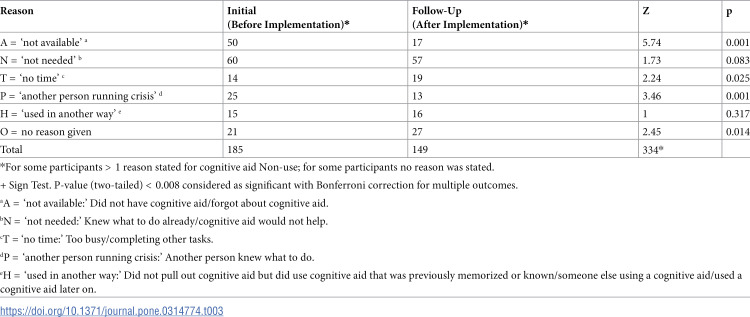
Results: The response rate was 64.5%. One-hundred eighty-five reasons for non-use were collected before the focused program and 149 after. Overall, 80% of clinicians had encountered at least one critical event during the study period and use of cognitive aids during all reported events was 7%. Six categories of reasons for non-use were identified: 'Not Available', 'Not Needed', 'No Time', 'Another Person In Charge', 'Used In Another Way', 'No Reason Given'. After implementation, a decrease in the number of respondents who cited availability and who cited 'another person running crisis,' as reasons for non-use was observed (p < 0.001).
Conclusions: Implementation of cognitive aids for critical events in an academic anesthesia environment improved the perception of cognitive aid availability and decreased the number of subjects who chose to not use the aid due to another person running the crisis response. Looking at the multiple reasons for cognitive aid non-use may guide implementation, training, and design.
期刊介绍:
PLOS ONE is an international, peer-reviewed, open-access, online publication. PLOS ONE welcomes reports on primary research from any scientific discipline. It provides:
* Open-access—freely accessible online, authors retain copyright
* Fast publication times
* Peer review by expert, practicing researchers
* Post-publication tools to indicate quality and impact
* Community-based dialogue on articles
* Worldwide media coverage





 京公网安备 11010802042870号
京ICP备2023020795号-1
京公网安备 11010802042870号
京ICP备2023020795号-1

 分享
分享
 求助内容:
求助内容: 应助结果提醒方式:
 扫码关注我们
