Wenhao Gao, Priyanka Raghavan, Ron Shprints, Connor W. Coley
{"title":"Revealing the Relationship between Publication Bias and Chemical Reactivity with Contrastive Learning","authors":"Wenhao Gao, Priyanka Raghavan, Ron Shprints, Connor W. Coley","doi":"10.1021/jacs.5c01120","DOIUrl":null,"url":null,"abstract":"A synthetic method’s substrate tolerance and generality are often showcased in a “substrate scope” table. However, substrate selection exhibits a frequently discussed publication bias: unsuccessful experiments or low-yielding results are rarely reported. In this work, we explore more deeply the relationship between such a publication bias and chemical reactivity beyond the simple analysis of yield distributions using a novel neural network training strategy, <i>substrate scope contrastive learning</i>. By treating reported substrates as positive samples and nonreported substrates as negative samples, our contrastive learning strategy teaches a model to group molecules within a numerical embedding space, based on historical trends in published substrate scope tables. Training on 20,798 aryl halides in the CAS Content Collection<sup>TM</sup>, spanning thousands of publications from 2010 to 2015, we demonstrate that the learned embeddings exhibit a correlation with physical organic reactivity descriptors through both intuitive visualizations and quantitative regression analyses. Additionally, these embeddings are applicable to various reaction modeling tasks like yield prediction and regioselectivity prediction, underscoring the potential to use historical reaction data as a pretraining task. This work not only presents a chemistry-specific machine learning training strategy to learn from literature data in a new way but also represents a unique approach to uncover trends in chemical reactivity reflected by trends in substrate selection in publications.","PeriodicalId":49,"journal":{"name":"Journal of the American Chemical Society","volume":"15 1","pages":""},"PeriodicalIF":15.6000,"publicationDate":"2025-03-02","publicationTypes":"Journal Article","fieldsOfStudy":null,"isOpenAccess":false,"openAccessPdf":"","citationCount":"0","resultStr":null,"platform":"Semanticscholar","paperid":null,"PeriodicalName":"Journal of the American Chemical Society","FirstCategoryId":"92","ListUrlMain":"https://doi.org/10.1021/jacs.5c01120","RegionNum":1,"RegionCategory":"化学","ArticlePicture":[],"TitleCN":null,"AbstractTextCN":null,"PMCID":null,"EPubDate":"","PubModel":"","JCR":"Q1","JCRName":"CHEMISTRY, MULTIDISCIPLINARY","Score":null,"Total":0}
引用次数: 0
Abstract
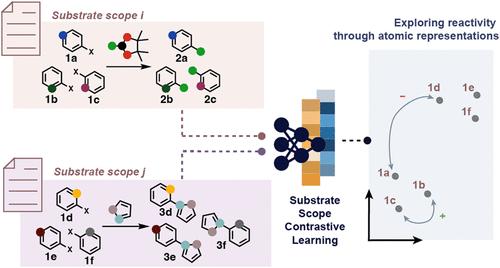
A synthetic method’s substrate tolerance and generality are often showcased in a “substrate scope” table. However, substrate selection exhibits a frequently discussed publication bias: unsuccessful experiments or low-yielding results are rarely reported. In this work, we explore more deeply the relationship between such a publication bias and chemical reactivity beyond the simple analysis of yield distributions using a novel neural network training strategy, substrate scope contrastive learning. By treating reported substrates as positive samples and nonreported substrates as negative samples, our contrastive learning strategy teaches a model to group molecules within a numerical embedding space, based on historical trends in published substrate scope tables. Training on 20,798 aryl halides in the CAS Content CollectionTM, spanning thousands of publications from 2010 to 2015, we demonstrate that the learned embeddings exhibit a correlation with physical organic reactivity descriptors through both intuitive visualizations and quantitative regression analyses. Additionally, these embeddings are applicable to various reaction modeling tasks like yield prediction and regioselectivity prediction, underscoring the potential to use historical reaction data as a pretraining task. This work not only presents a chemistry-specific machine learning training strategy to learn from literature data in a new way but also represents a unique approach to uncover trends in chemical reactivity reflected by trends in substrate selection in publications.
期刊介绍:
The flagship journal of the American Chemical Society, known as the Journal of the American Chemical Society (JACS), has been a prestigious publication since its establishment in 1879. It holds a preeminent position in the field of chemistry and related interdisciplinary sciences. JACS is committed to disseminating cutting-edge research papers, covering a wide range of topics, and encompasses approximately 19,000 pages of Articles, Communications, and Perspectives annually. With a weekly publication frequency, JACS plays a vital role in advancing the field of chemistry by providing essential research.



 京公网安备 11010802042870号
京ICP备2023020795号-1
京公网安备 11010802042870号
京ICP备2023020795号-1

 分享
分享
 求助内容:
求助内容: 应助结果提醒方式:
 扫码关注我们
