Efficiency and mechanism of a novel La-based hydrogel designed for controlling lake eutrophication: Insight from phosphorus release characteristics of sediment, sulfur-driven autotrophic denitrification and cyanobacterial bloom response
Qinyi Chen , Zhicong Wang , Bingjie Zhao , Haining Huang , Yuchen Geng , Yuang Ding , Dunhai Li
{"title":"Efficiency and mechanism of a novel La-based hydrogel designed for controlling lake eutrophication: Insight from phosphorus release characteristics of sediment, sulfur-driven autotrophic denitrification and cyanobacterial bloom response","authors":"Qinyi Chen , Zhicong Wang , Bingjie Zhao , Haining Huang , Yuchen Geng , Yuang Ding , Dunhai Li","doi":"10.1016/j.watres.2025.123431","DOIUrl":null,"url":null,"abstract":"<div><div>Reported nutrient passivators often target single-nutrient control and require complex, energy-intensive processes. In this study, we developed a mesoporous network-structured spherical La-based hydrogel for dual nitrogen and phosphorus control. The hydrogel framework, cross-linked by sodium alginate and lanthanum, encapsulates free La³⁺. The preparation process avoids high-energy techniques and produces no waste, with recyclable reagents. Through adsorption tests, cryo-electron microscopy, and surface area and pore size analysis, we found that the mesoporous structure shields internal free La³⁺, preventing rapid release and minimizing waste of La³⁺. The cross-linked La³⁺ in the spherical framework is released by microbial degradation of the polysaccharide skeleton, inducing anaerobic conditions in the sediment and passivating soluble reactive phosphorus (SRP) simultaneously. The G-units in sodium alginate act as a carbon source, enhancing sulfur-nitrogen cycle coupling, denitrification and reducing NO₃⁻ release. Three-month laboratory simulations and nine-month field <em>in-situ</em> experiments demonstrated significant nutrient control. In the field trials, one month after application, the SRP concentration in the water column decreased to 0.006 mg/L (a 75 % reduction), and the NO₃⁻ concentration decreased to 0.15 mg/L (an 87.5 % reduction), with greatly improved water transparency and no cyanobacterial blooms. This study provides a novel design concept for a nutrient passivator that involves clean production, balanced input-output, and full mobilization of microbial metabolism. The properties, mechanisms, and effects of the material were comprehensively explored and verified from various aspects. This material can provide a new option for controlling endogenous pollution in eutrophic lakes.</div></div>","PeriodicalId":443,"journal":{"name":"Water Research","volume":"279 ","pages":"Article 123431"},"PeriodicalIF":12.4000,"publicationDate":"2025-03-02","publicationTypes":"Journal Article","fieldsOfStudy":null,"isOpenAccess":false,"openAccessPdf":"","citationCount":"0","resultStr":null,"platform":"Semanticscholar","paperid":null,"PeriodicalName":"Water Research","FirstCategoryId":"93","ListUrlMain":"https://www.sciencedirect.com/science/article/pii/S0043135425003446","RegionNum":1,"RegionCategory":"环境科学与生态学","ArticlePicture":[],"TitleCN":null,"AbstractTextCN":null,"PMCID":null,"EPubDate":"","PubModel":"","JCR":"Q1","JCRName":"ENGINEERING, ENVIRONMENTAL","Score":null,"Total":0}
引用次数: 0
Abstract
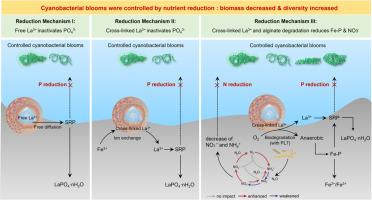
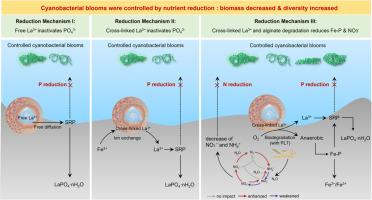
Reported nutrient passivators often target single-nutrient control and require complex, energy-intensive processes. In this study, we developed a mesoporous network-structured spherical La-based hydrogel for dual nitrogen and phosphorus control. The hydrogel framework, cross-linked by sodium alginate and lanthanum, encapsulates free La³⁺. The preparation process avoids high-energy techniques and produces no waste, with recyclable reagents. Through adsorption tests, cryo-electron microscopy, and surface area and pore size analysis, we found that the mesoporous structure shields internal free La³⁺, preventing rapid release and minimizing waste of La³⁺. The cross-linked La³⁺ in the spherical framework is released by microbial degradation of the polysaccharide skeleton, inducing anaerobic conditions in the sediment and passivating soluble reactive phosphorus (SRP) simultaneously. The G-units in sodium alginate act as a carbon source, enhancing sulfur-nitrogen cycle coupling, denitrification and reducing NO₃⁻ release. Three-month laboratory simulations and nine-month field in-situ experiments demonstrated significant nutrient control. In the field trials, one month after application, the SRP concentration in the water column decreased to 0.006 mg/L (a 75 % reduction), and the NO₃⁻ concentration decreased to 0.15 mg/L (an 87.5 % reduction), with greatly improved water transparency and no cyanobacterial blooms. This study provides a novel design concept for a nutrient passivator that involves clean production, balanced input-output, and full mobilization of microbial metabolism. The properties, mechanisms, and effects of the material were comprehensively explored and verified from various aspects. This material can provide a new option for controlling endogenous pollution in eutrophic lakes.
期刊介绍:
Water Research, along with its open access companion journal Water Research X, serves as a platform for publishing original research papers covering various aspects of the science and technology related to the anthropogenic water cycle, water quality, and its management worldwide. The audience targeted by the journal comprises biologists, chemical engineers, chemists, civil engineers, environmental engineers, limnologists, and microbiologists. The scope of the journal include:
•Treatment processes for water and wastewaters (municipal, agricultural, industrial, and on-site treatment), including resource recovery and residuals management;
•Urban hydrology including sewer systems, stormwater management, and green infrastructure;
•Drinking water treatment and distribution;
•Potable and non-potable water reuse;
•Sanitation, public health, and risk assessment;
•Anaerobic digestion, solid and hazardous waste management, including source characterization and the effects and control of leachates and gaseous emissions;
•Contaminants (chemical, microbial, anthropogenic particles such as nanoparticles or microplastics) and related water quality sensing, monitoring, fate, and assessment;
•Anthropogenic impacts on inland, tidal, coastal and urban waters, focusing on surface and ground waters, and point and non-point sources of pollution;
•Environmental restoration, linked to surface water, groundwater and groundwater remediation;
•Analysis of the interfaces between sediments and water, and between water and atmosphere, focusing specifically on anthropogenic impacts;
•Mathematical modelling, systems analysis, machine learning, and beneficial use of big data related to the anthropogenic water cycle;
•Socio-economic, policy, and regulations studies.



 京公网安备 11010802042870号
京ICP备2023020795号-1
京公网安备 11010802042870号
京ICP备2023020795号-1

 分享
分享
 求助内容:
求助内容: 应助结果提醒方式:
 扫码关注我们
