Jueun Koh, Sohee Kim, Gyeonghye Yim, Jihun Yu, Jaehwan Kim, Sang Hoon Joo*, Hongje Jang* and Young Jin Sa*,
{"title":"Pt-MoOx Hybrid Electrocatalysts Modulating Local Environment for Enhanced Activity toward Hydrogen Electrocatalysis","authors":"Jueun Koh, Sohee Kim, Gyeonghye Yim, Jihun Yu, Jaehwan Kim, Sang Hoon Joo*, Hongje Jang* and Young Jin Sa*, ","doi":"10.1021/acsmaterialslett.4c02409","DOIUrl":null,"url":null,"abstract":"<p >The alkaline hydrogen evolution reaction (HER) and hydrogen oxidation reaction (HOR) are crucial for achieving high efficiency in anion-exchange membrane water electrolyzers and fuel cells. While Pt is highly active for HER/HOR at low pH, its activity decreases ∼200-fold under alkaline conditions due to stronger hydrogen binding. Manipulating the local environment around the electrode is an effective but underexplored strategy in hydrogen electrocatalysis. In this study, we prepared nanohybrid electrocatalysts comprising Pt nanoparticles and Mo oxides (Pt-MoO<sub><i>x</i></sub>). Pt-MoO<sub><i>x</i></sub> exhibited a 2.6-fold increase in alkaline HER/HOR activity compared to that of Pt black. It demonstrated a low overpotential of 65 mV at −10 mA cm<sup>–2</sup>, with stability for 3 days. The enhanced reaction kinetics were attributed to the decreased hydrogen binding strength by MoO<sub><i>x</i></sub> and stabilized local environment resulting from H+/H<sub>2</sub>O exchange equilibria by the acidic Mo−OH species. This work provides an alternative design strategy for fine-tuning electrosorption properties.</p>","PeriodicalId":19,"journal":{"name":"ACS Materials Letters","volume":"7 3","pages":"707–714 707–714"},"PeriodicalIF":8.7000,"publicationDate":"2025-01-24","publicationTypes":"Journal Article","fieldsOfStudy":null,"isOpenAccess":false,"openAccessPdf":"","citationCount":"0","resultStr":null,"platform":"Semanticscholar","paperid":null,"PeriodicalName":"ACS Materials Letters","FirstCategoryId":"92","ListUrlMain":"https://pubs.acs.org/doi/10.1021/acsmaterialslett.4c02409","RegionNum":1,"RegionCategory":"化学","ArticlePicture":[],"TitleCN":null,"AbstractTextCN":null,"PMCID":null,"EPubDate":"","PubModel":"","JCR":"Q1","JCRName":"MATERIALS SCIENCE, MULTIDISCIPLINARY","Score":null,"Total":0}
引用次数: 0
Abstract
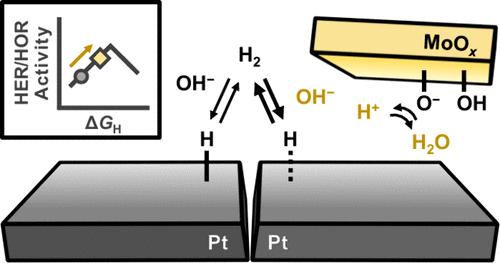
The alkaline hydrogen evolution reaction (HER) and hydrogen oxidation reaction (HOR) are crucial for achieving high efficiency in anion-exchange membrane water electrolyzers and fuel cells. While Pt is highly active for HER/HOR at low pH, its activity decreases ∼200-fold under alkaline conditions due to stronger hydrogen binding. Manipulating the local environment around the electrode is an effective but underexplored strategy in hydrogen electrocatalysis. In this study, we prepared nanohybrid electrocatalysts comprising Pt nanoparticles and Mo oxides (Pt-MoOx). Pt-MoOx exhibited a 2.6-fold increase in alkaline HER/HOR activity compared to that of Pt black. It demonstrated a low overpotential of 65 mV at −10 mA cm–2, with stability for 3 days. The enhanced reaction kinetics were attributed to the decreased hydrogen binding strength by MoOx and stabilized local environment resulting from H+/H2O exchange equilibria by the acidic Mo−OH species. This work provides an alternative design strategy for fine-tuning electrosorption properties.
期刊介绍:
ACS Materials Letters is a journal that publishes high-quality and urgent papers at the forefront of fundamental and applied research in the field of materials science. It aims to bridge the gap between materials and other disciplines such as chemistry, engineering, and biology. The journal encourages multidisciplinary and innovative research that addresses global challenges. Papers submitted to ACS Materials Letters should clearly demonstrate the need for rapid disclosure of key results. The journal is interested in various areas including the design, synthesis, characterization, and evaluation of emerging materials, understanding the relationships between structure, property, and performance, as well as developing materials for applications in energy, environment, biomedical, electronics, and catalysis. The journal has a 2-year impact factor of 11.4 and is dedicated to publishing transformative materials research with fast processing times. The editors and staff of ACS Materials Letters actively participate in major scientific conferences and engage closely with readers and authors. The journal also maintains an active presence on social media to provide authors with greater visibility.



 京公网安备 11010802042870号
京ICP备2023020795号-1
京公网安备 11010802042870号
京ICP备2023020795号-1

 分享
分享
 求助内容:
求助内容: 应助结果提醒方式:
 扫码关注我们
