{"title":"Zinc Stabilized Cation Ordered Chalcopyrite Thin Film for Enhanced Thermoelectric Power Generation Near Room Temperature","authors":"Hong Pang, Cédric Bourgès, Naohito Tsujii, Jha Rajveer, Naoyuki Kawamoto, Fumihiko Ichihara, Takahiro Baba, Tetsuya Baba, Naoki Sato, Yuichi Yamasaki and Takao Mori*, ","doi":"10.1021/acsmaterialslett.4c01898","DOIUrl":null,"url":null,"abstract":"<p >Multinary sulfides represent a significant family of semiconductors because of their low cost and promising performance, yet controlling their composition is challenging. CuFeS<sub>2</sub> thin films are particularly attractive because of their great potential in thermoelectricity and photovoltaics. Herein we reveal the newest finding that Zn promotes the cation ordering and stabilizes the chalcopyrite CuFeS<sub>2</sub> film, preventing the reverse transformation to wurtzite with a random distribution of Cu–Fe at high temperature. The thermoelectric properties of chalcopyrite thin films are investigated as a function of Zn content, resulting in an optimized power factor of 0.168 mW/m·K<sup>2</sup> at room temperature, outperforming any CuFeS<sub>2</sub> thin films ever reported. For the first time, synchrotron-based <i>in situ</i> X-ray diffraction and X-ray absorption fine structure confirm the phase transition, offering insights into the isomeric structure of CuFeS<sub>2</sub> and the role of Zn. The in-depth understanding of cation-ordering and phase transformation between CuFeS<sub>2</sub> polymorphs might impact the multinary sulfide film fabrication and improvement in efficiency of renewable energy applications.</p>","PeriodicalId":19,"journal":{"name":"ACS Materials Letters","volume":"7 3","pages":"715–723 715–723"},"PeriodicalIF":8.7000,"publicationDate":"2025-01-25","publicationTypes":"Journal Article","fieldsOfStudy":null,"isOpenAccess":false,"openAccessPdf":"","citationCount":"0","resultStr":null,"platform":"Semanticscholar","paperid":null,"PeriodicalName":"ACS Materials Letters","FirstCategoryId":"92","ListUrlMain":"https://pubs.acs.org/doi/10.1021/acsmaterialslett.4c01898","RegionNum":1,"RegionCategory":"化学","ArticlePicture":[],"TitleCN":null,"AbstractTextCN":null,"PMCID":null,"EPubDate":"","PubModel":"","JCR":"Q1","JCRName":"MATERIALS SCIENCE, MULTIDISCIPLINARY","Score":null,"Total":0}
引用次数: 0
Abstract
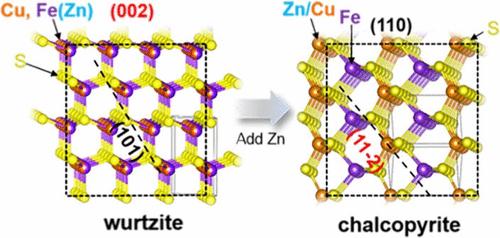
Multinary sulfides represent a significant family of semiconductors because of their low cost and promising performance, yet controlling their composition is challenging. CuFeS2 thin films are particularly attractive because of their great potential in thermoelectricity and photovoltaics. Herein we reveal the newest finding that Zn promotes the cation ordering and stabilizes the chalcopyrite CuFeS2 film, preventing the reverse transformation to wurtzite with a random distribution of Cu–Fe at high temperature. The thermoelectric properties of chalcopyrite thin films are investigated as a function of Zn content, resulting in an optimized power factor of 0.168 mW/m·K2 at room temperature, outperforming any CuFeS2 thin films ever reported. For the first time, synchrotron-based in situ X-ray diffraction and X-ray absorption fine structure confirm the phase transition, offering insights into the isomeric structure of CuFeS2 and the role of Zn. The in-depth understanding of cation-ordering and phase transformation between CuFeS2 polymorphs might impact the multinary sulfide film fabrication and improvement in efficiency of renewable energy applications.
期刊介绍:
ACS Materials Letters is a journal that publishes high-quality and urgent papers at the forefront of fundamental and applied research in the field of materials science. It aims to bridge the gap between materials and other disciplines such as chemistry, engineering, and biology. The journal encourages multidisciplinary and innovative research that addresses global challenges. Papers submitted to ACS Materials Letters should clearly demonstrate the need for rapid disclosure of key results. The journal is interested in various areas including the design, synthesis, characterization, and evaluation of emerging materials, understanding the relationships between structure, property, and performance, as well as developing materials for applications in energy, environment, biomedical, electronics, and catalysis. The journal has a 2-year impact factor of 11.4 and is dedicated to publishing transformative materials research with fast processing times. The editors and staff of ACS Materials Letters actively participate in major scientific conferences and engage closely with readers and authors. The journal also maintains an active presence on social media to provide authors with greater visibility.



 京公网安备 11010802042870号
京ICP备2023020795号-1
京公网安备 11010802042870号
京ICP备2023020795号-1

 分享
分享
 求助内容:
求助内容: 应助结果提醒方式:
 扫码关注我们
