Haiyang Ren, Peihui Li, Jie Hao, Wan Xiong, Linqi Pei, Boyu Wang, Cong Zhao, Suhang He, Shan Jin*, Jingtao Lü*, Jinying Wang*, Chuancheng Jia* and Xuefeng Guo*,
{"title":"Unveiling Sophisticated Intermolecular van der Waals Interactions at the Single-Molecule Level","authors":"Haiyang Ren, Peihui Li, Jie Hao, Wan Xiong, Linqi Pei, Boyu Wang, Cong Zhao, Suhang He, Shan Jin*, Jingtao Lü*, Jinying Wang*, Chuancheng Jia* and Xuefeng Guo*, ","doi":"10.1021/acsmaterialslett.5c00047","DOIUrl":null,"url":null,"abstract":"<p >Weak yet ubiquitous van der Waals (vdW) interactions play an essential role in shaping the structure, stability, and functionality of materials. Particularly, intermolecular vdW interactions profoundly impact molecular stacking orders and electronic properties. However, comprehending and precisely controlling intermolecular vdW interactions has posed a longstanding challenge. Here, we employ a combination of single-molecule electrical measurements and theoretical calculations to dissect and further regulate sophisticated vdW interactions in a single-dimer junction. Specifically, by introducing an aminomethyl group, the electrostatic force resulting from the dipole–dipole interaction predominantly dictates the bistable conformation and conductance of benzylamine dimers. As molecular π-conjugation increases, the influence of exchange and dispersion interactions is significantly amplified in (9H-fluoren-2-yl)methylamine dimers. Furthermore, the application of electric fields effectively modulates the vdW interactions in dimers, impacting their structures and conductance. Investigating these vdW interactions yields profound insights into the fundamental principles governing the behavior of chemical and biological systems.</p>","PeriodicalId":19,"journal":{"name":"ACS Materials Letters","volume":"7 3","pages":"754–760 754–760"},"PeriodicalIF":8.7000,"publicationDate":"2025-01-30","publicationTypes":"Journal Article","fieldsOfStudy":null,"isOpenAccess":false,"openAccessPdf":"","citationCount":"0","resultStr":null,"platform":"Semanticscholar","paperid":null,"PeriodicalName":"ACS Materials Letters","FirstCategoryId":"92","ListUrlMain":"https://pubs.acs.org/doi/10.1021/acsmaterialslett.5c00047","RegionNum":1,"RegionCategory":"化学","ArticlePicture":[],"TitleCN":null,"AbstractTextCN":null,"PMCID":null,"EPubDate":"","PubModel":"","JCR":"Q1","JCRName":"MATERIALS SCIENCE, MULTIDISCIPLINARY","Score":null,"Total":0}
引用次数: 0
Abstract
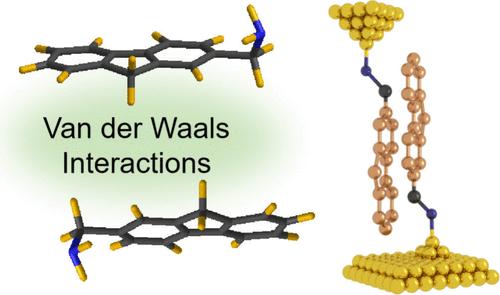
Weak yet ubiquitous van der Waals (vdW) interactions play an essential role in shaping the structure, stability, and functionality of materials. Particularly, intermolecular vdW interactions profoundly impact molecular stacking orders and electronic properties. However, comprehending and precisely controlling intermolecular vdW interactions has posed a longstanding challenge. Here, we employ a combination of single-molecule electrical measurements and theoretical calculations to dissect and further regulate sophisticated vdW interactions in a single-dimer junction. Specifically, by introducing an aminomethyl group, the electrostatic force resulting from the dipole–dipole interaction predominantly dictates the bistable conformation and conductance of benzylamine dimers. As molecular π-conjugation increases, the influence of exchange and dispersion interactions is significantly amplified in (9H-fluoren-2-yl)methylamine dimers. Furthermore, the application of electric fields effectively modulates the vdW interactions in dimers, impacting their structures and conductance. Investigating these vdW interactions yields profound insights into the fundamental principles governing the behavior of chemical and biological systems.
期刊介绍:
ACS Materials Letters is a journal that publishes high-quality and urgent papers at the forefront of fundamental and applied research in the field of materials science. It aims to bridge the gap between materials and other disciplines such as chemistry, engineering, and biology. The journal encourages multidisciplinary and innovative research that addresses global challenges. Papers submitted to ACS Materials Letters should clearly demonstrate the need for rapid disclosure of key results. The journal is interested in various areas including the design, synthesis, characterization, and evaluation of emerging materials, understanding the relationships between structure, property, and performance, as well as developing materials for applications in energy, environment, biomedical, electronics, and catalysis. The journal has a 2-year impact factor of 11.4 and is dedicated to publishing transformative materials research with fast processing times. The editors and staff of ACS Materials Letters actively participate in major scientific conferences and engage closely with readers and authors. The journal also maintains an active presence on social media to provide authors with greater visibility.



 京公网安备 11010802042870号
京ICP备2023020795号-1
京公网安备 11010802042870号
京ICP备2023020795号-1

 分享
分享
 求助内容:
求助内容: 应助结果提醒方式:
 扫码关注我们
