Rongyi Kuang, Huiwang Lian, Meng Gao, Yunfei Zhu, Simin Gu, Liangying Shen, Xiaofeng Lin, Lin Huang, Chong-Geng Ma, Andrzej Suchocki, Yaroslav Zhydachevskyy, Bo-Mei Liu* and Jing Wang*,
{"title":"Integrated Multifunctional Platform with X-ray and Near-Infrared Driven Photochromic Behavior for Reversible Quad-Mode Optical Imaging","authors":"Rongyi Kuang, Huiwang Lian, Meng Gao, Yunfei Zhu, Simin Gu, Liangying Shen, Xiaofeng Lin, Lin Huang, Chong-Geng Ma, Andrzej Suchocki, Yaroslav Zhydachevskyy, Bo-Mei Liu* and Jing Wang*, ","doi":"10.1021/acsmaterialslett.4c02468","DOIUrl":null,"url":null,"abstract":"<p >Noninvasive optical imaging techniques, including X-ray and near-infrared (NIR), hold significant value for scientific research and industrial applications. However, there is still a lack of a convenient platform that integrates X-ray imaging and NIR imaging in both bright- and dark-field applications. Here, a rare-earth ion-doped LaNbO<sub>4</sub>:Pr,Er photochromic luminescent material is developed, integrating X-ray-induced coloration, NIR-induced bleaching, photoluminescence, and luminescence modulation. Under alternating X-ray and NIR light irradiation, the reflectivity and luminescence intensity can be reversibly tuned to display four optical states: white, black, dark, and bright. By utilizing the switchable optical states, quad-mode imaging of X-ray and NIR in bright and dark fields is achieved. NIR-induced photobleaching imaging, when employed as adjuncts to X-ray-induced photochromic imaging, has the potential to significantly reduce radiation-induced damage to biological tissues. These results provide unique insights for designing advanced materials and photonic storage technologies toward advanced multiwavelength, multienvironment, and multimode noninvasive imaging.</p>","PeriodicalId":19,"journal":{"name":"ACS Materials Letters","volume":"7 3","pages":"820–828 820–828"},"PeriodicalIF":8.7000,"publicationDate":"2025-01-31","publicationTypes":"Journal Article","fieldsOfStudy":null,"isOpenAccess":false,"openAccessPdf":"","citationCount":"0","resultStr":null,"platform":"Semanticscholar","paperid":null,"PeriodicalName":"ACS Materials Letters","FirstCategoryId":"92","ListUrlMain":"https://pubs.acs.org/doi/10.1021/acsmaterialslett.4c02468","RegionNum":1,"RegionCategory":"化学","ArticlePicture":[],"TitleCN":null,"AbstractTextCN":null,"PMCID":null,"EPubDate":"","PubModel":"","JCR":"Q1","JCRName":"MATERIALS SCIENCE, MULTIDISCIPLINARY","Score":null,"Total":0}
引用次数: 0
Abstract
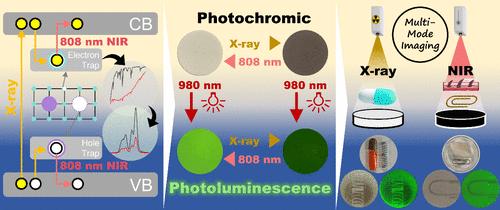
Noninvasive optical imaging techniques, including X-ray and near-infrared (NIR), hold significant value for scientific research and industrial applications. However, there is still a lack of a convenient platform that integrates X-ray imaging and NIR imaging in both bright- and dark-field applications. Here, a rare-earth ion-doped LaNbO4:Pr,Er photochromic luminescent material is developed, integrating X-ray-induced coloration, NIR-induced bleaching, photoluminescence, and luminescence modulation. Under alternating X-ray and NIR light irradiation, the reflectivity and luminescence intensity can be reversibly tuned to display four optical states: white, black, dark, and bright. By utilizing the switchable optical states, quad-mode imaging of X-ray and NIR in bright and dark fields is achieved. NIR-induced photobleaching imaging, when employed as adjuncts to X-ray-induced photochromic imaging, has the potential to significantly reduce radiation-induced damage to biological tissues. These results provide unique insights for designing advanced materials and photonic storage technologies toward advanced multiwavelength, multienvironment, and multimode noninvasive imaging.
期刊介绍:
ACS Materials Letters is a journal that publishes high-quality and urgent papers at the forefront of fundamental and applied research in the field of materials science. It aims to bridge the gap between materials and other disciplines such as chemistry, engineering, and biology. The journal encourages multidisciplinary and innovative research that addresses global challenges. Papers submitted to ACS Materials Letters should clearly demonstrate the need for rapid disclosure of key results. The journal is interested in various areas including the design, synthesis, characterization, and evaluation of emerging materials, understanding the relationships between structure, property, and performance, as well as developing materials for applications in energy, environment, biomedical, electronics, and catalysis. The journal has a 2-year impact factor of 11.4 and is dedicated to publishing transformative materials research with fast processing times. The editors and staff of ACS Materials Letters actively participate in major scientific conferences and engage closely with readers and authors. The journal also maintains an active presence on social media to provide authors with greater visibility.



 京公网安备 11010802042870号
京ICP备2023020795号-1
京公网安备 11010802042870号
京ICP备2023020795号-1

 分享
分享
 求助内容:
求助内容: 应助结果提醒方式:
 扫码关注我们
