{"title":"Regulating Benzothiadiazole-Based Covalent–Organic Frameworks to Boost Hydrogen Peroxide Photosynthesis and Pathogenic Bacterial Elimination","authors":"Wenbin Zhong, Wang-Kang Han, Shuai Bi, Xinkun Ma, Chu Wang, Yinglong Wu, Ting He, Zidan Zhang, Jingjing Guo and Yanli Zhao*, ","doi":"10.1021/acsmaterialslett.4c02312","DOIUrl":null,"url":null,"abstract":"<p >Benzothiadiazole offers an effective charge transfer channel and serves as a suitable unit for constructing donor–acceptor (D–A) covalent–organic frameworks (COFs), yet systematic investigation on benzothiadiazole-containing COFs is still rare. Herein, we construct four highly crystalline COFs and carefully explore their H<sub>2</sub>O<sub>2</sub> photosynthetic efficiency. Changing the donor unit from phenyl to naphthalenyl group effectively enhances the H<sub>2</sub>O<sub>2</sub> yield rate by nearly 3-fold, highlighting the importance of regulating D–A configuration. The optimized COF (BTpaNda) presents a high H<sub>2</sub>O<sub>2</sub> yield rate of 10,122 μmol g<sup>–1</sup> h<sup>–1</sup>. Theoretical calculations reveal that BTpaNda COF has the lowest Gibbs free energy in rate-determining oxygen-containing intermediate formation, corroborating the superb H<sub>2</sub>O<sub>2</sub> photosynthesis. Furthermore, the BTpaNda COF demonstrates good stability and excellent bacterial elimination effects with the involvement of oxygen-containing intermediates. Thus, the structural regulation of benzothiadiazole-containing COFs on photocatalytic H<sub>2</sub>O<sub>2</sub> generation and cascade bacterial elimination with oxygen-containing intermediate generation is demonstrated.</p>","PeriodicalId":19,"journal":{"name":"ACS Materials Letters","volume":"7 3","pages":"811–819 811–819"},"PeriodicalIF":8.7000,"publicationDate":"2025-01-31","publicationTypes":"Journal Article","fieldsOfStudy":null,"isOpenAccess":false,"openAccessPdf":"","citationCount":"0","resultStr":null,"platform":"Semanticscholar","paperid":null,"PeriodicalName":"ACS Materials Letters","FirstCategoryId":"92","ListUrlMain":"https://pubs.acs.org/doi/10.1021/acsmaterialslett.4c02312","RegionNum":1,"RegionCategory":"化学","ArticlePicture":[],"TitleCN":null,"AbstractTextCN":null,"PMCID":null,"EPubDate":"","PubModel":"","JCR":"Q1","JCRName":"MATERIALS SCIENCE, MULTIDISCIPLINARY","Score":null,"Total":0}
引用次数: 0
Abstract
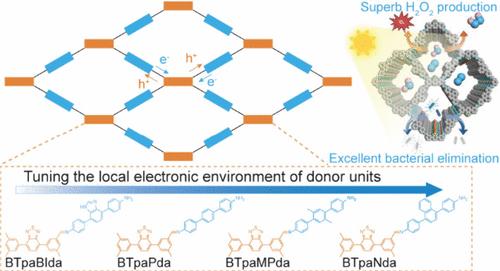
Benzothiadiazole offers an effective charge transfer channel and serves as a suitable unit for constructing donor–acceptor (D–A) covalent–organic frameworks (COFs), yet systematic investigation on benzothiadiazole-containing COFs is still rare. Herein, we construct four highly crystalline COFs and carefully explore their H2O2 photosynthetic efficiency. Changing the donor unit from phenyl to naphthalenyl group effectively enhances the H2O2 yield rate by nearly 3-fold, highlighting the importance of regulating D–A configuration. The optimized COF (BTpaNda) presents a high H2O2 yield rate of 10,122 μmol g–1 h–1. Theoretical calculations reveal that BTpaNda COF has the lowest Gibbs free energy in rate-determining oxygen-containing intermediate formation, corroborating the superb H2O2 photosynthesis. Furthermore, the BTpaNda COF demonstrates good stability and excellent bacterial elimination effects with the involvement of oxygen-containing intermediates. Thus, the structural regulation of benzothiadiazole-containing COFs on photocatalytic H2O2 generation and cascade bacterial elimination with oxygen-containing intermediate generation is demonstrated.
期刊介绍:
ACS Materials Letters is a journal that publishes high-quality and urgent papers at the forefront of fundamental and applied research in the field of materials science. It aims to bridge the gap between materials and other disciplines such as chemistry, engineering, and biology. The journal encourages multidisciplinary and innovative research that addresses global challenges. Papers submitted to ACS Materials Letters should clearly demonstrate the need for rapid disclosure of key results. The journal is interested in various areas including the design, synthesis, characterization, and evaluation of emerging materials, understanding the relationships between structure, property, and performance, as well as developing materials for applications in energy, environment, biomedical, electronics, and catalysis. The journal has a 2-year impact factor of 11.4 and is dedicated to publishing transformative materials research with fast processing times. The editors and staff of ACS Materials Letters actively participate in major scientific conferences and engage closely with readers and authors. The journal also maintains an active presence on social media to provide authors with greater visibility.



 京公网安备 11010802042870号
京ICP备2023020795号-1
京公网安备 11010802042870号
京ICP备2023020795号-1

 分享
分享
 求助内容:
求助内容: 应助结果提醒方式:
 扫码关注我们
