Xiaohui Ye , Miaomiao Wei , Zhiyuan Yang , Yurong Li , Xi Zheng , Mengzhen Chen , Shubin Huang , Yi He , Jiachuan Liang , Mengyue Gu , Liang Guo , Jinying Zhang
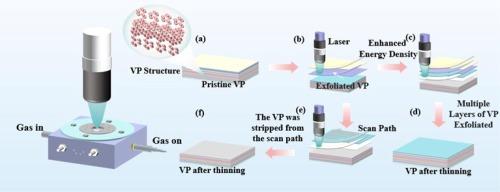
{"title":"Solid-state thinning of violet phosphorus by femtosecond laser and facile recognition of its thickness","authors":"Xiaohui Ye , Miaomiao Wei , Zhiyuan Yang , Yurong Li , Xi Zheng , Mengzhen Chen , Shubin Huang , Yi He , Jiachuan Liang , Mengyue Gu , Liang Guo , Jinying Zhang","doi":"10.1016/j.optlastec.2025.112698","DOIUrl":null,"url":null,"abstract":"<div><div>Violet Phosphorus (VP), as a burgeoning layered material, has numerous remarkable merits, which strongly depend on its thicknesses. It is significant to control and recognize the thickness in a facile way for widely applications. This paper employed 515 nm femtosecond (fs) laser to control VP thickness in solid state precisely. The VP nanosheets were exfoliated from 500 nm to 80 nm at a span of dozens of nanometers. The mechanism of VP exfoliation was the interaction of laser and VP. The laser decreased the interlayer Van der Waals force and increases the lattice vibration, leading to the decomposition of VP. Various approaches were conducted to characterize the thickness of VP quantitatively and qualitatively. The strict correspondence was established between RGB in optical images and layer number of VP. It can easily obtain the thickness information only by optical images rather than expensive and time-consuming atomic force microscopy (AFM). This work develops a novel approach to exfoliate VP in solid state for high-end applications, and provides a facile thought to quantitative characterize the VP thicknesses in an efficient and low-cost mean.</div></div>","PeriodicalId":19511,"journal":{"name":"Optics and Laser Technology","volume":"186 ","pages":"Article 112698"},"PeriodicalIF":5.0000,"publicationDate":"2025-03-03","publicationTypes":"Journal Article","fieldsOfStudy":null,"isOpenAccess":false,"openAccessPdf":"","citationCount":"0","resultStr":null,"platform":"Semanticscholar","paperid":null,"PeriodicalName":"Optics and Laser Technology","FirstCategoryId":"101","ListUrlMain":"https://www.sciencedirect.com/science/article/pii/S0030399225002865","RegionNum":2,"RegionCategory":"物理与天体物理","ArticlePicture":[],"TitleCN":null,"AbstractTextCN":null,"PMCID":null,"EPubDate":"","PubModel":"","JCR":"Q1","JCRName":"OPTICS","Score":null,"Total":0}
引用次数: 0
Abstract
Violet Phosphorus (VP), as a burgeoning layered material, has numerous remarkable merits, which strongly depend on its thicknesses. It is significant to control and recognize the thickness in a facile way for widely applications. This paper employed 515 nm femtosecond (fs) laser to control VP thickness in solid state precisely. The VP nanosheets were exfoliated from 500 nm to 80 nm at a span of dozens of nanometers. The mechanism of VP exfoliation was the interaction of laser and VP. The laser decreased the interlayer Van der Waals force and increases the lattice vibration, leading to the decomposition of VP. Various approaches were conducted to characterize the thickness of VP quantitatively and qualitatively. The strict correspondence was established between RGB in optical images and layer number of VP. It can easily obtain the thickness information only by optical images rather than expensive and time-consuming atomic force microscopy (AFM). This work develops a novel approach to exfoliate VP in solid state for high-end applications, and provides a facile thought to quantitative characterize the VP thicknesses in an efficient and low-cost mean.
期刊介绍:
Optics & Laser Technology aims to provide a vehicle for the publication of a broad range of high quality research and review papers in those fields of scientific and engineering research appertaining to the development and application of the technology of optics and lasers. Papers describing original work in these areas are submitted to rigorous refereeing prior to acceptance for publication.
The scope of Optics & Laser Technology encompasses, but is not restricted to, the following areas:
•development in all types of lasers
•developments in optoelectronic devices and photonics
•developments in new photonics and optical concepts
•developments in conventional optics, optical instruments and components
•techniques of optical metrology, including interferometry and optical fibre sensors
•LIDAR and other non-contact optical measurement techniques, including optical methods in heat and fluid flow
•applications of lasers to materials processing, optical NDT display (including holography) and optical communication
•research and development in the field of laser safety including studies of hazards resulting from the applications of lasers (laser safety, hazards of laser fume)
•developments in optical computing and optical information processing
•developments in new optical materials
•developments in new optical characterization methods and techniques
•developments in quantum optics
•developments in light assisted micro and nanofabrication methods and techniques
•developments in nanophotonics and biophotonics
•developments in imaging processing and systems



 京公网安备 11010802042870号
京ICP备2023020795号-1
京公网安备 11010802042870号
京ICP备2023020795号-1

 分享
分享
 求助内容:
求助内容: 应助结果提醒方式:
 扫码关注我们
