Yuyang He, Junmei Li, Evan Siemann, Bo Li, Yunjian Xu, Yi Wang
{"title":"Plant Invasion Increases Soil Microbial Biomass Carbon: Meta-Analysis and Empirical Tests","authors":"Yuyang He, Junmei Li, Evan Siemann, Bo Li, Yunjian Xu, Yi Wang","doi":"10.1111/gcb.70109","DOIUrl":null,"url":null,"abstract":"<div>\n \n <p>Soil organic carbon (SOC) is a vital component of the global carbon cycle. SOC influences soil fertility and structure and is controlled by various factors, including land use, land management practices, and climate change. Biological invasion is a significant yet controversial factor that can alter SOC levels. We conducted a meta-analysis of 445 observations from 61 published reports and followed up with field surveys to clarify the impact of plant invasion on SOC. Our results indicated that plant invasion leads to a 29% increase in microbial biomass carbon (MBC), which is one of the key fractions of SOC. Specifically, among different ecosystems, plant invasion caused MBC increases of 59% in estuaries, 59% in alluvial land, 53% in wetlands, and 80% in orchards. Furthermore, invasion by plants from the Asteraceae family resulted in a 33% increase in MBC, whereas invasion by plants from the Lythraceae family caused a 72% increase in MBC. Our field survey also revealed that plant invasion elevated the soil MBC content relative to the occurrence of native plants or bare ground. Overall, these findings suggest that plant invasion impacts soil carbon, especially by increasing MBC, which may in turn affect future invasions. These effects are influenced by the type of invasive species, ecosystem type, and soil layer depth, highlighting the complex role of biological invasion in the global carbon cycle.</p>\n </div>","PeriodicalId":175,"journal":{"name":"Global Change Biology","volume":"31 3","pages":""},"PeriodicalIF":12.0000,"publicationDate":"2025-03-02","publicationTypes":"Journal Article","fieldsOfStudy":null,"isOpenAccess":false,"openAccessPdf":"","citationCount":"0","resultStr":null,"platform":"Semanticscholar","paperid":null,"PeriodicalName":"Global Change Biology","FirstCategoryId":"93","ListUrlMain":"https://onlinelibrary.wiley.com/doi/10.1111/gcb.70109","RegionNum":1,"RegionCategory":"环境科学与生态学","ArticlePicture":[],"TitleCN":null,"AbstractTextCN":null,"PMCID":null,"EPubDate":"","PubModel":"","JCR":"Q1","JCRName":"BIODIVERSITY CONSERVATION","Score":null,"Total":0}
引用次数: 0
Abstract
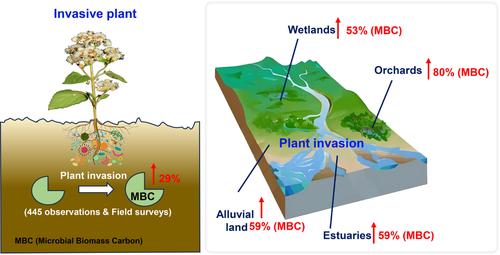
Soil organic carbon (SOC) is a vital component of the global carbon cycle. SOC influences soil fertility and structure and is controlled by various factors, including land use, land management practices, and climate change. Biological invasion is a significant yet controversial factor that can alter SOC levels. We conducted a meta-analysis of 445 observations from 61 published reports and followed up with field surveys to clarify the impact of plant invasion on SOC. Our results indicated that plant invasion leads to a 29% increase in microbial biomass carbon (MBC), which is one of the key fractions of SOC. Specifically, among different ecosystems, plant invasion caused MBC increases of 59% in estuaries, 59% in alluvial land, 53% in wetlands, and 80% in orchards. Furthermore, invasion by plants from the Asteraceae family resulted in a 33% increase in MBC, whereas invasion by plants from the Lythraceae family caused a 72% increase in MBC. Our field survey also revealed that plant invasion elevated the soil MBC content relative to the occurrence of native plants or bare ground. Overall, these findings suggest that plant invasion impacts soil carbon, especially by increasing MBC, which may in turn affect future invasions. These effects are influenced by the type of invasive species, ecosystem type, and soil layer depth, highlighting the complex role of biological invasion in the global carbon cycle.
期刊介绍:
Global Change Biology is an environmental change journal committed to shaping the future and addressing the world's most pressing challenges, including sustainability, climate change, environmental protection, food and water safety, and global health.
Dedicated to fostering a profound understanding of the impacts of global change on biological systems and offering innovative solutions, the journal publishes a diverse range of content, including primary research articles, technical advances, research reviews, reports, opinions, perspectives, commentaries, and letters. Starting with the 2024 volume, Global Change Biology will transition to an online-only format, enhancing accessibility and contributing to the evolution of scholarly communication.



 京公网安备 11010802042870号
京ICP备2023020795号-1
京公网安备 11010802042870号
京ICP备2023020795号-1

 分享
分享
 求助内容:
求助内容: 应助结果提醒方式:
 扫码关注我们
