{"title":"Effect of perioperative individualized nutrition intervention on pancreatic surgery outcomes: a prospective single-center study.","authors":"Qing Chen, Chunhong Xiao, Xusangni Li, Qian Li, Huishuang Wu, Meiping Wang, Weixuan Hong, Aiwen Huang","doi":"10.1186/s41043-025-00758-w","DOIUrl":null,"url":null,"abstract":"<p><strong>Background: </strong>There is currently a lack of reports on prospective randomized controlled trials (RCTs) focused on personalized nutritional support in pancreatic surgery. This study aimed to evaluate the impact of perioperative individualized nutritional intervention on the outcomes of patients undergoing pancreatic surgery within the framework of enhanced recovery after surgery (ERAS).</p><p><strong>Methods: </strong>This prospective cohort study enrolled 96 patients, randomly divided into a trial group and a control group in a 1:1 ratio. The primary endpoint was the change in body composition, including body cell mass (BCM), fat-free mass (FFM), skeletal muscle mass (SMM), and phase angle (PA). Secondary outcomes included time to first postoperative flatus, time to first bowel movement, length of hospital stay, and nutritional indicators.</p><p><strong>Results: </strong>No significant differences were observed in the demographic characteristics between the two groups. The ratio of actual total calorie intake to recommended daily intake in the trial group was significantly higher than the control group (87.01% vs. 69.50%, P < 0.001). The ratio of actual protein intake to recommended daily intake was significantly higher in the trial group than the control group (96.18% vs.76.29%, P < 0.001). In body composition data, significant differences were found between the two groups in the ratio of BCM, FFM, and SMM at the study endpoint compared to admission. Additionally, a significant difference between the two groups was present in the ratio of BCM, FFM, and SMM at the third postoperative day (POD 3) compared with those at admission. While no significant differences were found between the groups in time to first flatus and time to first stool, the trial group had a significantly shorter postoperative hospital stay compared to the control group (15.9d vs. 20.4d, P = 0.046). Nutritional index analysis revealed a statistically significant difference in the ratio of serum total protein at the study endpoint compared POD 3 (P < 0.05), but no significant differences were found in serum prealbumin, albumin, and hemoglobin.</p><p><strong>Conclusions: </strong>Personalized nutritional interventions throughout the perioperative period improved patients' nutritional status and reduced the length of postoperative hospital stay.</p>","PeriodicalId":15969,"journal":{"name":"Journal of Health, Population, and Nutrition","volume":"44 1","pages":"51"},"PeriodicalIF":2.8000,"publicationDate":"2025-02-28","publicationTypes":"Journal Article","fieldsOfStudy":null,"isOpenAccess":false,"openAccessPdf":"https://www.ncbi.nlm.nih.gov/pmc/articles/PMC11871664/pdf/","citationCount":"0","resultStr":null,"platform":"Semanticscholar","paperid":null,"PeriodicalName":"Journal of Health, Population, and Nutrition","FirstCategoryId":"3","ListUrlMain":"https://doi.org/10.1186/s41043-025-00758-w","RegionNum":3,"RegionCategory":"医学","ArticlePicture":[],"TitleCN":null,"AbstractTextCN":null,"PMCID":null,"EPubDate":"","PubModel":"","JCR":"Q3","JCRName":"ENVIRONMENTAL SCIENCES","Score":null,"Total":0}
引用次数: 0
Abstract
Background: There is currently a lack of reports on prospective randomized controlled trials (RCTs) focused on personalized nutritional support in pancreatic surgery. This study aimed to evaluate the impact of perioperative individualized nutritional intervention on the outcomes of patients undergoing pancreatic surgery within the framework of enhanced recovery after surgery (ERAS).
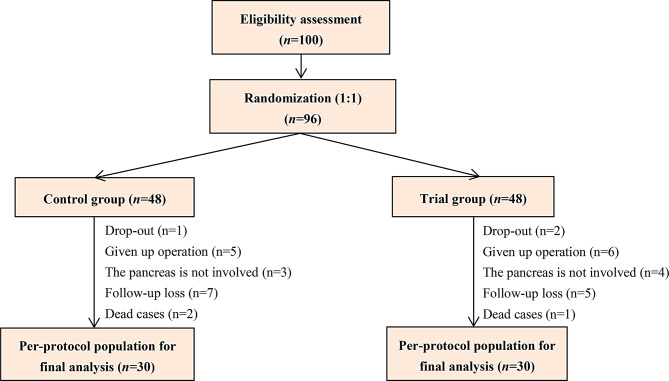
Methods: This prospective cohort study enrolled 96 patients, randomly divided into a trial group and a control group in a 1:1 ratio. The primary endpoint was the change in body composition, including body cell mass (BCM), fat-free mass (FFM), skeletal muscle mass (SMM), and phase angle (PA). Secondary outcomes included time to first postoperative flatus, time to first bowel movement, length of hospital stay, and nutritional indicators.
Results: No significant differences were observed in the demographic characteristics between the two groups. The ratio of actual total calorie intake to recommended daily intake in the trial group was significantly higher than the control group (87.01% vs. 69.50%, P < 0.001). The ratio of actual protein intake to recommended daily intake was significantly higher in the trial group than the control group (96.18% vs.76.29%, P < 0.001). In body composition data, significant differences were found between the two groups in the ratio of BCM, FFM, and SMM at the study endpoint compared to admission. Additionally, a significant difference between the two groups was present in the ratio of BCM, FFM, and SMM at the third postoperative day (POD 3) compared with those at admission. While no significant differences were found between the groups in time to first flatus and time to first stool, the trial group had a significantly shorter postoperative hospital stay compared to the control group (15.9d vs. 20.4d, P = 0.046). Nutritional index analysis revealed a statistically significant difference in the ratio of serum total protein at the study endpoint compared POD 3 (P < 0.05), but no significant differences were found in serum prealbumin, albumin, and hemoglobin.
Conclusions: Personalized nutritional interventions throughout the perioperative period improved patients' nutritional status and reduced the length of postoperative hospital stay.
背景:目前缺乏关于胰腺手术中个性化营养支持的前瞻性随机对照试验(rct)的报道。本研究旨在评估围手术期个体化营养干预对胰腺手术患者术后恢复(ERAS)框架下预后的影响。方法:前瞻性队列研究纳入96例患者,按1:1的比例随机分为试验组和对照组。主要终点是身体组成的变化,包括身体细胞质量(BCM)、无脂肪质量(FFM)、骨骼肌质量(SMM)和相角(PA)。次要结局包括术后第一次排气时间、第一次排便时间、住院时间和营养指标。结果:两组患者人口学特征无显著差异。试验组患者实际总热量摄入与推荐日摄入量之比显著高于对照组(87.01% vs 69.50%)。结论:围手术期的个性化营养干预改善了患者的营养状况,缩短了术后住院时间。
期刊介绍:
Journal of Health, Population and Nutrition brings together research on all aspects of issues related to population, nutrition and health. The journal publishes articles across a broad range of topics including global health, maternal and child health, nutrition, common illnesses and determinants of population health.




 京公网安备 11010802042870号
京ICP备2023020795号-1
京公网安备 11010802042870号
京ICP备2023020795号-1

 分享
分享
 求助内容:
求助内容: 应助结果提醒方式:
 扫码关注我们
