Mohammad Jarallah, Thomas M Withers, Sheeba Rosewilliam, Afroditi Stathi, Colin J Greaves
{"title":"Methods for assessing exercise fidelity in unsupervised home-based cardiovascular rehabilitation: a scoping review.","authors":"Mohammad Jarallah, Thomas M Withers, Sheeba Rosewilliam, Afroditi Stathi, Colin J Greaves","doi":"10.1186/s13102-025-01069-7","DOIUrl":null,"url":null,"abstract":"<p><strong>Background: </strong>Home-based cardiac rehabilitation is increasingly popular for patients with cardiovascular diseases. However, this mode of rehabilitation involves unsupervised exercise, making it challenging to assess, correct, and monitor exercise fidelity (the extent to which the patient performs the exercise intended by the intervention provider). This review aimed to identify the range, validity, and acceptability of measures for assessing exercise fidelity in unsupervised, home-based cardiovascular rehabilitation.</p><p><strong>Methods: </strong>We searched PubMed, Embase, CINAHL, Medline, and PsycINFO for studies published between 2000 and 2024 to identify observational studies, trials, and protocols published in English with a home-based cardiovascular rehabilitation intervention and at least one measure of exercise fidelity (e.g., adherence to the intended frequency, intensity, time, type, safety, progression/regression). Two reviewers selected eligible studies and extracted data, including study characteristics, exercise components, adherence definition, adherence measures, and data on measurement validity or acceptability. We conducted a narrative synthesis using a comprehensive definition of exercise fidelity, which evolved as the analysis progressed.</p><p><strong>Results: </strong>Forty-six articles describing 41 studies were included. Exercise intensity was the most commonly measured fidelity component (38/41 studies), followed by exercise frequency (32/41 studies). Exercise intensity was mostly assessed by wearable devices (28/41 studies). Frequency of exercise was most commonly assessed subjectively using a self-reported exercise log or diary, but also (objectively) using wearable devices. Exercise quantity was most commonly assessed (in terms of time or duration) by self-reported exercise logs, diaries and wearable devices, or (in terms of steps or distance) mostly by wearable devices (pedometers, other step activity monitors). Safety was only assessed in 12/41 studies. No studies assessed progression or regression of exercise, quality of exercise (accuracy of movement) or the appropriateness of progression or regression.</p><p><strong>Conclusions: </strong>Most studies to date have conceptualised exercise fidelity or adherence narrowly, ignoring important elements of the initial exercise prescription and many have relied on non-validated self-report measures. We present a comprehensive framework for assessing exercise fidelity, which may be useful for designing more robust assessments of exercise fidelity in home-based rehabilitation programmes.</p>","PeriodicalId":48585,"journal":{"name":"BMC Sports Science Medicine and Rehabilitation","volume":"17 1","pages":"31"},"PeriodicalIF":3.4000,"publicationDate":"2025-02-28","publicationTypes":"Journal Article","fieldsOfStudy":null,"isOpenAccess":false,"openAccessPdf":"https://www.ncbi.nlm.nih.gov/pmc/articles/PMC11871813/pdf/","citationCount":"0","resultStr":null,"platform":"Semanticscholar","paperid":null,"PeriodicalName":"BMC Sports Science Medicine and Rehabilitation","FirstCategoryId":"3","ListUrlMain":"https://doi.org/10.1186/s13102-025-01069-7","RegionNum":3,"RegionCategory":"医学","ArticlePicture":[],"TitleCN":null,"AbstractTextCN":null,"PMCID":null,"EPubDate":"","PubModel":"","JCR":"Q1","JCRName":"REHABILITATION","Score":null,"Total":0}
引用次数: 0
Abstract
Background: Home-based cardiac rehabilitation is increasingly popular for patients with cardiovascular diseases. However, this mode of rehabilitation involves unsupervised exercise, making it challenging to assess, correct, and monitor exercise fidelity (the extent to which the patient performs the exercise intended by the intervention provider). This review aimed to identify the range, validity, and acceptability of measures for assessing exercise fidelity in unsupervised, home-based cardiovascular rehabilitation.
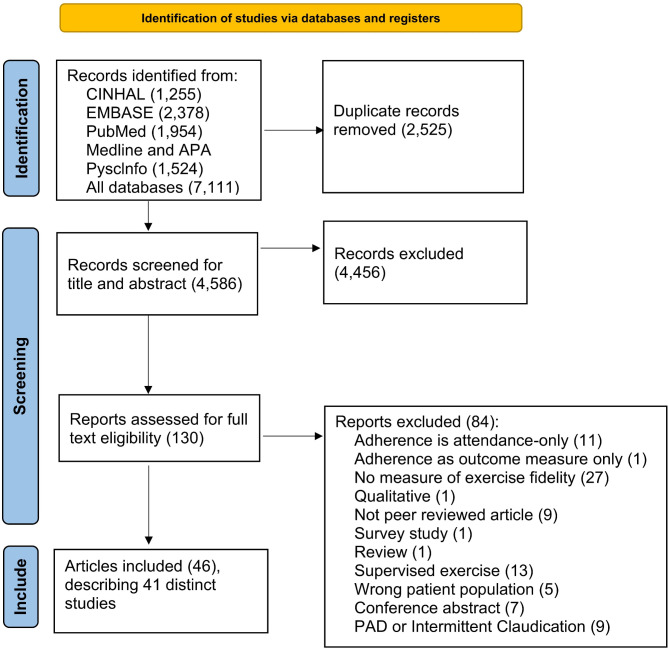
Methods: We searched PubMed, Embase, CINAHL, Medline, and PsycINFO for studies published between 2000 and 2024 to identify observational studies, trials, and protocols published in English with a home-based cardiovascular rehabilitation intervention and at least one measure of exercise fidelity (e.g., adherence to the intended frequency, intensity, time, type, safety, progression/regression). Two reviewers selected eligible studies and extracted data, including study characteristics, exercise components, adherence definition, adherence measures, and data on measurement validity or acceptability. We conducted a narrative synthesis using a comprehensive definition of exercise fidelity, which evolved as the analysis progressed.
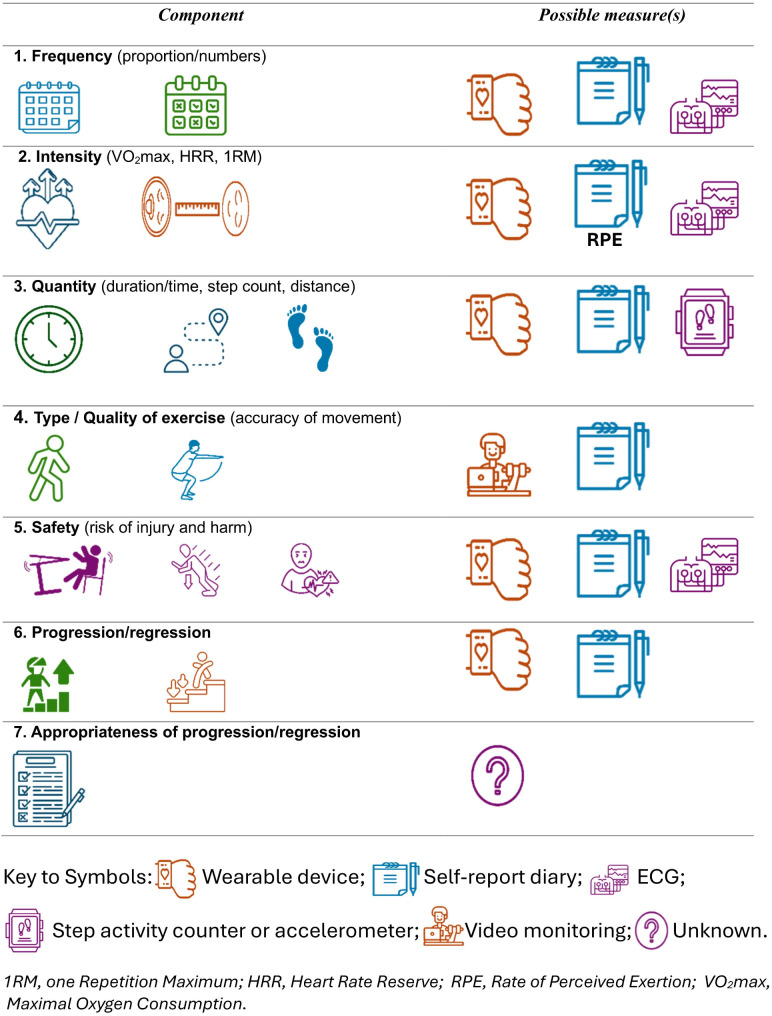
Results: Forty-six articles describing 41 studies were included. Exercise intensity was the most commonly measured fidelity component (38/41 studies), followed by exercise frequency (32/41 studies). Exercise intensity was mostly assessed by wearable devices (28/41 studies). Frequency of exercise was most commonly assessed subjectively using a self-reported exercise log or diary, but also (objectively) using wearable devices. Exercise quantity was most commonly assessed (in terms of time or duration) by self-reported exercise logs, diaries and wearable devices, or (in terms of steps or distance) mostly by wearable devices (pedometers, other step activity monitors). Safety was only assessed in 12/41 studies. No studies assessed progression or regression of exercise, quality of exercise (accuracy of movement) or the appropriateness of progression or regression.
Conclusions: Most studies to date have conceptualised exercise fidelity or adherence narrowly, ignoring important elements of the initial exercise prescription and many have relied on non-validated self-report measures. We present a comprehensive framework for assessing exercise fidelity, which may be useful for designing more robust assessments of exercise fidelity in home-based rehabilitation programmes.
期刊介绍:
BMC Sports Science, Medicine and Rehabilitation is an open access, peer reviewed journal that considers articles on all aspects of sports medicine and the exercise sciences, including rehabilitation, traumatology, cardiology, physiology, and nutrition.




 京公网安备 11010802042870号
京ICP备2023020795号-1
京公网安备 11010802042870号
京ICP备2023020795号-1

 分享
分享
 求助内容:
求助内容: 应助结果提醒方式:
 扫码关注我们
