Alexander J Büsser, Renato Durrer, Moritz Freidank, Matteo Togninalli, Antonio Olivieri, Michael A Grandner, William V McCall
{"title":"Medical ontology learning framework to investigate daytime impairment in insomnia disorder and treatment effects.","authors":"Alexander J Büsser, Renato Durrer, Moritz Freidank, Matteo Togninalli, Antonio Olivieri, Michael A Grandner, William V McCall","doi":"10.1038/s43856-024-00698-2","DOIUrl":null,"url":null,"abstract":"<p><strong>Background: </strong>Specificity challenges frequently arise in medical ontology used for the representation of real-world data, particularly in defining mental health disorders within widely used classification systems such as the International Classification of Diseases (ICD). This study aims to address these challenges by introducing the Disease-Specific Medical Ontology Learning (DiSMOL) framework, designed to generate precise disease representations from clinical physician notes, with a focus on daytime impairment in insomnia disorder.</p><p><strong>Methods: </strong>The study applied the Disease-Specific Medical Ontology Learning framework to clinical notes to better represent daytime impairment. The framework's performance was compared to insomnia expert-selected codes from ICD. Key statistical methods included sensitivity and F1-score comparisons, as well as analysis of symptom changes after the use of various medications, including benzodiazepines, non-benzodiazepine receptor agonists, and trazodone.</p><p><strong>Results: </strong>The DiSMOL framework significantly enhances the identification of daytime impairment in people with insomnia. Sensitivity increases from 17% to 98%, and the F1-score improves from 28% to 86%, compared with expert-selected ICD codes. Additionally, the framework reveals significant increases in daytime impairment symptoms following benzodiazepine use (18.9%), while traditional ICD codes do not detect any significant change.</p><p><strong>Conclusions: </strong>The study demonstrates that DiSMOL offers a more accurate method for identifying specific disease aspects, such as daytime impairment in insomnia, than traditional coding systems. These findings highlight the potential of specialized ontologies to enhance the representation and analysis of real-world clinical data, with important implications for healthcare policy and personalized medicine.</p>","PeriodicalId":72646,"journal":{"name":"Communications medicine","volume":"5 1","pages":"54"},"PeriodicalIF":5.4000,"publicationDate":"2025-02-28","publicationTypes":"Journal Article","fieldsOfStudy":null,"isOpenAccess":false,"openAccessPdf":"https://www.ncbi.nlm.nih.gov/pmc/articles/PMC11871003/pdf/","citationCount":"0","resultStr":null,"platform":"Semanticscholar","paperid":null,"PeriodicalName":"Communications medicine","FirstCategoryId":"1085","ListUrlMain":"https://doi.org/10.1038/s43856-024-00698-2","RegionNum":0,"RegionCategory":null,"ArticlePicture":[],"TitleCN":null,"AbstractTextCN":null,"PMCID":null,"EPubDate":"","PubModel":"","JCR":"Q1","JCRName":"MEDICINE, RESEARCH & EXPERIMENTAL","Score":null,"Total":0}
引用次数: 0
Abstract
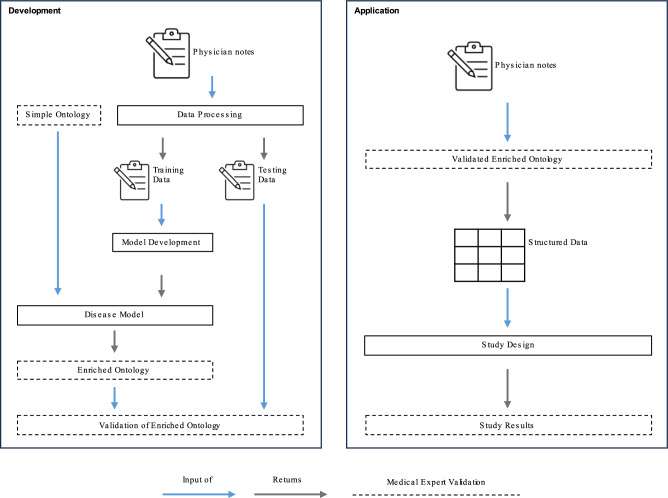
Background: Specificity challenges frequently arise in medical ontology used for the representation of real-world data, particularly in defining mental health disorders within widely used classification systems such as the International Classification of Diseases (ICD). This study aims to address these challenges by introducing the Disease-Specific Medical Ontology Learning (DiSMOL) framework, designed to generate precise disease representations from clinical physician notes, with a focus on daytime impairment in insomnia disorder.
Methods: The study applied the Disease-Specific Medical Ontology Learning framework to clinical notes to better represent daytime impairment. The framework's performance was compared to insomnia expert-selected codes from ICD. Key statistical methods included sensitivity and F1-score comparisons, as well as analysis of symptom changes after the use of various medications, including benzodiazepines, non-benzodiazepine receptor agonists, and trazodone.
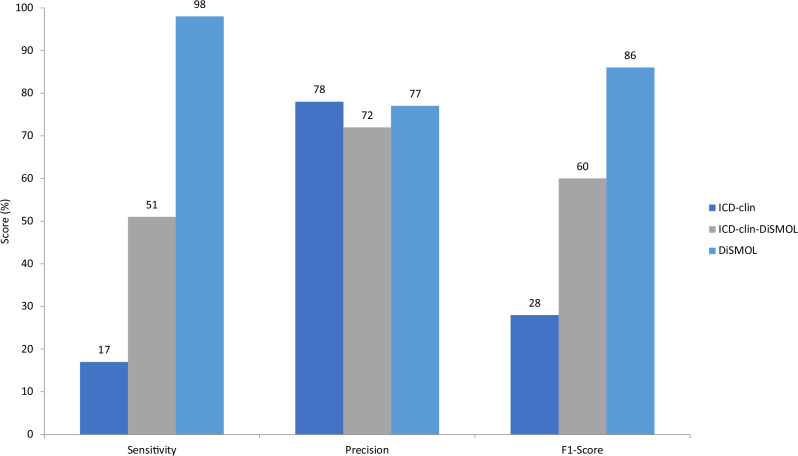
Results: The DiSMOL framework significantly enhances the identification of daytime impairment in people with insomnia. Sensitivity increases from 17% to 98%, and the F1-score improves from 28% to 86%, compared with expert-selected ICD codes. Additionally, the framework reveals significant increases in daytime impairment symptoms following benzodiazepine use (18.9%), while traditional ICD codes do not detect any significant change.
Conclusions: The study demonstrates that DiSMOL offers a more accurate method for identifying specific disease aspects, such as daytime impairment in insomnia, than traditional coding systems. These findings highlight the potential of specialized ontologies to enhance the representation and analysis of real-world clinical data, with important implications for healthcare policy and personalized medicine.



 京公网安备 11010802042870号
京ICP备2023020795号-1
京公网安备 11010802042870号
京ICP备2023020795号-1

 分享
分享

 求助内容:
求助内容: 应助结果提醒方式:
 扫码关注我们
