Daivat Bhavsar, Laura Duffy, Hamin Jo, Cynthia Lokker, R Brian Haynes, Alfonso Iorio, Ana Marusic, Jeremy Y Ng
{"title":"Policies on artificial intelligence chatbots among academic publishers: a cross-sectional audit.","authors":"Daivat Bhavsar, Laura Duffy, Hamin Jo, Cynthia Lokker, R Brian Haynes, Alfonso Iorio, Ana Marusic, Jeremy Y Ng","doi":"10.1186/s41073-025-00158-y","DOIUrl":null,"url":null,"abstract":"<p><strong>Background: </strong>Artificial intelligence (AI) chatbots are novel computer programs that can generate text or content in a natural language format. Academic publishers are adapting to the transformative role of AI chatbots in producing or facilitating scientific research. This study aimed to examine the policies established by scientific, technical, and medical academic publishers for defining and regulating the authors' responsible use of AI chatbots.</p><p><strong>Methods: </strong>This study performed a cross-sectional audit on the publicly available policies of 162 academic publishers, indexed as members of the International Association of the Scientific, Technical, and Medical Publishers (STM). Data extraction of publicly available policies on the webpages of all STM academic publishers was performed independently, in duplicate, with content analysis reviewed by a third contributor (September 2023-December 2023). Data was categorized into policy elements, such as 'proofreading' and 'image generation'. Counts and percentages of 'yes' (i.e., permitted), 'no', and 'no available information' (NAI) were established for each policy element.</p><p><strong>Results: </strong>A total of 56/162 (34.6%) STM academic publishers had a publicly available policy guiding the authors' use of AI chatbots. No policy allowed authorship for AI chatbots (or other AI tool). Most (49/56 or 87.5%) required specific disclosure of AI chatbot use. Four policies/publishers placed a complete ban on the use of AI chatbots by authors.</p><p><strong>Conclusions: </strong>Only a third of STM academic publishers had publicly available policies as of December 2023. A re-examination of all STM members in 12-18 months may uncover evolving approaches toward AI chatbot use with more academic publishers having a policy.</p>","PeriodicalId":74682,"journal":{"name":"Research integrity and peer review","volume":"10 1","pages":"1"},"PeriodicalIF":10.7000,"publicationDate":"2025-02-28","publicationTypes":"Journal Article","fieldsOfStudy":null,"isOpenAccess":false,"openAccessPdf":"https://www.ncbi.nlm.nih.gov/pmc/articles/PMC11869395/pdf/","citationCount":"0","resultStr":null,"platform":"Semanticscholar","paperid":null,"PeriodicalName":"Research integrity and peer review","FirstCategoryId":"1085","ListUrlMain":"https://doi.org/10.1186/s41073-025-00158-y","RegionNum":0,"RegionCategory":null,"ArticlePicture":[],"TitleCN":null,"AbstractTextCN":null,"PMCID":null,"EPubDate":"","PubModel":"","JCR":"Q1","JCRName":"ETHICS","Score":null,"Total":0}
引用次数: 0
Abstract
Background: Artificial intelligence (AI) chatbots are novel computer programs that can generate text or content in a natural language format. Academic publishers are adapting to the transformative role of AI chatbots in producing or facilitating scientific research. This study aimed to examine the policies established by scientific, technical, and medical academic publishers for defining and regulating the authors' responsible use of AI chatbots.
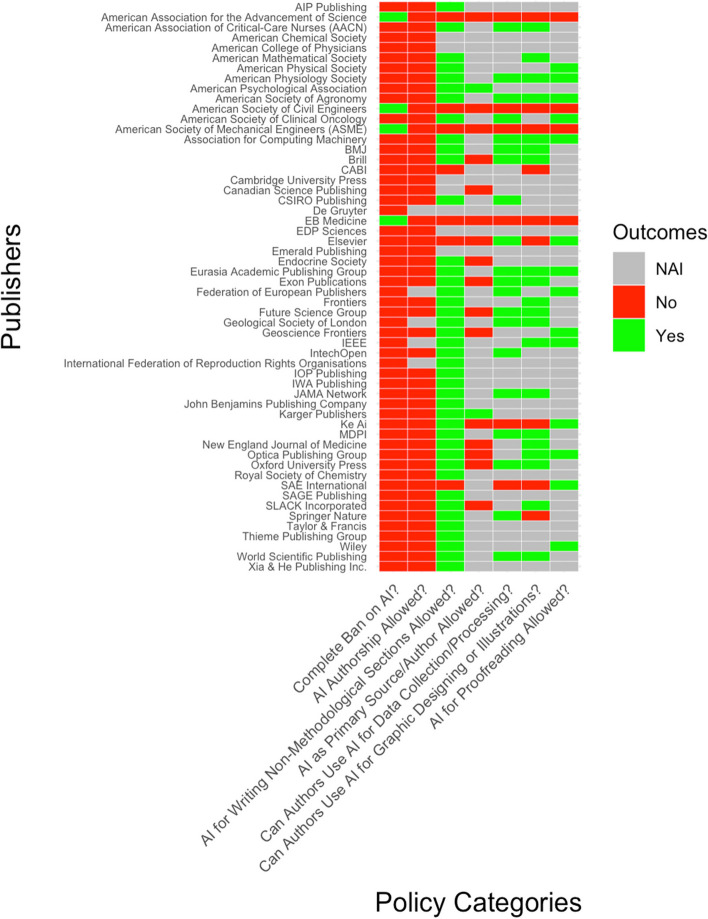
Methods: This study performed a cross-sectional audit on the publicly available policies of 162 academic publishers, indexed as members of the International Association of the Scientific, Technical, and Medical Publishers (STM). Data extraction of publicly available policies on the webpages of all STM academic publishers was performed independently, in duplicate, with content analysis reviewed by a third contributor (September 2023-December 2023). Data was categorized into policy elements, such as 'proofreading' and 'image generation'. Counts and percentages of 'yes' (i.e., permitted), 'no', and 'no available information' (NAI) were established for each policy element.
Results: A total of 56/162 (34.6%) STM academic publishers had a publicly available policy guiding the authors' use of AI chatbots. No policy allowed authorship for AI chatbots (or other AI tool). Most (49/56 or 87.5%) required specific disclosure of AI chatbot use. Four policies/publishers placed a complete ban on the use of AI chatbots by authors.
Conclusions: Only a third of STM academic publishers had publicly available policies as of December 2023. A re-examination of all STM members in 12-18 months may uncover evolving approaches toward AI chatbot use with more academic publishers having a policy.



 京公网安备 11010802042870号
京ICP备2023020795号-1
京公网安备 11010802042870号
京ICP备2023020795号-1

 分享
分享

 求助内容:
求助内容: 应助结果提醒方式:
 扫码关注我们
