Yao Wang, Bowei Li, Haifei Wang, Zeyu Zhang, Zhengzheng Dang, Yanfeng Miao, Ke Ma, Zhixiao Qin, Lei Lu, Ni Zhang, Yanming Wang, Yuetian Chen, Yixin Zhao
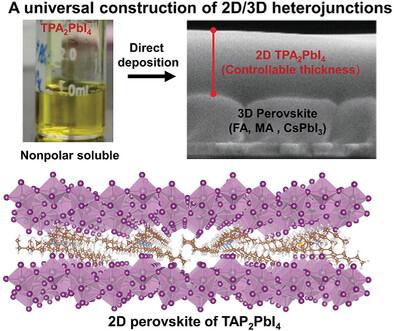
{"title":"A Soft Nonpolar-Soluble Two-Dimensional Perovskite for General Construction of Mixed-Dimensional Heterojunctions","authors":"Yao Wang, Bowei Li, Haifei Wang, Zeyu Zhang, Zhengzheng Dang, Yanfeng Miao, Ke Ma, Zhixiao Qin, Lei Lu, Ni Zhang, Yanming Wang, Yuetian Chen, Yixin Zhao","doi":"10.1002/adma.202419750","DOIUrl":null,"url":null,"abstract":"<p>Constructing mixed-dimensional heterojunctions through ion exchange between functional organic ammonium halides and the already-deposited bulk 3D perovskite films is a widely adopted strategy to effectively passivate and stabilize perovskite solar cells (PSCs). Such process poses challenges in precisely controlling the composition and distribution of the heterojunctions across the film, in particular for large-area applications. Here, a soft 2D perovskite based on tetrapheptyl-ammonium iodide (TPAI), noted as TPA<sub>2</sub>PbI<sub>4</sub> is reported. It is the first-reported nonpolar readily soluble 2D perovskite, leading to highly compact and oriented perovskite layers. In addition, this nonpolar soluble TPA<sub>2</sub>PbI<sub>4</sub> is beneficial to universally construct thickness-controllable mixed-dimensional perovskite heterojunctions to suppress the non-radiative recombination and promote charge-carrier transfer on all the FA-, MA- and CsPbI<sub>3</sub> PSCs. Such a unique strategy is also suitable for upscaling fabrication, demonstrated by 30 cm × 30 cm FAPbI<sub>3</sub> perovskite submodules with a certified efficiency of 22.06%.</p>","PeriodicalId":114,"journal":{"name":"Advanced Materials","volume":"37 14","pages":""},"PeriodicalIF":26.8000,"publicationDate":"2025-03-03","publicationTypes":"Journal Article","fieldsOfStudy":null,"isOpenAccess":false,"openAccessPdf":"","citationCount":"0","resultStr":null,"platform":"Semanticscholar","paperid":null,"PeriodicalName":"Advanced Materials","FirstCategoryId":"88","ListUrlMain":"https://advanced.onlinelibrary.wiley.com/doi/10.1002/adma.202419750","RegionNum":1,"RegionCategory":"材料科学","ArticlePicture":[],"TitleCN":null,"AbstractTextCN":null,"PMCID":null,"EPubDate":"","PubModel":"","JCR":"Q1","JCRName":"CHEMISTRY, MULTIDISCIPLINARY","Score":null,"Total":0}
引用次数: 0
Abstract
Constructing mixed-dimensional heterojunctions through ion exchange between functional organic ammonium halides and the already-deposited bulk 3D perovskite films is a widely adopted strategy to effectively passivate and stabilize perovskite solar cells (PSCs). Such process poses challenges in precisely controlling the composition and distribution of the heterojunctions across the film, in particular for large-area applications. Here, a soft 2D perovskite based on tetrapheptyl-ammonium iodide (TPAI), noted as TPA2PbI4 is reported. It is the first-reported nonpolar readily soluble 2D perovskite, leading to highly compact and oriented perovskite layers. In addition, this nonpolar soluble TPA2PbI4 is beneficial to universally construct thickness-controllable mixed-dimensional perovskite heterojunctions to suppress the non-radiative recombination and promote charge-carrier transfer on all the FA-, MA- and CsPbI3 PSCs. Such a unique strategy is also suitable for upscaling fabrication, demonstrated by 30 cm × 30 cm FAPbI3 perovskite submodules with a certified efficiency of 22.06%.
通过功能有机卤化铵与已沉积的大块三维钙钛矿薄膜之间的离子交换构建混合维异质结是有效钝化和稳定钙钛矿太阳能电池(PSCs)的一种广泛采用的策略。这种工艺在精确控制薄膜上异质结的组成和分布方面提出了挑战,特别是在大面积应用中。本文报道了一种基于四七基碘化铵(TPAI)的二维软钙钛矿,称为TPA2PbI4。这是首次报道的非极性易溶二维钙钛矿,导致高度致密和定向的钙钛矿层。此外,这种非极性可溶性TPA2PbI4有利于普遍构建厚度可控的混合维钙钛矿异质结,以抑制FA-, MA-和CsPbI3 PSCs的非辐射重组并促进电荷载流子转移。这种独特的策略也适用于升级制造,30 cm × 30 cm FAPbI3钙钛矿子模块证明了其认证效率为22.06%。
期刊介绍:
Advanced Materials, one of the world's most prestigious journals and the foundation of the Advanced portfolio, is the home of choice for best-in-class materials science for more than 30 years. Following this fast-growing and interdisciplinary field, we are considering and publishing the most important discoveries on any and all materials from materials scientists, chemists, physicists, engineers as well as health and life scientists and bringing you the latest results and trends in modern materials-related research every week.







 京公网安备 11010802042870号
京ICP备2023020795号-1
京公网安备 11010802042870号
京ICP备2023020795号-1

 分享
分享
 求助内容:
求助内容: 应助结果提醒方式:
 扫码关注我们
