Yaozong Yang, Zhaolin Li, Min Zhang, Jie Wang, Yue Wang, Jingyi Qiu, Hailei Zhao
{"title":"Electrolyte Chemistry Modulation Toward High-Performance and Ultralow-Temperature Silicon Anode","authors":"Yaozong Yang, Zhaolin Li, Min Zhang, Jie Wang, Yue Wang, Jingyi Qiu, Hailei Zhao","doi":"10.1002/adma.202417981","DOIUrl":null,"url":null,"abstract":"<p>The high-capacity silicon (Si) anode usually suffers from rapid capacity decay and low Coulombic efficiency in carbonate electrolytes resulting from large volume expansion and unstable solid electrolyte interphase (SEI). In addition, the sluggish electrode kinetics in routine electrolytes at subzero temperatures severely hampers the operational capabilities of Si-based batteries. Herein, a rational electrolyte design strategy is reported to tune the solvation chemistry and interfacial behavior of the electrolyte for high-performance Si anode. The interfacial stability and electrochemical reaction kinetics can be enhanced simultaneously at both room temperature and ultralow temperature by combining two kinds of ether-based solvents (cyclopentylmethyl ether and tetrahydrofuran), which enables high cation conductivity, low Li-ion desolvation barrier, and formation of a robust LiF-elastic polymer SEI. Consequently, the optimized electrolyte extends the cyclability of the Si anode, maintaining more than 80% capacity retention over 200 cycles at −20 and −35 °C. Even at −40 °C, the Si electrode still delivers a high reversible capacity of 2157.0 mAh g<sup>−1</sup>, showing the highest capacity retention of 68.5% up to date relative to its room-temperature capacity. Moreover, the assembled full cells Si||LiFePO<sub>4</sub> and Si||LiNi<sub>0.8</sub>Co<sub>0.1</sub>Mn<sub>0.1</sub>O<sub>2</sub> demonstrate excellent electrochemical performance with no capacity degradation over 180 and 120 cycles, respectively, at −20 °C.</p>","PeriodicalId":114,"journal":{"name":"Advanced Materials","volume":"37 15","pages":""},"PeriodicalIF":26.8000,"publicationDate":"2025-03-02","publicationTypes":"Journal Article","fieldsOfStudy":null,"isOpenAccess":false,"openAccessPdf":"","citationCount":"0","resultStr":null,"platform":"Semanticscholar","paperid":null,"PeriodicalName":"Advanced Materials","FirstCategoryId":"88","ListUrlMain":"https://advanced.onlinelibrary.wiley.com/doi/10.1002/adma.202417981","RegionNum":1,"RegionCategory":"材料科学","ArticlePicture":[],"TitleCN":null,"AbstractTextCN":null,"PMCID":null,"EPubDate":"","PubModel":"","JCR":"Q1","JCRName":"CHEMISTRY, MULTIDISCIPLINARY","Score":null,"Total":0}
引用次数: 0
Abstract
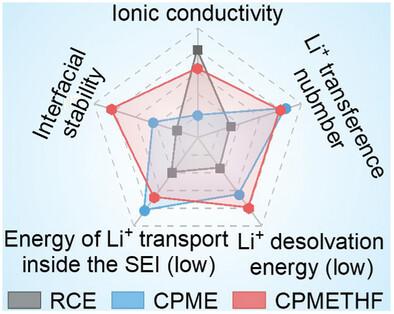
The high-capacity silicon (Si) anode usually suffers from rapid capacity decay and low Coulombic efficiency in carbonate electrolytes resulting from large volume expansion and unstable solid electrolyte interphase (SEI). In addition, the sluggish electrode kinetics in routine electrolytes at subzero temperatures severely hampers the operational capabilities of Si-based batteries. Herein, a rational electrolyte design strategy is reported to tune the solvation chemistry and interfacial behavior of the electrolyte for high-performance Si anode. The interfacial stability and electrochemical reaction kinetics can be enhanced simultaneously at both room temperature and ultralow temperature by combining two kinds of ether-based solvents (cyclopentylmethyl ether and tetrahydrofuran), which enables high cation conductivity, low Li-ion desolvation barrier, and formation of a robust LiF-elastic polymer SEI. Consequently, the optimized electrolyte extends the cyclability of the Si anode, maintaining more than 80% capacity retention over 200 cycles at −20 and −35 °C. Even at −40 °C, the Si electrode still delivers a high reversible capacity of 2157.0 mAh g−1, showing the highest capacity retention of 68.5% up to date relative to its room-temperature capacity. Moreover, the assembled full cells Si||LiFePO4 and Si||LiNi0.8Co0.1Mn0.1O2 demonstrate excellent electrochemical performance with no capacity degradation over 180 and 120 cycles, respectively, at −20 °C.
高容量硅(Si)阳极在碳酸盐电解质中由于体积膨胀大和固体电解质界面相(SEI)不稳定,通常存在容量衰减快和库仑效率低的问题。此外,常规电解质在零下温度下的缓慢电极动力学严重阻碍了硅基电池的运行能力。本文报道了一种合理的电解质设计策略,以调整高性能硅阳极电解质的溶剂化化学和界面行为。结合两种醚基溶剂(环戊基甲基醚和四氢呋喃),可以在室温和超低温下同时增强界面稳定性和电化学反应动力学,从而实现高阳离子电导率,低锂离子脱溶势垒,形成坚固的锂离子弹性聚合物SEI。因此,优化的电解质延长了硅阳极的可循环性,在- 20和- 35°C的200次循环中保持超过80%的容量保留。即使在- 40°C下,Si电极仍然提供2157.0 mAh g - 1的高可逆容量,相对于其室温容量,显示出迄今为止最高的68.5%的容量保持率。此外,组装的全电池Si||LiFePO4和Si||LiNi0.8Co0.1Mn0.1O2在−20°C下分别在180和120次循环中表现出优异的电化学性能,容量没有下降。
期刊介绍:
Advanced Materials, one of the world's most prestigious journals and the foundation of the Advanced portfolio, is the home of choice for best-in-class materials science for more than 30 years. Following this fast-growing and interdisciplinary field, we are considering and publishing the most important discoveries on any and all materials from materials scientists, chemists, physicists, engineers as well as health and life scientists and bringing you the latest results and trends in modern materials-related research every week.







 京公网安备 11010802042870号
京ICP备2023020795号-1
京公网安备 11010802042870号
京ICP备2023020795号-1

 分享
分享
 求助内容:
求助内容: 应助结果提醒方式:
 扫码关注我们
