{"title":"Stereoisomerism of Vicinal Polydichloronorbornene for Ultra-High-Temperature Capacitive Energy Storage","authors":"Jing Hao, Stuti Shukla, Rishi Gurnani, Madhubanti Mukherjee, Harikrishna Sahu, Ashish Khomane, Pritish Aklujkar, Mohak Desai, Chao Wu, Rampi Ramprasad, Gregory Sotzing, Yang Cao","doi":"10.1002/adma.202417625","DOIUrl":null,"url":null,"abstract":"<p>The emergence of high-density electronics in aerospace and renewable energies demands high temperature dielectrics. Molecular engineering represents a vital strategy for designing dielectric polymers, yet the influence of stereochemistry remains untapped. Herein, by designing halogen substituents of an aromatic pendant attached to a bicyclic mainchain, vicinal polydichloronorbornene (PDCNB) with a high glass-transition temperature (<i>T</i><sub>g</sub>) of 263 °C is obtained. Further study unveils the profound effect of stereochemistry on the properties of exo- and endo-PDCNB. Both isomers show identical high <i>T</i><sub>g</sub> and bandgap (4.3 eV), imparting PDCNBs with remarkable capacitive energy storage, outperforming existing polymers and nanocomposites with two orders of magnitude lower conduction at an ultra-high temperature of 250 °C. Moreover, the effect of stereoisomerism is manifested in the differences in backbone spacing, π-stacking, barrier height, and trap states, and the resulting distinct high field performance. Exo-PDCNB displays an extremely low conduction of 6.8 × 10<sup>−14</sup> S m⁻<sup>1</sup> at 200 <span>m</span>V m⁻<sup>1</sup> and maintains a record charge-discharge efficiency of 82% at 450 <span>m</span>V m⁻<sup>1</sup>, while endo-PDCNB exhibits a high breakdown strength of 600 <span>m</span>V m⁻<sup>1</sup> with a remarkable discharged density of 4.47 J cm⁻<sup>3</sup>, all at 250 °C. This study unleashes a stereochemistry-based strategy with vicinal dichloro substitution to further boost the <i>T</i><sub>g</sub> of polynorbornene for ultra-high-temperature applications.</p>","PeriodicalId":114,"journal":{"name":"Advanced Materials","volume":"37 15","pages":""},"PeriodicalIF":26.8000,"publicationDate":"2025-03-03","publicationTypes":"Journal Article","fieldsOfStudy":null,"isOpenAccess":false,"openAccessPdf":"","citationCount":"0","resultStr":null,"platform":"Semanticscholar","paperid":null,"PeriodicalName":"Advanced Materials","FirstCategoryId":"88","ListUrlMain":"https://advanced.onlinelibrary.wiley.com/doi/10.1002/adma.202417625","RegionNum":1,"RegionCategory":"材料科学","ArticlePicture":[],"TitleCN":null,"AbstractTextCN":null,"PMCID":null,"EPubDate":"","PubModel":"","JCR":"Q1","JCRName":"CHEMISTRY, MULTIDISCIPLINARY","Score":null,"Total":0}
引用次数: 0
Abstract
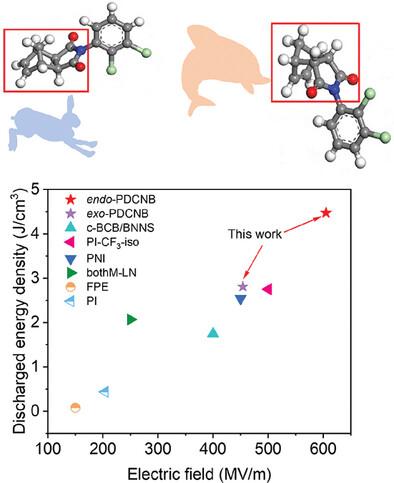
The emergence of high-density electronics in aerospace and renewable energies demands high temperature dielectrics. Molecular engineering represents a vital strategy for designing dielectric polymers, yet the influence of stereochemistry remains untapped. Herein, by designing halogen substituents of an aromatic pendant attached to a bicyclic mainchain, vicinal polydichloronorbornene (PDCNB) with a high glass-transition temperature (Tg) of 263 °C is obtained. Further study unveils the profound effect of stereochemistry on the properties of exo- and endo-PDCNB. Both isomers show identical high Tg and bandgap (4.3 eV), imparting PDCNBs with remarkable capacitive energy storage, outperforming existing polymers and nanocomposites with two orders of magnitude lower conduction at an ultra-high temperature of 250 °C. Moreover, the effect of stereoisomerism is manifested in the differences in backbone spacing, π-stacking, barrier height, and trap states, and the resulting distinct high field performance. Exo-PDCNB displays an extremely low conduction of 6.8 × 10⁻¹⁴ S m⁻1 at 200 mV m⁻1 and maintains a record charge-discharge efficiency of 82% at 450 mV m⁻1, while endo-PDCNB exhibits a high breakdown strength of 600 mV m⁻1 with a remarkable discharged density of 4.47 J cm⁻3, all at 250 °C. This study unleashes a stereochemistry-based strategy with vicinal dichloro substitution to further boost the Tg of polynorbornene for ultra-high-temperature applications.
高密度电子产品在航空航天和可再生能源领域的出现需要高温电介质。分子工程代表了设计介电聚合物的重要策略,但立体化学的影响仍未开发。本文通过设计双环主链上的芳香族悬垂的卤素取代基,得到了玻璃化转变温度(Tg)高达263℃的邻聚二氯生冰片烯(PDCNB)。进一步的研究揭示了立体化学对外链和内链pdcnb性质的深远影响。两种异构体均表现出相同的高Tg和带隙(4.3 eV),使PDCNBs具有卓越的电容储能性能,在250°C的超高温下,其导电率比现有聚合物和纳米复合材料低两个数量级。此外,立体异构的影响还表现在主链间距、π堆积、势垒高度和陷阱态的差异,以及由此产生的明显的高场性能。Exo-PDCNB在200 mV m - 1时的极低传导率为6.8 × 10⁻¹⁴ S m - 1,在450 mV m - 1时保持了82%的充电-放电效率,而endo-PDCNB在250°C时表现出600 mV m - 1的高击穿强度和4.47 J cm - 3的惊人的放电密度。本研究提出了一种基于立体化学的邻二氯取代策略,以进一步提高聚降冰片烯在超高温应用中的Tg。
期刊介绍:
Advanced Materials, one of the world's most prestigious journals and the foundation of the Advanced portfolio, is the home of choice for best-in-class materials science for more than 30 years. Following this fast-growing and interdisciplinary field, we are considering and publishing the most important discoveries on any and all materials from materials scientists, chemists, physicists, engineers as well as health and life scientists and bringing you the latest results and trends in modern materials-related research every week.







 京公网安备 11010802042870号
京ICP备2023020795号-1
京公网安备 11010802042870号
京ICP备2023020795号-1

 分享
分享
 求助内容:
求助内容: 应助结果提醒方式:
 扫码关注我们
