Huibin Liu, Xiaohan Hou, Qicheng Zhang, Wenchao Peng, Yang Li, Xiaobin Fan
{"title":"Representative By-Products of Aqueous Zinc-Vanadium Batteries: Origins, Roles, Strategies, and Prospects","authors":"Huibin Liu, Xiaohan Hou, Qicheng Zhang, Wenchao Peng, Yang Li, Xiaobin Fan","doi":"10.1002/aenm.202406171","DOIUrl":null,"url":null,"abstract":"<p>Aqueous zinc-ion batteries (AZIBs) are of interest in next-generation energy storage applications owing to their safety, environmental friendliness, and cost-effectiveness. Vanadium-based oxides are promising cathodes for AZIBs due to their appropriate structure and multielectron redox processes. Although hundreds of studies are devoted to understanding the mechanisms and developing high-performance vanadium-based cathodes, many puzzles and controversies still exist, especially regarding the two representative by-products, basic zinc salt (BZS) and zinc pyrovanadate (ZVO). BZS and ZVO are often observed on vanadium-based cathode and zinc anode during cycling, directly affecting battery performance. However, the two by-products’ controversial and unclassified insights and unclear mechanisms have severely limited the Zn-V batteries’ progress. Therefore, this review aims to exhaustively elucidate the “past and present” of the two by-products following a logical sequence of origin, role, inhibition strategy, and prospect. Notably, the review incorporates substantial comments and understandings of the long-neglected controversial issues related to the by-products, especially the BZS-related energy storage mechanisms and ZVO-related dissolution mechanisms. This review is expected to provide scientific guidelines for future optimization and commercialization of Zn-V batteries.</p>","PeriodicalId":111,"journal":{"name":"Advanced Energy Materials","volume":"15 17","pages":""},"PeriodicalIF":26.0000,"publicationDate":"2025-03-03","publicationTypes":"Journal Article","fieldsOfStudy":null,"isOpenAccess":false,"openAccessPdf":"","citationCount":"0","resultStr":null,"platform":"Semanticscholar","paperid":null,"PeriodicalName":"Advanced Energy Materials","FirstCategoryId":"88","ListUrlMain":"https://advanced.onlinelibrary.wiley.com/doi/10.1002/aenm.202406171","RegionNum":1,"RegionCategory":"材料科学","ArticlePicture":[],"TitleCN":null,"AbstractTextCN":null,"PMCID":null,"EPubDate":"","PubModel":"","JCR":"Q1","JCRName":"CHEMISTRY, PHYSICAL","Score":null,"Total":0}
引用次数: 0
Abstract
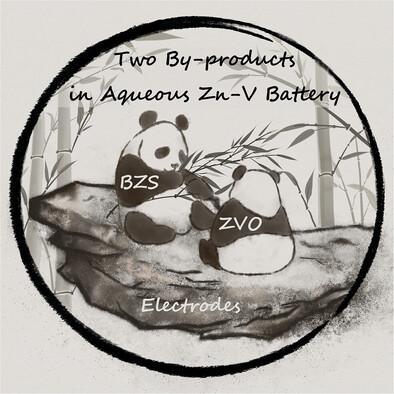
Aqueous zinc-ion batteries (AZIBs) are of interest in next-generation energy storage applications owing to their safety, environmental friendliness, and cost-effectiveness. Vanadium-based oxides are promising cathodes for AZIBs due to their appropriate structure and multielectron redox processes. Although hundreds of studies are devoted to understanding the mechanisms and developing high-performance vanadium-based cathodes, many puzzles and controversies still exist, especially regarding the two representative by-products, basic zinc salt (BZS) and zinc pyrovanadate (ZVO). BZS and ZVO are often observed on vanadium-based cathode and zinc anode during cycling, directly affecting battery performance. However, the two by-products’ controversial and unclassified insights and unclear mechanisms have severely limited the Zn-V batteries’ progress. Therefore, this review aims to exhaustively elucidate the “past and present” of the two by-products following a logical sequence of origin, role, inhibition strategy, and prospect. Notably, the review incorporates substantial comments and understandings of the long-neglected controversial issues related to the by-products, especially the BZS-related energy storage mechanisms and ZVO-related dissolution mechanisms. This review is expected to provide scientific guidelines for future optimization and commercialization of Zn-V batteries.
期刊介绍:
Established in 2011, Advanced Energy Materials is an international, interdisciplinary, English-language journal that focuses on materials used in energy harvesting, conversion, and storage. It is regarded as a top-quality journal alongside Advanced Materials, Advanced Functional Materials, and Small.
With a 2022 Impact Factor of 27.8, Advanced Energy Materials is considered a prime source for the best energy-related research. The journal covers a wide range of topics in energy-related research, including organic and inorganic photovoltaics, batteries and supercapacitors, fuel cells, hydrogen generation and storage, thermoelectrics, water splitting and photocatalysis, solar fuels and thermosolar power, magnetocalorics, and piezoelectronics.
The readership of Advanced Energy Materials includes materials scientists, chemists, physicists, and engineers in both academia and industry. The journal is indexed in various databases and collections, such as Advanced Technologies & Aerospace Database, FIZ Karlsruhe, INSPEC (IET), Science Citation Index Expanded, Technology Collection, and Web of Science, among others.






 京公网安备 11010802042870号
京ICP备2023020795号-1
京公网安备 11010802042870号
京ICP备2023020795号-1

 分享
分享
 求助内容:
求助内容: 应助结果提醒方式:
 扫码关注我们
