Hyeokjun Jang, Mu Geun Son, Duho Han, Jinyeong Choi, Jin Hong Lee, Pilgun Oh, Joonhee Kang, Minjoon Park
{"title":"Revisiting Membrane-Free Zn–Mn Redox Flow Batteries: An Innovative Universal Aspartic Acid Additive for Superior Stability","authors":"Hyeokjun Jang, Mu Geun Son, Duho Han, Jinyeong Choi, Jin Hong Lee, Pilgun Oh, Joonhee Kang, Minjoon Park","doi":"10.1002/aenm.202500621","DOIUrl":null,"url":null,"abstract":"<p>An all-aqueous membrane-free Zn–Mn redox flow battery utilizing deposition chemistry can be an excellent alternative to conventional aqueous redox flow batteries for reducing costs and improving stability. In the neutral/mildly acidic electrolyte environment of aqueous Zn–Mn redox flow batteries, the anode still suffers from issues such as zinc dendrite growth and corrosion, while the cathode struggles with poor reversibility. The same issues arise in membrane-free Zn–Mn redox flow batteries that use a combined electrolyte, where both anolyte and catholyte are combined. Therefore, it is possible to simultaneously address the issues of both the anode and cathode by using a single additive in the combined electrolyte. Here, aspartic acid is introduced as a universal additive for an all-aqueous membrane-free Zn–Mn redox flow battery. In the combined electrolyte, aspartic acid bonded to the Zn anode surface, Zn<sup>2+</sup> ions, and Mn<sup>2+</sup> ions, resolving almost all the side reactions. Impressively, membrane-free Zn–Mn redox flow battery with aspartic acid demonstrated remarkable cycling stability of 300 cycles at an areal capacity of 10 mAh cm<sup>−2</sup>. A new efficient strategy is proposed for controlling overall side reactions by the simple addition of a single additive in the integrated electrolyte with this report.</p>","PeriodicalId":111,"journal":{"name":"Advanced Energy Materials","volume":"15 17","pages":""},"PeriodicalIF":26.0000,"publicationDate":"2025-03-03","publicationTypes":"Journal Article","fieldsOfStudy":null,"isOpenAccess":false,"openAccessPdf":"https://onlinelibrary.wiley.com/doi/epdf/10.1002/aenm.202500621","citationCount":"0","resultStr":null,"platform":"Semanticscholar","paperid":null,"PeriodicalName":"Advanced Energy Materials","FirstCategoryId":"88","ListUrlMain":"https://advanced.onlinelibrary.wiley.com/doi/10.1002/aenm.202500621","RegionNum":1,"RegionCategory":"材料科学","ArticlePicture":[],"TitleCN":null,"AbstractTextCN":null,"PMCID":null,"EPubDate":"","PubModel":"","JCR":"Q1","JCRName":"CHEMISTRY, PHYSICAL","Score":null,"Total":0}
引用次数: 0
Abstract
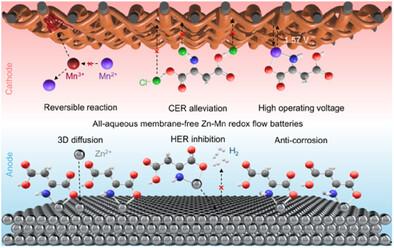
An all-aqueous membrane-free Zn–Mn redox flow battery utilizing deposition chemistry can be an excellent alternative to conventional aqueous redox flow batteries for reducing costs and improving stability. In the neutral/mildly acidic electrolyte environment of aqueous Zn–Mn redox flow batteries, the anode still suffers from issues such as zinc dendrite growth and corrosion, while the cathode struggles with poor reversibility. The same issues arise in membrane-free Zn–Mn redox flow batteries that use a combined electrolyte, where both anolyte and catholyte are combined. Therefore, it is possible to simultaneously address the issues of both the anode and cathode by using a single additive in the combined electrolyte. Here, aspartic acid is introduced as a universal additive for an all-aqueous membrane-free Zn–Mn redox flow battery. In the combined electrolyte, aspartic acid bonded to the Zn anode surface, Zn2+ ions, and Mn2+ ions, resolving almost all the side reactions. Impressively, membrane-free Zn–Mn redox flow battery with aspartic acid demonstrated remarkable cycling stability of 300 cycles at an areal capacity of 10 mAh cm−2. A new efficient strategy is proposed for controlling overall side reactions by the simple addition of a single additive in the integrated electrolyte with this report.
利用沉积化学的全水无膜锌锰氧化还原液流电池可以成为传统水氧化还原液流电池的一种极好的替代品,可以降低成本并提高稳定性。在中性/轻度酸性的液流电池中,阳极仍然存在锌枝晶生长和腐蚀等问题,而阴极则存在可逆性差的问题。同样的问题也出现在使用复合电解质的无膜锌锰氧化还原液电池中,其中阳极液和阴极液结合在一起。因此,通过在复合电解质中使用单一添加剂,可以同时解决阳极和阴极的问题。本文介绍了天冬氨酸作为全水无膜锌锰氧化还原液流电池的通用添加剂。在复合电解质中,天冬氨酸与Zn阳极表面、Zn2+离子和Mn2+离子结合,几乎解决了所有的副反应。令人印象深刻的是,含天冬氨酸的无膜锌锰氧化还原液流电池在10 mAh cm−2的面积容量下表现出300次循环的显著稳定性。本文提出了一种新的有效的控制整体副反应的策略,即在集成电解质中加入一种简单的添加剂。
期刊介绍:
Established in 2011, Advanced Energy Materials is an international, interdisciplinary, English-language journal that focuses on materials used in energy harvesting, conversion, and storage. It is regarded as a top-quality journal alongside Advanced Materials, Advanced Functional Materials, and Small.
With a 2022 Impact Factor of 27.8, Advanced Energy Materials is considered a prime source for the best energy-related research. The journal covers a wide range of topics in energy-related research, including organic and inorganic photovoltaics, batteries and supercapacitors, fuel cells, hydrogen generation and storage, thermoelectrics, water splitting and photocatalysis, solar fuels and thermosolar power, magnetocalorics, and piezoelectronics.
The readership of Advanced Energy Materials includes materials scientists, chemists, physicists, and engineers in both academia and industry. The journal is indexed in various databases and collections, such as Advanced Technologies & Aerospace Database, FIZ Karlsruhe, INSPEC (IET), Science Citation Index Expanded, Technology Collection, and Web of Science, among others.






 京公网安备 11010802042870号
京ICP备2023020795号-1
京公网安备 11010802042870号
京ICP备2023020795号-1

 分享
分享
 求助内容:
求助内容: 应助结果提醒方式:
 扫码关注我们
