{"title":"Möbius Solvation Structure for Zinc-Ion Batteries","authors":"Yanbin Qiu, Yushuang Lin, Dehuan Shi, Haiyang Zhang, Jing Luo, Jinquan Chen, Zheyuan Liu, Yan Yu, Dewu Lin, Wenjun Zhang, Yitan Li, Chengkai Yang","doi":"10.1002/adma.202415373","DOIUrl":null,"url":null,"abstract":"<p>Zinc-ion batteries (ZIBs) have promising prospects in energy storage field, but the water molecules in aqueous electrolytes significantly compromise the stability of the anode and cathode interfaces and hinder the low-temperature performance. Herein, water-in-oil type Möbius polarity topological solvation composed of oil, water, and amphiphilic salt are first-ever pioneered, forming the surfactant-free microemulsion electrolyte (SFMEE). This water-in-oil type Möbius solvation structure, characterized by its distinct inner and outer layers and a polarity inversion feature, successfully connects the non-polar phase with the polar phase, eliminating the need for surfactants to reduce costs and system complexity. The amphiphilic anion of salt creates a polarity singularity and stabilizes the polarity-reversed encapsulation. The outer oil layer disrupts the cohesive polarity network of water and constructs a polarity-reversed cage to restrict water. A series of SFMEE combinations are investigated and then directly applied to ZIBs, confirming excellent universality and durability of this design. The Zn||NVO (NaV₃O₈·1.5H₂O) cells using SFMEE can stably cycle for 4000 cycles with a capacity of 125 mAh g<sup>−1</sup> and 86.8% capacity retention. This discovery of Möbius solvation structure unlock unprecedented levels of electrolyte design and illuminate the development of next-generation high-performance energy storage systems.</p>","PeriodicalId":114,"journal":{"name":"Advanced Materials","volume":"37 13","pages":""},"PeriodicalIF":26.8000,"publicationDate":"2025-03-03","publicationTypes":"Journal Article","fieldsOfStudy":null,"isOpenAccess":false,"openAccessPdf":"","citationCount":"0","resultStr":null,"platform":"Semanticscholar","paperid":null,"PeriodicalName":"Advanced Materials","FirstCategoryId":"88","ListUrlMain":"https://advanced.onlinelibrary.wiley.com/doi/10.1002/adma.202415373","RegionNum":1,"RegionCategory":"材料科学","ArticlePicture":[],"TitleCN":null,"AbstractTextCN":null,"PMCID":null,"EPubDate":"","PubModel":"","JCR":"Q1","JCRName":"CHEMISTRY, MULTIDISCIPLINARY","Score":null,"Total":0}
引用次数: 0
Abstract
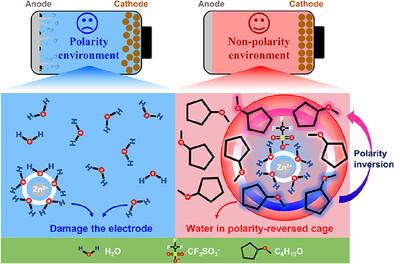
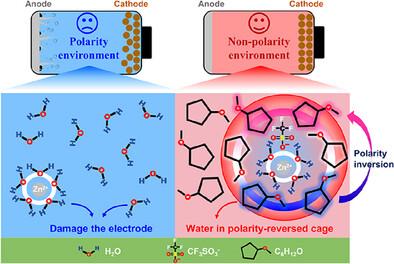
Zinc-ion batteries (ZIBs) have promising prospects in energy storage field, but the water molecules in aqueous electrolytes significantly compromise the stability of the anode and cathode interfaces and hinder the low-temperature performance. Herein, water-in-oil type Möbius polarity topological solvation composed of oil, water, and amphiphilic salt are first-ever pioneered, forming the surfactant-free microemulsion electrolyte (SFMEE). This water-in-oil type Möbius solvation structure, characterized by its distinct inner and outer layers and a polarity inversion feature, successfully connects the non-polar phase with the polar phase, eliminating the need for surfactants to reduce costs and system complexity. The amphiphilic anion of salt creates a polarity singularity and stabilizes the polarity-reversed encapsulation. The outer oil layer disrupts the cohesive polarity network of water and constructs a polarity-reversed cage to restrict water. A series of SFMEE combinations are investigated and then directly applied to ZIBs, confirming excellent universality and durability of this design. The Zn||NVO (NaV₃O₈·1.5H₂O) cells using SFMEE can stably cycle for 4000 cycles with a capacity of 125 mAh g−1 and 86.8% capacity retention. This discovery of Möbius solvation structure unlock unprecedented levels of electrolyte design and illuminate the development of next-generation high-performance energy storage systems.
锌离子电池在储能领域具有广阔的应用前景,但水溶液中的水分子严重影响了电池阳极和阴极界面的稳定性,阻碍了电池的低温性能。本文首次开创了油包水型Möbius极性拓扑溶剂化,由油、水和两亲性盐组成,形成无表面活性剂的微乳液电解质(SFMEE)。这种油包水型Möbius溶剂化结构的特点是其内层和外层明显,具有极性反转特征,成功地将非极性相与极性相连接起来,从而消除了对表面活性剂的需求,从而降低了成本和系统复杂性。盐的两亲性阴离子产生极性奇点,稳定极性反转包封。外油层破坏了水的内聚极性网络,构建了一个极性反转的笼状结构来限制水的存在。研究了一系列SFMEE组合,并将其直接应用于zbs,证实了该设计具有良好的通用性和耐久性。使用SFMEE的Zn||NVO (NaV₃O₈·1.5H₂O)电池可以稳定循环4000次,容量为125 mAh g - 1,容量保持率为86.8%。Möbius溶剂化结构的发现开启了前所未有的电解质设计水平,并照亮了下一代高性能储能系统的发展。
期刊介绍:
Advanced Materials, one of the world's most prestigious journals and the foundation of the Advanced portfolio, is the home of choice for best-in-class materials science for more than 30 years. Following this fast-growing and interdisciplinary field, we are considering and publishing the most important discoveries on any and all materials from materials scientists, chemists, physicists, engineers as well as health and life scientists and bringing you the latest results and trends in modern materials-related research every week.







 京公网安备 11010802042870号
京ICP备2023020795号-1
京公网安备 11010802042870号
京ICP备2023020795号-1

 分享
分享
 求助内容:
求助内容: 应助结果提醒方式:
 扫码关注我们
