Kanghong Wang, Yi Tao, Zikun Tang, Haiguang Zhao, Xuhui Sun, Federico Rosei, Dong Liu and Yujie Xiong
{"title":"Stability of photoelectrochemical cells based on colloidal quantum dots","authors":"Kanghong Wang, Yi Tao, Zikun Tang, Haiguang Zhao, Xuhui Sun, Federico Rosei, Dong Liu and Yujie Xiong","doi":"10.1039/D4CS00587B","DOIUrl":null,"url":null,"abstract":"<p >Solar-driven photoelectrochemical (PEC) cells, sensitized by colloidal quantum dots (QDs), are emerging as a promising approach for solar-to-fuel conversion, including hydrogen evolution and peroxide production. The high absorption coefficient and customizable size/composition/shape of QDs can effectively enhance and broaden the light absorption capabilities of the system. Additionally, QD-based heterostructures can facilitate carrier transfer, thereby enhancing the overall performance. To date, the photocurrent density of QD based photoelectrodes for water splitting has significantly surpassed that of conventional metal oxides and sulfides. However, despite recent advances in enhancing the photocurrent density of QD-based photoelectrodes, long-term operational stability remains a key challenge for their practical applications. Few studies so far have investigated in depth the stability mechanism of QD-based PEC cells alongside potential fabrication improvements. In this Review, we first discuss the dominant factors and mechanisms responsible for the deterioration of both QDs and QD-based PEC devices. Subsequently, we outline the prevalent processing techniques and effective strategies for the fabrication of durable PEC cells. Finally, future perspectives and research directions in this field are proposed.</p>","PeriodicalId":68,"journal":{"name":"Chemical Society Reviews","volume":" 7","pages":" 3513-3534"},"PeriodicalIF":39.0000,"publicationDate":"2025-03-03","publicationTypes":"Journal Article","fieldsOfStudy":null,"isOpenAccess":false,"openAccessPdf":"","citationCount":"0","resultStr":null,"platform":"Semanticscholar","paperid":null,"PeriodicalName":"Chemical Society Reviews","FirstCategoryId":"92","ListUrlMain":"https://pubs.rsc.org/en/content/articlelanding/2025/cs/d4cs00587b","RegionNum":1,"RegionCategory":"化学","ArticlePicture":[],"TitleCN":null,"AbstractTextCN":null,"PMCID":null,"EPubDate":"","PubModel":"","JCR":"Q1","JCRName":"CHEMISTRY, MULTIDISCIPLINARY","Score":null,"Total":0}
引用次数: 0
Abstract
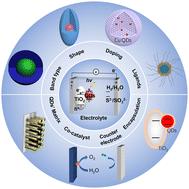
Solar-driven photoelectrochemical (PEC) cells, sensitized by colloidal quantum dots (QDs), are emerging as a promising approach for solar-to-fuel conversion, including hydrogen evolution and peroxide production. The high absorption coefficient and customizable size/composition/shape of QDs can effectively enhance and broaden the light absorption capabilities of the system. Additionally, QD-based heterostructures can facilitate carrier transfer, thereby enhancing the overall performance. To date, the photocurrent density of QD based photoelectrodes for water splitting has significantly surpassed that of conventional metal oxides and sulfides. However, despite recent advances in enhancing the photocurrent density of QD-based photoelectrodes, long-term operational stability remains a key challenge for their practical applications. Few studies so far have investigated in depth the stability mechanism of QD-based PEC cells alongside potential fabrication improvements. In this Review, we first discuss the dominant factors and mechanisms responsible for the deterioration of both QDs and QD-based PEC devices. Subsequently, we outline the prevalent processing techniques and effective strategies for the fabrication of durable PEC cells. Finally, future perspectives and research directions in this field are proposed.
期刊介绍:
Chemical Society Reviews is published by: Royal Society of Chemistry.
Focus: Review articles on topics of current interest in chemistry;
Predecessors: Quarterly Reviews, Chemical Society (1947–1971);
Current title: Since 1971;
Impact factor: 60.615 (2021);
Themed issues: Occasional themed issues on new and emerging areas of research in the chemical sciences





 京公网安备 11010802042870号
京ICP备2023020795号-1
京公网安备 11010802042870号
京ICP备2023020795号-1

 分享
分享
 求助内容:
求助内容: 应助结果提醒方式:
 扫码关注我们
