Niki Mavragani, Alexandros A. Kitos, Rezeda Gayfullina, Akseli Mansikkamäki, Jani O. Moilanen and Muralee Murugesu
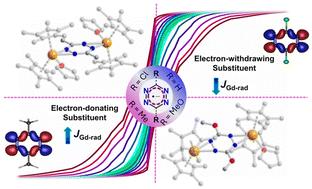
{"title":"Exploring the substitution effect on the magnetic coupling of tetrazinyl-bridged Ln2 single-molecule magnets†","authors":"Niki Mavragani, Alexandros A. Kitos, Rezeda Gayfullina, Akseli Mansikkamäki, Jani O. Moilanen and Muralee Murugesu","doi":"10.1039/D4QI02796E","DOIUrl":null,"url":null,"abstract":"<p >The design of new radical bridging ligands that can effectively promote strong magnetic coupling with Ln<small><sup>III</sup></small> ions needs to focus on radicals that are susceptible to synthetic modifications and bear diffuse spin density on their donor atoms. To probe this, we introduced various substituents possessing different electron-withdrawing/donating capabilities into the redox-active <em>s</em>-tetrazinyl centre. This allowed for the systematic tuning of the redox and optoelectronic properties of the tetrazinyl ring. The effect of substitution on the strength of Ln–rad magnetic coupling was investigated on a series of radical-bridged Ln metallocene complexes featuring the 3,6-dimethyl-1,2,4,5-tetrazine (dmtz) and the 3,6-dimethoxy-1,2,4,5-tetrazine (dmeotz) ligands; [(Cp*<small><sub>2</sub></small>Ln)<small><sub>2</sub></small>(dmtz˙<small><sup>−</sup></small>)(THF)<small><sub>2</sub></small>][BPh<small><sub>4</sub></small>]·THF (Ln = Gd (<strong>1-Gd</strong>) or Dy (<strong>1-Dy</strong>); Cp* = pentamethylcyclopentadienyl; THF = tetrahydrofuran) and [(Cp*<small><sub>2</sub></small>Ln)<small><sub>2</sub></small>(dmeotz˙<small><sup>−</sup></small>)(THF)][BPh<small><sub>4</sub></small>] (Ln = Gd (<strong>2-Gd</strong>) or Dy (<strong>2-Dy</strong>)). Cyclic voltammetry, UV-Vis absorption spectroscopy, SQUID magnetometry and <em>ab initio</em> as well as density functional theory (DFT) calculations are combined to underline the trends observed in this study, while comparisons with the unsubstituted 1,2,4,5-tetrazine (tz) and the 3,6-dichloro-1,2,4,5-tetrazine (dctz) are made. Notably, an intricate interplay between orbital overlap, ligand substituent effects and changes in the coordination environment is found to collectively dictate the magnitude of <em>J</em><small><sub>Gd–rad</sub></small> in the investigated systems. The strong magnetic coupling combined with highly anisotropic Dy<small><sup>III</sup></small> ions makes <strong>1-Dy</strong> and <strong>2-Dy</strong> exhibit slow magnetic relaxation in the absence of an external applied field. For <strong>1-Dy</strong>, an opening of the hysteresis loop is observed with <em>H</em><small><sub>c</sub></small> = ∼5000 Oe, one of the highest coercivities for a dinuclear organic radical-bridged single-molecule magnet.</p>","PeriodicalId":79,"journal":{"name":"Inorganic Chemistry Frontiers","volume":" 9","pages":" 3403-3415"},"PeriodicalIF":6.4000,"publicationDate":"2025-03-03","publicationTypes":"Journal Article","fieldsOfStudy":null,"isOpenAccess":false,"openAccessPdf":"https://pubs.rsc.org/en/content/articlepdf/2025/qi/d4qi02796e?page=search","citationCount":"0","resultStr":null,"platform":"Semanticscholar","paperid":null,"PeriodicalName":"Inorganic Chemistry Frontiers","FirstCategoryId":"92","ListUrlMain":"https://pubs.rsc.org/en/content/articlelanding/2025/qi/d4qi02796e","RegionNum":1,"RegionCategory":"化学","ArticlePicture":[],"TitleCN":null,"AbstractTextCN":null,"PMCID":null,"EPubDate":"","PubModel":"","JCR":"Q1","JCRName":"CHEMISTRY, INORGANIC & NUCLEAR","Score":null,"Total":0}
引用次数: 0
Abstract
The design of new radical bridging ligands that can effectively promote strong magnetic coupling with LnIII ions needs to focus on radicals that are susceptible to synthetic modifications and bear diffuse spin density on their donor atoms. To probe this, we introduced various substituents possessing different electron-withdrawing/donating capabilities into the redox-active s-tetrazinyl centre. This allowed for the systematic tuning of the redox and optoelectronic properties of the tetrazinyl ring. The effect of substitution on the strength of Ln–rad magnetic coupling was investigated on a series of radical-bridged Ln metallocene complexes featuring the 3,6-dimethyl-1,2,4,5-tetrazine (dmtz) and the 3,6-dimethoxy-1,2,4,5-tetrazine (dmeotz) ligands; [(Cp*2Ln)2(dmtz˙−)(THF)2][BPh4]·THF (Ln = Gd (1-Gd) or Dy (1-Dy); Cp* = pentamethylcyclopentadienyl; THF = tetrahydrofuran) and [(Cp*2Ln)2(dmeotz˙−)(THF)][BPh4] (Ln = Gd (2-Gd) or Dy (2-Dy)). Cyclic voltammetry, UV-Vis absorption spectroscopy, SQUID magnetometry and ab initio as well as density functional theory (DFT) calculations are combined to underline the trends observed in this study, while comparisons with the unsubstituted 1,2,4,5-tetrazine (tz) and the 3,6-dichloro-1,2,4,5-tetrazine (dctz) are made. Notably, an intricate interplay between orbital overlap, ligand substituent effects and changes in the coordination environment is found to collectively dictate the magnitude of JGd–rad in the investigated systems. The strong magnetic coupling combined with highly anisotropic DyIII ions makes 1-Dy and 2-Dy exhibit slow magnetic relaxation in the absence of an external applied field. For 1-Dy, an opening of the hysteresis loop is observed with Hc = ∼5000 Oe, one of the highest coercivities for a dinuclear organic radical-bridged single-molecule magnet.




 京公网安备 11010802042870号
京ICP备2023020795号-1
京公网安备 11010802042870号
京ICP备2023020795号-1

 分享
分享
 求助内容:
求助内容: 应助结果提醒方式:
 扫码关注我们
