Javier Sánchez Lorente, Aleksandr V. Sokolov, Gavin Ferguson, Helgi B. Schiöth, Alexander S. Hauser, David E. Gloriam
{"title":"GPCR drug discovery: new agents, targets and indications","authors":"Javier Sánchez Lorente, Aleksandr V. Sokolov, Gavin Ferguson, Helgi B. Schiöth, Alexander S. Hauser, David E. Gloriam","doi":"10.1038/s41573-025-01139-y","DOIUrl":null,"url":null,"abstract":"G protein-coupled receptors (GPCRs) form one of the largest drug target families, reflecting their involvement in numerous pathophysiological processes. In this Review, we analyse drug discovery trends for the GPCR superfamily, covering compounds, targets and indications that have reached regulatory approval or that are being investigated in clinical trials. We find that there are 516 approved drugs targeting GPCRs, making up 36% of all approved drugs. These drugs act on 121 GPCR targets, one-third of all non-sensory GPCRs. Furthermore, 337 agents targeting 133 GPCRs, including 30 novel targets, are being investigated in clinical trials. Notably, 165 of these agents are approved drugs being tested for additional indications and novel agents are increasingly allosteric modulators and biologics. Remarkably, diabetes and obesity drugs targeting GPCRs had sales of nearly US $30 billion in 2023 and the numbers of clinical trials for GPCR modulators in the metabolic diseases, oncology and immunology areas are increasing strongly. Finally, we highlight the potential of untapped target–disease associations and pathway-biased signalling. Overall, this Review provides an up-to-date reference for the drugged and potentially druggable GPCRome to inform future GPCR drug discovery and development. G protein-coupled receptors (GPCRs) are one of the largest families of drug targets. This Review analyses drug discovery trends for GPCRs, covering compounds, targets and indications that have reached regulatory approval or that are being investigated in clinical trials, and also highlights the potential of untapped target–disease associations and pathway-biased signalling.","PeriodicalId":19068,"journal":{"name":"Nature Reviews. Drug Discovery","volume":"24 6","pages":"458-479"},"PeriodicalIF":101.8000,"publicationDate":"2025-03-03","publicationTypes":"Journal Article","fieldsOfStudy":null,"isOpenAccess":false,"openAccessPdf":"","citationCount":"0","resultStr":null,"platform":"Semanticscholar","paperid":null,"PeriodicalName":"Nature Reviews. Drug Discovery","FirstCategoryId":"3","ListUrlMain":"https://www.nature.com/articles/s41573-025-01139-y","RegionNum":1,"RegionCategory":"医学","ArticlePicture":[],"TitleCN":null,"AbstractTextCN":null,"PMCID":null,"EPubDate":"","PubModel":"","JCR":"Q1","JCRName":"BIOTECHNOLOGY & APPLIED MICROBIOLOGY","Score":null,"Total":0}
引用次数: 0
Abstract
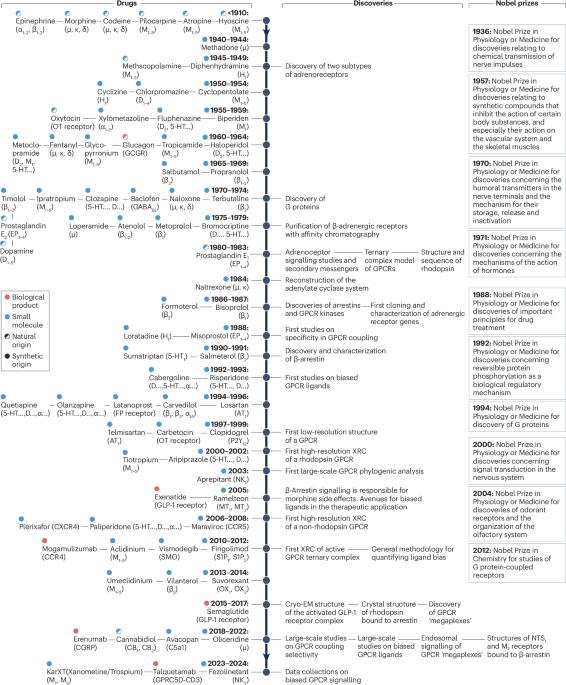
G protein-coupled receptors (GPCRs) form one of the largest drug target families, reflecting their involvement in numerous pathophysiological processes. In this Review, we analyse drug discovery trends for the GPCR superfamily, covering compounds, targets and indications that have reached regulatory approval or that are being investigated in clinical trials. We find that there are 516 approved drugs targeting GPCRs, making up 36% of all approved drugs. These drugs act on 121 GPCR targets, one-third of all non-sensory GPCRs. Furthermore, 337 agents targeting 133 GPCRs, including 30 novel targets, are being investigated in clinical trials. Notably, 165 of these agents are approved drugs being tested for additional indications and novel agents are increasingly allosteric modulators and biologics. Remarkably, diabetes and obesity drugs targeting GPCRs had sales of nearly US $30 billion in 2023 and the numbers of clinical trials for GPCR modulators in the metabolic diseases, oncology and immunology areas are increasing strongly. Finally, we highlight the potential of untapped target–disease associations and pathway-biased signalling. Overall, this Review provides an up-to-date reference for the drugged and potentially druggable GPCRome to inform future GPCR drug discovery and development. G protein-coupled receptors (GPCRs) are one of the largest families of drug targets. This Review analyses drug discovery trends for GPCRs, covering compounds, targets and indications that have reached regulatory approval or that are being investigated in clinical trials, and also highlights the potential of untapped target–disease associations and pathway-biased signalling.
期刊介绍:
Nature Reviews Drug Discovery is a monthly journal aimed at everyone working in the drug discovery and development arena.
Each issue includes:
Highest-quality reviews and perspectives covering a broad scope.
News stories investigating the hottest topics in drug discovery.
Timely summaries of key primary research papers.
Concise updates on the latest advances in areas such as new drug approvals, patent law, and emerging industry trends and strategies.



 京公网安备 11010802042870号
京ICP备2023020795号-1
京公网安备 11010802042870号
京ICP备2023020795号-1

 分享
分享
 求助内容:
求助内容: 应助结果提醒方式:
 扫码关注我们
