Sheraz Muhammad , Lixia Wang , Zhiyang Huang , Aling Zhou , Hazrat Bilal , Tayirjan Taylor Isimjan , Xiulin Yang
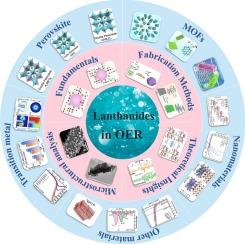
{"title":"Recent advances in lanthanide-based materials for oxygen evolution reaction: Challenges and future prospects","authors":"Sheraz Muhammad , Lixia Wang , Zhiyang Huang , Aling Zhou , Hazrat Bilal , Tayirjan Taylor Isimjan , Xiulin Yang","doi":"10.1016/j.ccr.2025.216573","DOIUrl":null,"url":null,"abstract":"<div><div>Lanthanide-based materials have emerged as highly promising electrocatalysts for the oxygen evolution reaction (OER), a pivotal process in water splitting and energy conversion applications. These materials present a sustainable and cost-effective alternative to noble-metal catalysts, addressing critical challenges of scarcity and cost. Their exceptional catalytic activity and stability are attributed to unique electronic properties, including multiple oxidation states, large ionic radius, and strong spin-orbit coupling. Recent breakthroughs demonstrate significant enhancements in overpotential reduction and long-term stability under extreme electrochemical conditions, positioning lanthanides as a transformative solution for renewable energy systems. This review comprehensively explores various classes of lanthanide-based OER electrocatalysts, including transition metals, metal-organic frameworks (MOFs), perovskites, nanomaterials, and chalcogenides, nitrides, borides, and phosphides. Perovskites, in particular, have achieved remarkable stability and efficiency, underscoring their potential for real-world applications. Tailored strategies such as anionic substitution and heteroatom doping further optimize the electronic structure, active site stabilization, and charge transfer efficiency, driving significant performance improvements. Notably, recent studies report a substantial reduction in overpotential by up to 200 mV for lanthanide-based materials, along with significantly enhanced catalytic durability compared to conventional noble-metal catalysts. Key challenges remain, such as improving electrical conductivity, scalability, and performance longevity. Strategic integration of lanthanides into catalytic frameworks addresses these limitations while reducing reliance on scarce resources. These advancements enable lanthanide-based OER electrocatalysts to revolutionize renewable energy technologies and drive the commercialization of efficient water-splitting and electrochemical processes.</div></div>","PeriodicalId":289,"journal":{"name":"Coordination Chemistry Reviews","volume":"534 ","pages":"Article 216573"},"PeriodicalIF":23.5000,"publicationDate":"2025-07-01","publicationTypes":"Journal Article","fieldsOfStudy":null,"isOpenAccess":false,"openAccessPdf":"","citationCount":"0","resultStr":null,"platform":"Semanticscholar","paperid":null,"PeriodicalName":"Coordination Chemistry Reviews","FirstCategoryId":"92","ListUrlMain":"https://www.sciencedirect.com/science/article/pii/S0010854525001432","RegionNum":1,"RegionCategory":"化学","ArticlePicture":[],"TitleCN":null,"AbstractTextCN":null,"PMCID":null,"EPubDate":"2025/3/4 0:00:00","PubModel":"Epub","JCR":"Q1","JCRName":"CHEMISTRY, INORGANIC & NUCLEAR","Score":null,"Total":0}
引用次数: 0
Abstract
Lanthanide-based materials have emerged as highly promising electrocatalysts for the oxygen evolution reaction (OER), a pivotal process in water splitting and energy conversion applications. These materials present a sustainable and cost-effective alternative to noble-metal catalysts, addressing critical challenges of scarcity and cost. Their exceptional catalytic activity and stability are attributed to unique electronic properties, including multiple oxidation states, large ionic radius, and strong spin-orbit coupling. Recent breakthroughs demonstrate significant enhancements in overpotential reduction and long-term stability under extreme electrochemical conditions, positioning lanthanides as a transformative solution for renewable energy systems. This review comprehensively explores various classes of lanthanide-based OER electrocatalysts, including transition metals, metal-organic frameworks (MOFs), perovskites, nanomaterials, and chalcogenides, nitrides, borides, and phosphides. Perovskites, in particular, have achieved remarkable stability and efficiency, underscoring their potential for real-world applications. Tailored strategies such as anionic substitution and heteroatom doping further optimize the electronic structure, active site stabilization, and charge transfer efficiency, driving significant performance improvements. Notably, recent studies report a substantial reduction in overpotential by up to 200 mV for lanthanide-based materials, along with significantly enhanced catalytic durability compared to conventional noble-metal catalysts. Key challenges remain, such as improving electrical conductivity, scalability, and performance longevity. Strategic integration of lanthanides into catalytic frameworks addresses these limitations while reducing reliance on scarce resources. These advancements enable lanthanide-based OER electrocatalysts to revolutionize renewable energy technologies and drive the commercialization of efficient water-splitting and electrochemical processes.
期刊介绍:
Coordination Chemistry Reviews offers rapid publication of review articles on current and significant topics in coordination chemistry, encompassing organometallic, supramolecular, theoretical, and bioinorganic chemistry. It also covers catalysis, materials chemistry, and metal-organic frameworks from a coordination chemistry perspective. Reviews summarize recent developments or discuss specific techniques, welcoming contributions from both established and emerging researchers.
The journal releases special issues on timely subjects, including those featuring contributions from specific regions or conferences. Occasional full-length book articles are also featured. Additionally, special volumes cover annual reviews of main group chemistry, transition metal group chemistry, and organometallic chemistry. These comprehensive reviews are vital resources for those engaged in coordination chemistry, further establishing Coordination Chemistry Reviews as a hub for insightful surveys in inorganic and physical inorganic chemistry.



 京公网安备 11010802042870号
京ICP备2023020795号-1
京公网安备 11010802042870号
京ICP备2023020795号-1

 分享
分享
 求助内容:
求助内容: 应助结果提醒方式:
 扫码关注我们
