{"title":"In-situ measurement of heat and mass transfer behavior in alternating-arc through polarity-switching self-adaptive shunt","authors":"Qingsong Hu, Minliang Wang, Zhaoyang Yan, Shujun Chen","doi":"10.1016/j.ijheatmasstransfer.2025.126891","DOIUrl":null,"url":null,"abstract":"<div><div>Correctly integrating and planning the use of heat source to provide heat and mass transfer on demand is the key factor to achieving high forming efficiency and high forming accuracy in arc-based directed energy deposition. The Alternating-Arc through Polarity-Switching Self-Adaptive Shunt (PSSAS) method precisely manages current distribution between wire and substrate, effectively decoupling heat and mass transfer. This allows tailored heat input for each deposition layer while maintaining high efficiency. Using in-situ measurements, this study quantifies heat transfer to the substrate and wire, calculates droplet temperature, and captures droplet size via high-speed imaging. Results show that PSSAS transfers anode heat from the substrate to the wire during the electrode negative (EN) phase, reducing substrate heat transfer by 45.9 % to 55.7 %. As EN current increases, substrate heat transfer grows slowly, rising only 41.7 % within 70A to 150A. At the same welding current, wire heat transfer in PSSAS is 31.3 % to 43.9 % higher than in traditional Variable Polarity Plasma Arc (VPPA), indicating superior wire melting efficiency. Overall, PSSAS reduces heat transfer to the substrate by approximately 50 % compared to the traditional VPPA mode, while increasing heat transfer to wire by about 35 %. Further analysis reveals that electromagnetic and plasma flow forces drive droplet transfer in PSSAS, ensuring controlled transfer and good forming quality. PSSAS thus offers decoupled heat and mass transfer with controllable droplet transfer, providing a novel approach for arc-based directed energy deposition.</div></div>","PeriodicalId":336,"journal":{"name":"International Journal of Heat and Mass Transfer","volume":"243 ","pages":"Article 126891"},"PeriodicalIF":5.8000,"publicationDate":"2025-03-04","publicationTypes":"Journal Article","fieldsOfStudy":null,"isOpenAccess":false,"openAccessPdf":"","citationCount":"0","resultStr":null,"platform":"Semanticscholar","paperid":null,"PeriodicalName":"International Journal of Heat and Mass Transfer","FirstCategoryId":"5","ListUrlMain":"https://www.sciencedirect.com/science/article/pii/S0017931025002327","RegionNum":2,"RegionCategory":"工程技术","ArticlePicture":[],"TitleCN":null,"AbstractTextCN":null,"PMCID":null,"EPubDate":"","PubModel":"","JCR":"Q1","JCRName":"ENGINEERING, MECHANICAL","Score":null,"Total":0}
引用次数: 0
Abstract
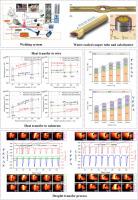
Correctly integrating and planning the use of heat source to provide heat and mass transfer on demand is the key factor to achieving high forming efficiency and high forming accuracy in arc-based directed energy deposition. The Alternating-Arc through Polarity-Switching Self-Adaptive Shunt (PSSAS) method precisely manages current distribution between wire and substrate, effectively decoupling heat and mass transfer. This allows tailored heat input for each deposition layer while maintaining high efficiency. Using in-situ measurements, this study quantifies heat transfer to the substrate and wire, calculates droplet temperature, and captures droplet size via high-speed imaging. Results show that PSSAS transfers anode heat from the substrate to the wire during the electrode negative (EN) phase, reducing substrate heat transfer by 45.9 % to 55.7 %. As EN current increases, substrate heat transfer grows slowly, rising only 41.7 % within 70A to 150A. At the same welding current, wire heat transfer in PSSAS is 31.3 % to 43.9 % higher than in traditional Variable Polarity Plasma Arc (VPPA), indicating superior wire melting efficiency. Overall, PSSAS reduces heat transfer to the substrate by approximately 50 % compared to the traditional VPPA mode, while increasing heat transfer to wire by about 35 %. Further analysis reveals that electromagnetic and plasma flow forces drive droplet transfer in PSSAS, ensuring controlled transfer and good forming quality. PSSAS thus offers decoupled heat and mass transfer with controllable droplet transfer, providing a novel approach for arc-based directed energy deposition.
期刊介绍:
International Journal of Heat and Mass Transfer is the vehicle for the exchange of basic ideas in heat and mass transfer between research workers and engineers throughout the world. It focuses on both analytical and experimental research, with an emphasis on contributions which increase the basic understanding of transfer processes and their application to engineering problems.
Topics include:
-New methods of measuring and/or correlating transport-property data
-Energy engineering
-Environmental applications of heat and/or mass transfer



 京公网安备 11010802042870号
京ICP备2023020795号-1
京公网安备 11010802042870号
京ICP备2023020795号-1

 分享
分享
 求助内容:
求助内容: 应助结果提醒方式:
 扫码关注我们
