Hui Bian , Dandan Ma , Yi Nan , Myung Hwa Kim , Sehoon Kim , Xiaoqiang Chen , Xiaojun Peng , Juyoung Yoon
{"title":"Advances in organic nano-architectures based on NIR-II small-molecule fluorophores for biomedical imaging and therapy","authors":"Hui Bian , Dandan Ma , Yi Nan , Myung Hwa Kim , Sehoon Kim , Xiaoqiang Chen , Xiaojun Peng , Juyoung Yoon","doi":"10.1016/j.ccr.2025.216551","DOIUrl":null,"url":null,"abstract":"<div><div>The second near-infrared window (NIR-II) has emerged as a highly promising domain for clinical applications, with small-molecule fluorophores leading this development. Various fluorophores, such as cyanine dyes, rhodamines, BODIPY, and D-A structured molecules, have been specifically designed to meet diverse biomedical needs. These fluorophores are distinguished by their precise chemical structures, ease of modification, and excellent biocompatibility, making them ideal for medical applications such as precise fluorescence imaging of micro bio-tissues, surgical navigation, in vivo cell tracking, advanced biosensing, and targeted phototherapy for malignant cell eradication. However, significant challenges persist in the clinical translation of these fluorophores, including low fluorescence efficiency and insufficient targeting specificity for diseased tissues. Nanotechnology has emerged as a powerful strategy to overcome these obstacles. Integrating nanocarriers with fluorophores enhances their photophysical characteristics, such as enhancing fluorescence emission, reactive oxygen species generation, and photothermal conversion efficiency in biological environments. Additionally, nanocarriers improve biophysical properties by enhancing solubility, prolonging circulation times, improving biocompatibility, and enabling more precise accumulation in pathological tissues. This review comprehensively analyzes the fundamental challenges associated with NIR-II small molecules, focusing on limitations that cannot be addressed through simple chemical modifications. It also explores how nanotechnology-based approaches can alleviate these challenges, emphasizing the mechanisms behind these enhancements. Furthermore, the review highlights the broad biomedical applications of nano-engineered NIR-II fluorophores. Lastly, it discusses the remaining barriers to clinical translation and emphasizes the growing role of artificial intelligence in expediting the rational design of novel NIR-II fluorophores and optimizing image processing techniques for enhanced diagnostic precision. By providing a comprehensive overview of the current state of the field, this review provides key insights that could expedite the clinical translation of NIR-II technologies.</div></div>","PeriodicalId":289,"journal":{"name":"Coordination Chemistry Reviews","volume":"534 ","pages":"Article 216551"},"PeriodicalIF":23.5000,"publicationDate":"2025-03-04","publicationTypes":"Journal Article","fieldsOfStudy":null,"isOpenAccess":false,"openAccessPdf":"","citationCount":"0","resultStr":null,"platform":"Semanticscholar","paperid":null,"PeriodicalName":"Coordination Chemistry Reviews","FirstCategoryId":"92","ListUrlMain":"https://www.sciencedirect.com/science/article/pii/S0010854525001213","RegionNum":1,"RegionCategory":"化学","ArticlePicture":[],"TitleCN":null,"AbstractTextCN":null,"PMCID":null,"EPubDate":"","PubModel":"","JCR":"Q1","JCRName":"CHEMISTRY, INORGANIC & NUCLEAR","Score":null,"Total":0}
引用次数: 0
Abstract
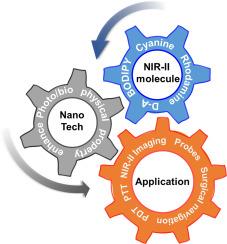
The second near-infrared window (NIR-II) has emerged as a highly promising domain for clinical applications, with small-molecule fluorophores leading this development. Various fluorophores, such as cyanine dyes, rhodamines, BODIPY, and D-A structured molecules, have been specifically designed to meet diverse biomedical needs. These fluorophores are distinguished by their precise chemical structures, ease of modification, and excellent biocompatibility, making them ideal for medical applications such as precise fluorescence imaging of micro bio-tissues, surgical navigation, in vivo cell tracking, advanced biosensing, and targeted phototherapy for malignant cell eradication. However, significant challenges persist in the clinical translation of these fluorophores, including low fluorescence efficiency and insufficient targeting specificity for diseased tissues. Nanotechnology has emerged as a powerful strategy to overcome these obstacles. Integrating nanocarriers with fluorophores enhances their photophysical characteristics, such as enhancing fluorescence emission, reactive oxygen species generation, and photothermal conversion efficiency in biological environments. Additionally, nanocarriers improve biophysical properties by enhancing solubility, prolonging circulation times, improving biocompatibility, and enabling more precise accumulation in pathological tissues. This review comprehensively analyzes the fundamental challenges associated with NIR-II small molecules, focusing on limitations that cannot be addressed through simple chemical modifications. It also explores how nanotechnology-based approaches can alleviate these challenges, emphasizing the mechanisms behind these enhancements. Furthermore, the review highlights the broad biomedical applications of nano-engineered NIR-II fluorophores. Lastly, it discusses the remaining barriers to clinical translation and emphasizes the growing role of artificial intelligence in expediting the rational design of novel NIR-II fluorophores and optimizing image processing techniques for enhanced diagnostic precision. By providing a comprehensive overview of the current state of the field, this review provides key insights that could expedite the clinical translation of NIR-II technologies.
期刊介绍:
Coordination Chemistry Reviews offers rapid publication of review articles on current and significant topics in coordination chemistry, encompassing organometallic, supramolecular, theoretical, and bioinorganic chemistry. It also covers catalysis, materials chemistry, and metal-organic frameworks from a coordination chemistry perspective. Reviews summarize recent developments or discuss specific techniques, welcoming contributions from both established and emerging researchers.
The journal releases special issues on timely subjects, including those featuring contributions from specific regions or conferences. Occasional full-length book articles are also featured. Additionally, special volumes cover annual reviews of main group chemistry, transition metal group chemistry, and organometallic chemistry. These comprehensive reviews are vital resources for those engaged in coordination chemistry, further establishing Coordination Chemistry Reviews as a hub for insightful surveys in inorganic and physical inorganic chemistry.



 京公网安备 11010802042870号
京ICP备2023020795号-1
京公网安备 11010802042870号
京ICP备2023020795号-1

 分享
分享
 求助内容:
求助内容: 应助结果提醒方式:
 扫码关注我们
