Pavitra Singh , E. Hemachandran , Umesh Prasad , Kamlesh Kumar Singh , B. Mallik
{"title":"Numerical analysis of a gas-solid vortex dryer integrated with a waste heat recovery system","authors":"Pavitra Singh , E. Hemachandran , Umesh Prasad , Kamlesh Kumar Singh , B. Mallik","doi":"10.1016/j.jtice.2025.106037","DOIUrl":null,"url":null,"abstract":"<div><div>The gas-solid vortex (GSV) dryer is considered to be very ideal for grain drying since it is characterized by a better transfer of heat and mass transfer capabilities. To improve this dryer for grain drying application, an enhanced version is proposed, which was the integration of a GSV dryer with a waste heat recovery (WHR) system. This would recycle waste heat during the initial drying phase and improve the overall efficiency of drying. Both numerical simulation and experimental validation were conducted on the enhanced dryer. The Eulerian-Eulerian approach was used to analyze numerically by ANSYS FLUENT 14.5. Dryer performance was assessed at different conditions, including temperatures of 328 K, 333 K, and 338 K; air velocities between 25 and 35 m/s; and solid feed amounts ranging from 500 to 1500 g. Waste heat recovery in the GSV dryer improved the efficiency of drying considerably by an increase of 29.7 %. This enhancement optimizes energy use and reduces operational costs, making the GSV dryer with the WHR system a more sustainable and cost-effective solution for grain drying.</div></div>","PeriodicalId":381,"journal":{"name":"Journal of the Taiwan Institute of Chemical Engineers","volume":"171 ","pages":"Article 106037"},"PeriodicalIF":6.3000,"publicationDate":"2025-06-01","publicationTypes":"Journal Article","fieldsOfStudy":null,"isOpenAccess":false,"openAccessPdf":"","citationCount":"0","resultStr":null,"platform":"Semanticscholar","paperid":null,"PeriodicalName":"Journal of the Taiwan Institute of Chemical Engineers","FirstCategoryId":"5","ListUrlMain":"https://www.sciencedirect.com/science/article/pii/S1876107025000902","RegionNum":3,"RegionCategory":"工程技术","ArticlePicture":[],"TitleCN":null,"AbstractTextCN":null,"PMCID":null,"EPubDate":"2025/3/3 0:00:00","PubModel":"Epub","JCR":"Q1","JCRName":"ENGINEERING, CHEMICAL","Score":null,"Total":0}
引用次数: 0
Abstract
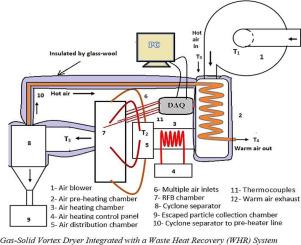
The gas-solid vortex (GSV) dryer is considered to be very ideal for grain drying since it is characterized by a better transfer of heat and mass transfer capabilities. To improve this dryer for grain drying application, an enhanced version is proposed, which was the integration of a GSV dryer with a waste heat recovery (WHR) system. This would recycle waste heat during the initial drying phase and improve the overall efficiency of drying. Both numerical simulation and experimental validation were conducted on the enhanced dryer. The Eulerian-Eulerian approach was used to analyze numerically by ANSYS FLUENT 14.5. Dryer performance was assessed at different conditions, including temperatures of 328 K, 333 K, and 338 K; air velocities between 25 and 35 m/s; and solid feed amounts ranging from 500 to 1500 g. Waste heat recovery in the GSV dryer improved the efficiency of drying considerably by an increase of 29.7 %. This enhancement optimizes energy use and reduces operational costs, making the GSV dryer with the WHR system a more sustainable and cost-effective solution for grain drying.
期刊介绍:
Journal of the Taiwan Institute of Chemical Engineers (formerly known as Journal of the Chinese Institute of Chemical Engineers) publishes original works, from fundamental principles to practical applications, in the broad field of chemical engineering with special focus on three aspects: Chemical and Biomolecular Science and Technology, Energy and Environmental Science and Technology, and Materials Science and Technology. Authors should choose for their manuscript an appropriate aspect section and a few related classifications when submitting to the journal online.



 京公网安备 11010802042870号
京ICP备2023020795号-1
京公网安备 11010802042870号
京ICP备2023020795号-1

 分享
分享
 求助内容:
求助内容: 应助结果提醒方式:
 扫码关注我们
