Baofa Lan, Shaohui Yuan, Yanyi Zhong, Wenkai Zhao, Jia Wang, Wendi Shi, Guankui Long, Oleg A. Rakitin, Jiangbin Zhang, Kai Han, Bin Kan and Yongsheng Chen
{"title":"A medium bandgap dimeric acceptor with a high open-circuit voltage for efficient organic solar cells†","authors":"Baofa Lan, Shaohui Yuan, Yanyi Zhong, Wenkai Zhao, Jia Wang, Wendi Shi, Guankui Long, Oleg A. Rakitin, Jiangbin Zhang, Kai Han, Bin Kan and Yongsheng Chen","doi":"10.1039/D5MH00129C","DOIUrl":null,"url":null,"abstract":"<p >Dimeric acceptors (DMAs) exhibit significant potential for optimizing both the efficiency and stability of organic solar cells (OSCs). However, medium band-gap DMAs with a high open-circuit voltage (<em>V</em><small><sub>oc</sub></small>) for efficient OSCs remain underexplored. In this study, we designed and synthesized a medium bandgap dimeric acceptor, designated DYO-1, through the strategy of alkoxy side-chain substitutions. The resultant DYO-1 exhibited an upshifted lowest unoccupied molecular orbital (LUMO) level and blue-shifted absorption. Notably, an <em>o</em>-xylene (<em>o</em>-XY) processed OSC with a PM6:DYO-1 binary blend achieved an ultra-high <em>V</em><small><sub>oc</sub></small> of 1.022 V and a fill factor (FF) of 73.9%, resulting in a power conversion efficiency (PCE) of 15.1%. To our knowledge, this is the highest PCE reported thus far for dimer-based OSCs with a <em>V</em><small><sub>oc</sub></small> exceeding 1.0 V. Furthermore, DYO-1 was incorporated into a PM6:L8-BO-X blend film, effectively reducing excessive aggregation of the host blend film, thus improving the carrier transport efficiency and enhancing both the short-circuit current (<em>J</em><small><sub>sc</sub></small>) and FF. Alongside the improvement in <em>V</em><small><sub>oc</sub></small>, the PM6:L8-BO-X:DYO-1 based ternary OSC, which is prepared using an <em>o</em>-XY solvent, achieved a prominent PCE of 19.6%. Additionally, a module device with an effective area of 13.5 cm<small><sup>2</sup></small> exhibited a PCE of 15.8%, highlighting the potential for large-area fabrications. Our study unveils the importance of medium bandgap dimeric acceptors in achieving efficient and stable OSCs, providing valuable insights into the design of high-performance electron acceptors.</p>","PeriodicalId":87,"journal":{"name":"Materials Horizons","volume":" 10","pages":" 3349-3357"},"PeriodicalIF":10.7000,"publicationDate":"2025-02-24","publicationTypes":"Journal Article","fieldsOfStudy":null,"isOpenAccess":false,"openAccessPdf":"","citationCount":"0","resultStr":null,"platform":"Semanticscholar","paperid":null,"PeriodicalName":"Materials Horizons","FirstCategoryId":"88","ListUrlMain":"https://pubs.rsc.org/en/content/articlelanding/2025/mh/d5mh00129c","RegionNum":2,"RegionCategory":"材料科学","ArticlePicture":[],"TitleCN":null,"AbstractTextCN":null,"PMCID":null,"EPubDate":"","PubModel":"","JCR":"Q1","JCRName":"CHEMISTRY, MULTIDISCIPLINARY","Score":null,"Total":0}
引用次数: 0
Abstract
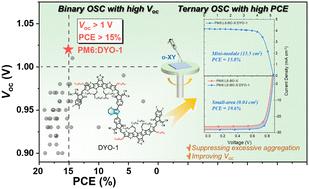
Dimeric acceptors (DMAs) exhibit significant potential for optimizing both the efficiency and stability of organic solar cells (OSCs). However, medium band-gap DMAs with a high open-circuit voltage (Voc) for efficient OSCs remain underexplored. In this study, we designed and synthesized a medium bandgap dimeric acceptor, designated DYO-1, through the strategy of alkoxy side-chain substitutions. The resultant DYO-1 exhibited an upshifted lowest unoccupied molecular orbital (LUMO) level and blue-shifted absorption. Notably, an o-xylene (o-XY) processed OSC with a PM6:DYO-1 binary blend achieved an ultra-high Voc of 1.022 V and a fill factor (FF) of 73.9%, resulting in a power conversion efficiency (PCE) of 15.1%. To our knowledge, this is the highest PCE reported thus far for dimer-based OSCs with a Voc exceeding 1.0 V. Furthermore, DYO-1 was incorporated into a PM6:L8-BO-X blend film, effectively reducing excessive aggregation of the host blend film, thus improving the carrier transport efficiency and enhancing both the short-circuit current (Jsc) and FF. Alongside the improvement in Voc, the PM6:L8-BO-X:DYO-1 based ternary OSC, which is prepared using an o-XY solvent, achieved a prominent PCE of 19.6%. Additionally, a module device with an effective area of 13.5 cm2 exhibited a PCE of 15.8%, highlighting the potential for large-area fabrications. Our study unveils the importance of medium bandgap dimeric acceptors in achieving efficient and stable OSCs, providing valuable insights into the design of high-performance electron acceptors.



 京公网安备 11010802042870号
京ICP备2023020795号-1
京公网安备 11010802042870号
京ICP备2023020795号-1

 分享
分享
 求助内容:
求助内容: 应助结果提醒方式:
 扫码关注我们
