{"title":"Signaling Pathways and Promising Small-Molecule Therapeutic Agents for Ischemic Stroke","authors":"Debasis Das, Yimeng Wu, Jian Hong","doi":"10.1002/cmdc.202400975","DOIUrl":null,"url":null,"abstract":"<p>Stroke is the second highest cause of death and leading cause of disability with high economic burden worldwide. The incidence of stroke is increasing faster and more prevalent for the global population over age 65. Ischemic stroke (IS) has a higher incidence than hemorrhagic stroke, accounting over 80 % of the total incidence of stroke. The rate of ischemic stroke is increasing in all age groups and both sexes. In present era, hypertension, high blood pressure and modern lifestyle are considered as the causes of the disease. The treatment options for stroke is still limited, mainly thrombolytic and thrombectomy therapy are available options. In the past decade, a number of therapeutic agents have been studied for the acute ischemic stroke to protect the brain from ischemic injury. Several study methods focus to improve neurons functions around the ischemic core and protect from the shock. Many signalling pathways including NF-kB, NrF, Nrf2-Keap1, PI3K/AKT, JAK/STAT signalling pathways are strongly associated for the indication. Controlling the signalling pathways by small molecules potentially improve the neuronal functions. In this article, we review the recent advancement of the drug discovery, controlling the signalling pathways by small molecules, and kinase inhibitors in ischemic stroke.</p>","PeriodicalId":147,"journal":{"name":"ChemMedChem","volume":"20 10","pages":""},"PeriodicalIF":3.4000,"publicationDate":"2025-03-02","publicationTypes":"Journal Article","fieldsOfStudy":null,"isOpenAccess":false,"openAccessPdf":"","citationCount":"0","resultStr":null,"platform":"Semanticscholar","paperid":null,"PeriodicalName":"ChemMedChem","FirstCategoryId":"3","ListUrlMain":"https://chemistry-europe.onlinelibrary.wiley.com/doi/10.1002/cmdc.202400975","RegionNum":4,"RegionCategory":"医学","ArticlePicture":[],"TitleCN":null,"AbstractTextCN":null,"PMCID":null,"EPubDate":"","PubModel":"","JCR":"Q2","JCRName":"CHEMISTRY, MEDICINAL","Score":null,"Total":0}
引用次数: 0
Abstract
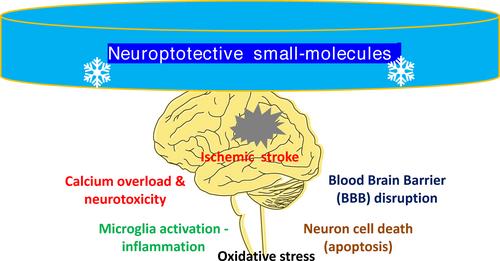
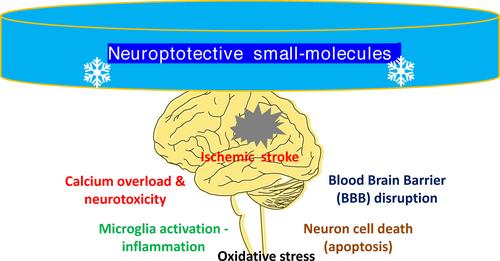
Stroke is the second highest cause of death and leading cause of disability with high economic burden worldwide. The incidence of stroke is increasing faster and more prevalent for the global population over age 65. Ischemic stroke (IS) has a higher incidence than hemorrhagic stroke, accounting over 80 % of the total incidence of stroke. The rate of ischemic stroke is increasing in all age groups and both sexes. In present era, hypertension, high blood pressure and modern lifestyle are considered as the causes of the disease. The treatment options for stroke is still limited, mainly thrombolytic and thrombectomy therapy are available options. In the past decade, a number of therapeutic agents have been studied for the acute ischemic stroke to protect the brain from ischemic injury. Several study methods focus to improve neurons functions around the ischemic core and protect from the shock. Many signalling pathways including NF-kB, NrF, Nrf2-Keap1, PI3K/AKT, JAK/STAT signalling pathways are strongly associated for the indication. Controlling the signalling pathways by small molecules potentially improve the neuronal functions. In this article, we review the recent advancement of the drug discovery, controlling the signalling pathways by small molecules, and kinase inhibitors in ischemic stroke.
期刊介绍:
Quality research. Outstanding publications. With an impact factor of 3.124 (2019), ChemMedChem is a top journal for research at the interface of chemistry, biology and medicine. It is published on behalf of Chemistry Europe, an association of 16 European chemical societies.
ChemMedChem publishes primary as well as critical secondary and tertiary information from authors across and for the world. Its mission is to integrate the wide and flourishing field of medicinal and pharmaceutical sciences, ranging from drug design and discovery to drug development and delivery, from molecular modeling to combinatorial chemistry, from target validation to lead generation and ADMET studies. ChemMedChem typically covers topics on small molecules, therapeutic macromolecules, peptides, peptidomimetics, and aptamers, protein-drug conjugates, nucleic acid therapies, and beginning 2017, nanomedicine, particularly 1) targeted nanodelivery, 2) theranostic nanoparticles, and 3) nanodrugs.
Contents
ChemMedChem publishes an attractive mixture of:
Full Papers and Communications
Reviews and Minireviews
Patent Reviews
Highlights and Concepts
Book and Multimedia Reviews.





 京公网安备 11010802042870号
京ICP备2023020795号-1
京公网安备 11010802042870号
京ICP备2023020795号-1

 分享
分享
 求助内容:
求助内容: 应助结果提醒方式:
 扫码关注我们
