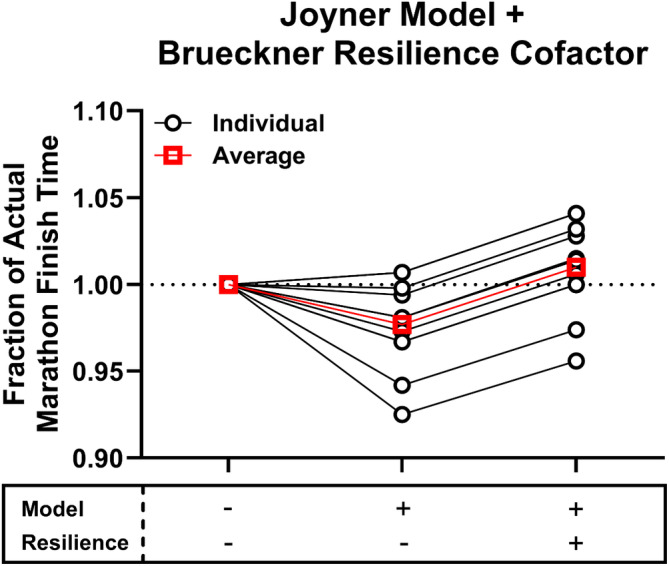
{"title":"Physiological Resilience: What Is It and How Might It Be Trained?","authors":"Andrew M Jones, Brett S Kirby","doi":"10.1111/sms.70032","DOIUrl":null,"url":null,"abstract":"<p><p>Physiological resilience has recently been recognized as an additional factor that influences endurance exercise performance. It has thus been incorporated into a modified, contemporary version of \"the Joyner model\" which acknowledges that start-line values of V̇O<sub>2</sub>max, efficiency or economy, and metabolic thresholds are prone to deterioration, often with appreciable interindividual variability, during prolonged endurance exercise. The physiological underpinnings of resilience are elusive and sports physiologists are presently concerned with developing practical testing protocols which reflect an athlete's resilience characteristics. It is also important to consider why some athletes are more resilient than others and whether resilience can be enhanced-and, if so, which training programs or specific training sessions might stimulate its development. While data are scant, the available evidence suggests that training consistency and the accumulation of relatively large volumes of training over the longer-term (i.e., several years) might promote resilience. The inclusion of regular prolonged exercise sessions within a training program, especially when these include bouts of high-intensity exercise at race pace or above or a progressive increase in intensity in the face of developing fatigue, might also represent an effective means of enhancing resilience. Finally, resistance training, especially heavy strength and plyometric training, appears to have positive effects on resilience. Considerations of training for resilience, alongside other more established physiological determinants of performance, will likely be important in the long-term development of successful endurance athletes.</p>","PeriodicalId":21466,"journal":{"name":"Scandinavian Journal of Medicine & Science in Sports","volume":"35 3","pages":"e70032"},"PeriodicalIF":3.8000,"publicationDate":"2025-03-01","publicationTypes":"Journal Article","fieldsOfStudy":null,"isOpenAccess":false,"openAccessPdf":"https://www.ncbi.nlm.nih.gov/pmc/articles/PMC11872681/pdf/","citationCount":"0","resultStr":null,"platform":"Semanticscholar","paperid":null,"PeriodicalName":"Scandinavian Journal of Medicine & Science in Sports","FirstCategoryId":"3","ListUrlMain":"https://doi.org/10.1111/sms.70032","RegionNum":2,"RegionCategory":"医学","ArticlePicture":[],"TitleCN":null,"AbstractTextCN":null,"PMCID":null,"EPubDate":"","PubModel":"","JCR":"Q1","JCRName":"SPORT SCIENCES","Score":null,"Total":0}
引用次数: 0
Abstract
Physiological resilience has recently been recognized as an additional factor that influences endurance exercise performance. It has thus been incorporated into a modified, contemporary version of "the Joyner model" which acknowledges that start-line values of V̇O2max, efficiency or economy, and metabolic thresholds are prone to deterioration, often with appreciable interindividual variability, during prolonged endurance exercise. The physiological underpinnings of resilience are elusive and sports physiologists are presently concerned with developing practical testing protocols which reflect an athlete's resilience characteristics. It is also important to consider why some athletes are more resilient than others and whether resilience can be enhanced-and, if so, which training programs or specific training sessions might stimulate its development. While data are scant, the available evidence suggests that training consistency and the accumulation of relatively large volumes of training over the longer-term (i.e., several years) might promote resilience. The inclusion of regular prolonged exercise sessions within a training program, especially when these include bouts of high-intensity exercise at race pace or above or a progressive increase in intensity in the face of developing fatigue, might also represent an effective means of enhancing resilience. Finally, resistance training, especially heavy strength and plyometric training, appears to have positive effects on resilience. Considerations of training for resilience, alongside other more established physiological determinants of performance, will likely be important in the long-term development of successful endurance athletes.
期刊介绍:
The Scandinavian Journal of Medicine & Science in Sports is a multidisciplinary journal published 12 times per year under the auspices of the Scandinavian Foundation of Medicine and Science in Sports.
It aims to publish high quality and impactful articles in the fields of orthopaedics, rehabilitation and sports medicine, exercise physiology and biochemistry, biomechanics and motor control, health and disease relating to sport, exercise and physical activity, as well as on the social and behavioural aspects of sport and exercise.





 京公网安备 11010802042870号
京ICP备2023020795号-1
京公网安备 11010802042870号
京ICP备2023020795号-1

 分享
分享
 求助内容:
求助内容: 应助结果提醒方式:
 扫码关注我们
