Lasya Daggumati BA , Chu-Shu Gu PhD , Raghu Kolluri MD, MS , Pavan Kavali MD , Suresh Vedantham MD
{"title":"The Effect of Thrombolysis of Deep Vein Thrombosis on Late Symptoms of Post–Pulmonary Embolism Syndrome","authors":"Lasya Daggumati BA , Chu-Shu Gu PhD , Raghu Kolluri MD, MS , Pavan Kavali MD , Suresh Vedantham MD","doi":"10.1016/j.jvir.2025.02.024","DOIUrl":null,"url":null,"abstract":"<div><div>In the Acute Venous Thrombosis: Thrombus Removal with Adjunctive Catheter-Directed Thrombolysis (ATTRACT) trial, 691 patients were randomly assigned to receive or not receive pharmacomechanical catheter-directed thrombolysis (PCDT) to treat acute proximal deep vein thrombosis (DVT). Serious adverse events and suspected pulmonary embolism (PE) (collectively, “late symptom events” [LSEs]) were reported. An independent physician, blinded to treatment allocation, categorized LSEs occurring 1–24 months after randomization by whether they could relate to post-PE syndrome. PE-related LSEs were frequent (66.7%) in patients who presented with diagnosed or suspected PE and infrequent (2.0%) in others; however, PCDT did not influence their occurrence (PCDT, 11.0% vs No-PCDT, 11.0; <em>P</em> = 1.000). However, in the iliofemoral DVT subgroup, patients in the PCDT arm had fewer PE-related LSEs per patient (PCDT, 0.14 vs No-PCDT, 0.24; <em>P</em> = .036) and fewer PE-related breathing/lung LSEs per patient (PCDT, 0.08 vs No-PCDT, 0.16; <em>P</em> = .023). PCDT was associated with a lower incidence of PE-related LSEs in patients with iliofemoral DVT who presented with PE symptoms at baseline. Evaluation for post-PE syndrome after DVT thrombolysis can be focused on this subset of patients.</div></div>","PeriodicalId":49962,"journal":{"name":"Journal of Vascular and Interventional Radiology","volume":"36 6","pages":"Pages 1026-1030"},"PeriodicalIF":3.1000,"publicationDate":"2025-06-01","publicationTypes":"Journal Article","fieldsOfStudy":null,"isOpenAccess":false,"openAccessPdf":"","citationCount":"0","resultStr":null,"platform":"Semanticscholar","paperid":null,"PeriodicalName":"Journal of Vascular and Interventional Radiology","FirstCategoryId":"3","ListUrlMain":"https://www.sciencedirect.com/science/article/pii/S1051044325002167","RegionNum":3,"RegionCategory":"医学","ArticlePicture":[],"TitleCN":null,"AbstractTextCN":null,"PMCID":null,"EPubDate":"2025/2/27 0:00:00","PubModel":"Epub","JCR":"Q2","JCRName":"PERIPHERAL VASCULAR DISEASE","Score":null,"Total":0}
引用次数: 0
Abstract
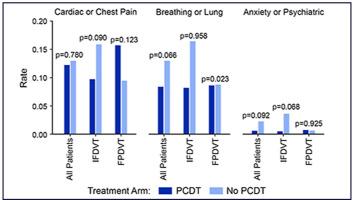
In the Acute Venous Thrombosis: Thrombus Removal with Adjunctive Catheter-Directed Thrombolysis (ATTRACT) trial, 691 patients were randomly assigned to receive or not receive pharmacomechanical catheter-directed thrombolysis (PCDT) to treat acute proximal deep vein thrombosis (DVT). Serious adverse events and suspected pulmonary embolism (PE) (collectively, “late symptom events” [LSEs]) were reported. An independent physician, blinded to treatment allocation, categorized LSEs occurring 1–24 months after randomization by whether they could relate to post-PE syndrome. PE-related LSEs were frequent (66.7%) in patients who presented with diagnosed or suspected PE and infrequent (2.0%) in others; however, PCDT did not influence their occurrence (PCDT, 11.0% vs No-PCDT, 11.0; P = 1.000). However, in the iliofemoral DVT subgroup, patients in the PCDT arm had fewer PE-related LSEs per patient (PCDT, 0.14 vs No-PCDT, 0.24; P = .036) and fewer PE-related breathing/lung LSEs per patient (PCDT, 0.08 vs No-PCDT, 0.16; P = .023). PCDT was associated with a lower incidence of PE-related LSEs in patients with iliofemoral DVT who presented with PE symptoms at baseline. Evaluation for post-PE syndrome after DVT thrombolysis can be focused on this subset of patients.
在 ATTRACT 试验中,691 名患者被随机分配接受或不接受药物机械导管引导溶栓疗法 (PCDT) 治疗急性近端深静脉血栓形成 (DVT)。严重不良事件和疑似 PE(统称为 "晚期症状事件",LSE)均有报告。一位独立医生在治疗分配盲法的基础上,根据是否与 PE 后综合征有关,对随机后 1-24 个月内发生的 LSE 进行了分类。在确诊或疑似 PE 的患者中,与 PE 相关的 LSE 频繁发生(66.7%),而在其他患者中则很少发生(2.0%),但 PCDT 并不影响其发生率(PCDT 11.0% vs. No-PCDT 11.0%,P=1.000)。然而,在髂股深静脉血栓亚组中,PCDT Arm 患者人均 PE 相关 LSE 更少(PCDT 0.14 vs. No-PCDT 0.24,p=0.036),人均 PE 相关呼吸/肺部 LSE 更少(PCDT 0.08 vs. No-PCDT 0.16,p=0.023)。这些研究结果表明,在对基线时有 PE 症状的髂股深静脉血栓患者进行研究时,可重点评估 DVT 溶栓后 PE 后综合征。
期刊介绍:
JVIR, published continuously since 1990, is an international, monthly peer-reviewed interventional radiology journal. As the official journal of the Society of Interventional Radiology, JVIR is the peer-reviewed journal of choice for interventional radiologists, radiologists, cardiologists, vascular surgeons, neurosurgeons, and other clinicians who seek current and reliable information on every aspect of vascular and interventional radiology. Each issue of JVIR covers critical and cutting-edge medical minimally invasive, clinical, basic research, radiological, pathological, and socioeconomic issues of importance to the field.




 京公网安备 11010802042870号
京ICP备2023020795号-1
京公网安备 11010802042870号
京ICP备2023020795号-1

 分享
分享

 求助内容:
求助内容: 应助结果提醒方式:
 扫码关注我们
