Yanhong Jessika Hu , Joanne M. Said , Jeanie L.Y. Cheong
{"title":"Rethinking Medication Safety in Pregnancy: How Target Trial Emulation and Real-World Data Bridge the Evidence Gap","authors":"Yanhong Jessika Hu , Joanne M. Said , Jeanie L.Y. Cheong","doi":"10.1016/j.jclinepi.2025.111747","DOIUrl":null,"url":null,"abstract":"<div><h3>Objectives</h3><div>The exclusion of pregnant women and infants from many randomized controlled trials (RCTs) has left critical gaps in medication safety, complicating clinical decision-making during these sensitive life stages. This commentary explores target trial emulation using real-world data as a robust alternative for advancing medication safety research when RCTs are not feasible.</div></div><div><h3>Methods</h3><div>Target trial emulation replicates the design principles of RCTs within observational data, accounting for the dynamic nature of medication exposure across gestational stages and adjusting for time-varying confounders. While challenges such as unmeasured confounding, selection bias, and violations of positivity assumptions remain, this method provides crucial insights to address current evidence gaps.</div></div><div><h3>Results</h3><div>Information on medication exposure effects will be obtained, which will inform safer medication guidelines in pregnancy and infancy. Future research integrating artificial intelligence–driven tools, open science practices, and robust data governance frameworks will further strengthen the reliability and impact of target trial emulation. Multinational collaboration and data sharing across diverse sources will accelerate the generation of evidence, ultimately advancing medication safety.</div></div><div><h3>Conclusion</h3><div>Target trial emulation, leveraging real-world data, is a promising alternative when traditional clinical trials are not feasible. This approach promotes safer medication use and improves health outcomes for mothers and infants.</div></div><div><h3>Plain Language Summary</h3><div>Many clinical trials exclude pregnant women and infants, leaving critical gaps in understanding medication safety during pregnancy and early life. Target trial emulation, which applies clinical trial principles to real-world data, offers a promising alternative when traditional trials are not feasible. This method allows researchers to study how medications affect pregnant women and babies at different stages of pregnancy while also considering factors that change over time. While there are still challenges, like unmeasured factors and bias remain, target trial emulation helps fill these knowledge gaps. Future advancements, including AI, Open Science, enhanced data sharing, and international collaboration, can further enhance this method's ability to improve the safety of medications for mothers and infants worldwide.</div></div>","PeriodicalId":51079,"journal":{"name":"Journal of Clinical Epidemiology","volume":"181 ","pages":"Article 111747"},"PeriodicalIF":5.8000,"publicationDate":"2025-05-01","publicationTypes":"Journal Article","fieldsOfStudy":null,"isOpenAccess":false,"openAccessPdf":"","citationCount":"0","resultStr":null,"platform":"Semanticscholar","paperid":null,"PeriodicalName":"Journal of Clinical Epidemiology","FirstCategoryId":"3","ListUrlMain":"https://www.sciencedirect.com/science/article/pii/S0895435625000800","RegionNum":2,"RegionCategory":"医学","ArticlePicture":[],"TitleCN":null,"AbstractTextCN":null,"PMCID":null,"EPubDate":"2025/2/28 0:00:00","PubModel":"Epub","JCR":"Q1","JCRName":"HEALTH CARE SCIENCES & SERVICES","Score":null,"Total":0}
引用次数: 0
Abstract
Objectives
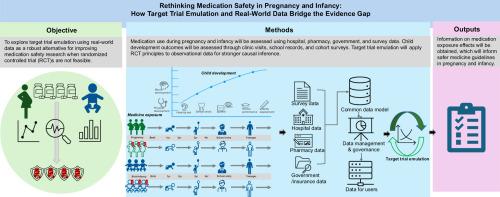
The exclusion of pregnant women and infants from many randomized controlled trials (RCTs) has left critical gaps in medication safety, complicating clinical decision-making during these sensitive life stages. This commentary explores target trial emulation using real-world data as a robust alternative for advancing medication safety research when RCTs are not feasible.
Methods
Target trial emulation replicates the design principles of RCTs within observational data, accounting for the dynamic nature of medication exposure across gestational stages and adjusting for time-varying confounders. While challenges such as unmeasured confounding, selection bias, and violations of positivity assumptions remain, this method provides crucial insights to address current evidence gaps.
Results
Information on medication exposure effects will be obtained, which will inform safer medication guidelines in pregnancy and infancy. Future research integrating artificial intelligence–driven tools, open science practices, and robust data governance frameworks will further strengthen the reliability and impact of target trial emulation. Multinational collaboration and data sharing across diverse sources will accelerate the generation of evidence, ultimately advancing medication safety.
Conclusion
Target trial emulation, leveraging real-world data, is a promising alternative when traditional clinical trials are not feasible. This approach promotes safer medication use and improves health outcomes for mothers and infants.
Plain Language Summary
Many clinical trials exclude pregnant women and infants, leaving critical gaps in understanding medication safety during pregnancy and early life. Target trial emulation, which applies clinical trial principles to real-world data, offers a promising alternative when traditional trials are not feasible. This method allows researchers to study how medications affect pregnant women and babies at different stages of pregnancy while also considering factors that change over time. While there are still challenges, like unmeasured factors and bias remain, target trial emulation helps fill these knowledge gaps. Future advancements, including AI, Open Science, enhanced data sharing, and international collaboration, can further enhance this method's ability to improve the safety of medications for mothers and infants worldwide.
期刊介绍:
The Journal of Clinical Epidemiology strives to enhance the quality of clinical and patient-oriented healthcare research by advancing and applying innovative methods in conducting, presenting, synthesizing, disseminating, and translating research results into optimal clinical practice. Special emphasis is placed on training new generations of scientists and clinical practice leaders.





 京公网安备 11010802042870号
京ICP备2023020795号-1
京公网安备 11010802042870号
京ICP备2023020795号-1

 分享
分享
 求助内容:
求助内容: 应助结果提醒方式:
 扫码关注我们
